What AI SEO services from a GEO agency include each month
AI SEO services from a GEO agency spend a month or two on setup, then repeat four jobs: prompt tracking, content, outside mentions and crawler access.
 By Emilis Zabilius · · 9 min read
AI SEO services from a GEO agency spend the first month or two on setup and then repeat four jobs every month: tracking a fixed set of buyer questions in each AI engine, publishing pages aimed at those questions, earning mentions on other sites and keeping AI crawlers able to read the site. The monthly fee mostly decides how many pages and placements each month carries and how long the contract runs.
TL;DR
- A GEO agency spends the first month or two on setup: an audit, a frozen prompt set, a baseline and a lead-source question.
- Every later month of GEO work repeats prompt tracking on each AI engine, pages aimed at tracked prompts, outside mentions and crawler checks.
- The median GEO and AEO retainer was $6,850 a month in First Page Sage’s October 2026 data, and higher tiers bought more deliverables each month.
What are GEO services?
Generative engine optimization services are the paid work that gets a company’s pages found, read and named by AI assistants such as ChatGPT, Google AI Overviews and Perplexity when buyers ask them how to solve a problem. The work falls into four recurring jobs: tracking prompts, writing pages aimed at those prompts, earning mentions on other sites and keeping AI crawlers able to reach the site.
The technical part overlaps with SEO, since Google’s guide to optimizing for generative AI features, last updated on 10 July 2026, says SEO best practices continue to be relevant for AI Overviews and AI Mode. Technical work opens the door to AI crawlers, and more frequent recommendations come from content and mentions on other sites, so those two jobs grow as a retainer grows.
A GEO retainer’s first month
The first month of a GEO retainer, sometimes two, builds what later months are measured against: an audit of how AI engines answer today and whether AI crawlers reach the site, a frozen set of tracked prompts and a baseline. Siege Media’s GEO page puts months one and two into a foundation phase with prompt-level citation mapping, a freshness audit, a baseline share-of-voice benchmark and a 12-month roadmap, as of 13 November 2026.
The prompt set comes from the buyers’ own words, so the questions the sales and support teams hear most are where the agency starts, and the set stays fixed as the benchmark. How the questions are chosen and frozen is set out in how to build a prompt set for AI visibility tracking.
Month one also adds a question to forms and calls asking each buyer how they found the company, since analytics files most buyers from AI answers under Google or Direct, as measuring AI search revenue when analytics credits Google explains. The setup and the recurring work divide this way:

The four setup jobs happen once, and the four recurring jobs fill every month after them. The numbers a first quarter should produce are laid out in the eight GEO metrics that show whether AI search brings in buyers.
Tracking and content every month
Every month, a GEO agency reads how each AI engine answered the tracked prompts, then publishes or rewrites pages for the prompts where the company is missing or described wrongly. Each engine draws on its own sources. ChatGPT, Google AI Overviews and Perplexity share only 2 of their top 10 cited sources when answering the same questions about the same brand, according to Agenzy’s 2026 source study (n=109 business projects).
The monthly report carries that reading to the company paying for it, from the full prompt table to the log of changes shipped, as what a monthly GEO report from an agency should show sets out.
New pages aim at the searches an engine runs as well as at the prompt itself. Google’s guide to generative AI features defines query fan-out as related queries the model generates to fetch more results, such as “best herbicides for lawns” for a lawn full of weeds. Pages also age, and Siege Media says its DataFlywheel technology refreshes client pages quarterly or faster.
Off-site mentions and crawler access
Off-site work earns mentions of the company on the sites AI engines draw on, such as editorial roundups, review sites and Reddit, because AI engines judge a brand by how many trusted sources mention it. Digital Elevator’s AI visibility page sells this as AI Visibility Mentions, from $3,495 a month for brand mentions, Reddit signal and editorial placements, as of 13 November 2026.
Google’s guide to generative AI features warns that seeking inauthentic mentions across the web is less helpful than it might seem, so a mention line in a GEO proposal should name the sites and say how each mention is earned.
Crawler access gets a check every month, because a CDN rule, a firewall update or a site rebuild can block AI crawlers without the owner noticing. OpenAI’s crawler documentation says sites opted out of OAI-SearchBot will not be shown in ChatGPT search answers, and that a robots.txt change can take about 24 hours to reach OpenAI’s systems. Which bots to let in is listed in the AI crawlers list with what each bot feeds.
What GEO retainers cost
GEO services pricing at an AI search optimization agency rises with the number of deliverables each month, and the higher tiers add digital PR, multi-market work and senior staff. From 6 July to 2 October 2026, First Page Sage, an agency that sells GEO itself, compiled 1,146 price quotes from 214 agencies and published the medians on 7 October 2026:
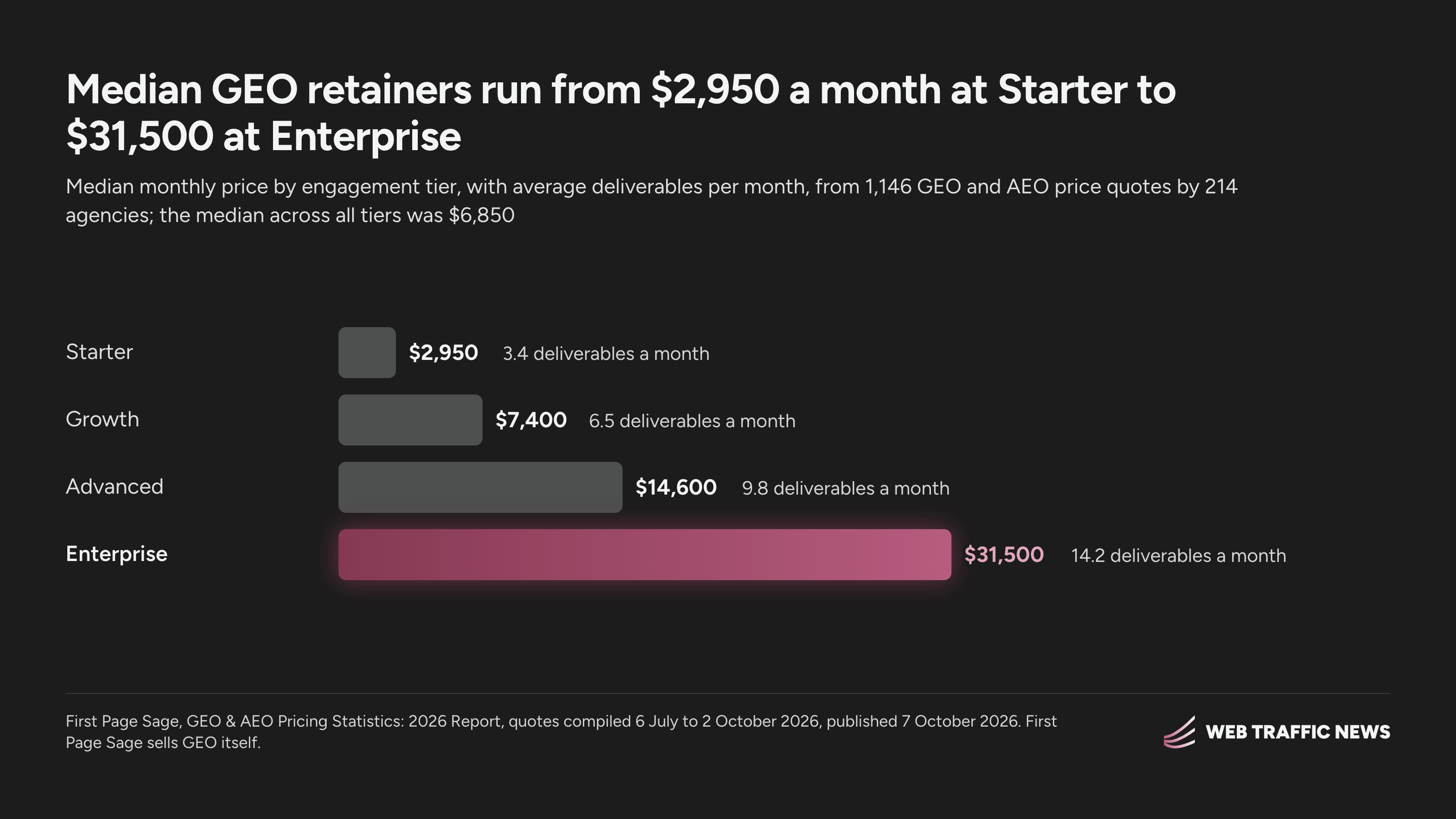
Medians ran $2,950 a month at Starter, $7,400 at Growth, $14,600 at Advanced and $31,500 at Enterprise, for 3.4, 6.5, 9.8 and 14.2 deliverables a month, and $6,850 across all tiers. A Starter engagement typically buys reporting, a technical audit and a few pages a month, while Enterprise clients paid 10.7 times the Starter median for 4.2 times the monthly deliverables.
Few agencies print a price. First Page Sage found that 23% of the 214 agencies publish any GEO or AEO pricing, and the starting prices of the nine in its published-pricing table sat mostly below the market median:
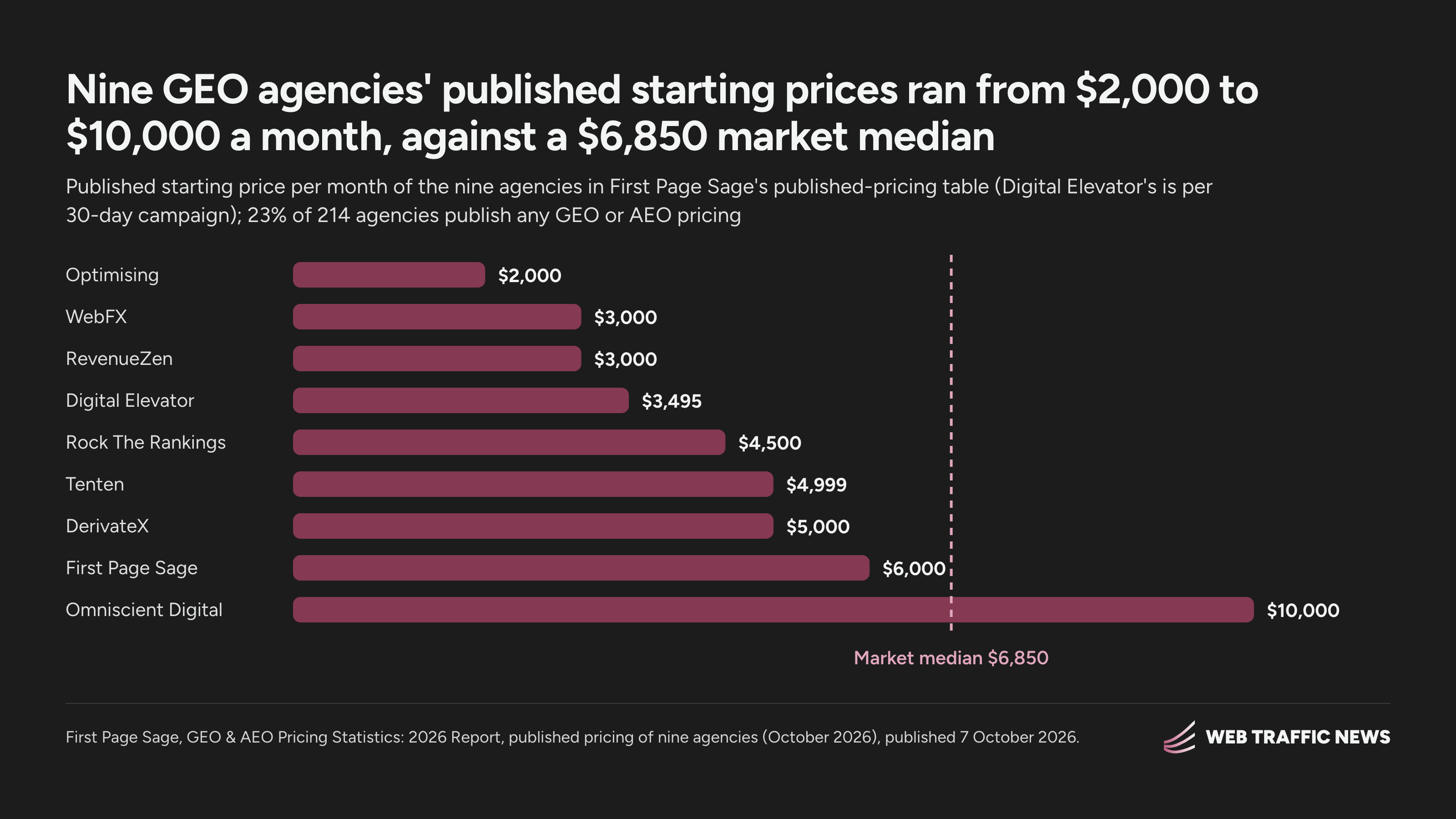
Optimising started at $2,000 a month, WebFX and RevenueZen at $3,000, Digital Elevator at $3,495 per 30-day campaign, Rock The Rankings at $4,500, Tenten at $4,999, DerivateX at $5,000, First Page Sage at $6,000 and Omniscient Digital at $10,000. First Page Sage puts the gap down to pricing pages leading with entry tiers. Omniscient Digital’s home page states that its full-service engagements start at $120,000 a year.
Published GEO agency prices mostly show entry tiers, so the price for a given monthly output comes from the proposal, and the ranking of US GEO agencies on what they publish compares the prices US agencies print.
What it means
The founder or head of marketing comparing GEO proposals should check each one in this order:
- Ask for the month-one list in writing: the audit, the tracked prompt set and its freeze date, the baseline window and the lead-source question.
- Ask how many new pages, rewrites and outside mentions each month carries, and on which AI engines the prompts are tracked.
- Set the monthly fee against the tier with the same output, and read a published price as the entry tier.
- Ask which sites the mentions will come from and how each one is earned.
- Read the first monthly report against the month-one baseline, engine by engine.
FAQ
How long is a GEO agency contract?
Most GEO contracts run three to twelve months. First Page Sage’s October 2026 data puts the typical minimum at 3 months for Starter, 6 for Growth and Advanced and 12 for Enterprise. Digital Elevator sells fixed 90-day sprints, and First Page Sage publishes month-to-month terms.
Is a paid GEO audit worth buying before a retainer?
A paid audit suits a company that wants evidence before committing to months of work. Peec AI’s GEO pricing guide, based on more than 20 agencies, puts an initial audit at €2,000 to €5,000. Digital Elevator gives its AI visibility report away free to teams that qualify.
What changes when an SEO agency adds AI search to its retainer?
The price usually rises in steps. Peec AI’s guide describes AI search insights added to SEO reports at no extra cost in months one and two, with 20 to 50 prompts, then a 15% higher retainer at month three and 25 to 30% more at month six for full AI search optimization. Whether the SEO agency alone is enough depends on prompt tracking per engine and earned mentions.
Is GEO more expensive than SEO?
Yes. In First Page Sage’s October 2026 data, GEO and AEO retainers cost 45% more than traditional SEO retainers, whose median was $4,740 a month. The SEO work that still counts in AI search and what GEO adds separates the work that carries over from the work that is new.
Is a GEO agency cheaper than hiring in house?
First Page Sage’s cost model says yes, though First Page Sage sells GEO itself. It priced a Growth-tier agency at $98,400 a year all-in against $146,028 for one in-house GEO specialist, for 6.5 deliverables a month against 3.1. Agencies published a first deliverable in 3.4 to 4.1 weeks, in-house approaches in 13.6 to 17.9.
Which industries pay the most for GEO?
Financial services companies paid the highest median, $9,850 a month, and home services companies the lowest, $3,190, in First Page Sage’s October 2026 data. The report ties the spread to how competitive AI answers are in each category and to how much each new customer is worth.
Are GEO agency prices rising?
Yes. The median GEO and AEO retainer rose 66% from the first quarter of 2024 to the third quarter of 2026, from $4,120 to $6,850 a month, while the SEO median rose 6%, according to First Page Sage’s quarterly series. GEO pricing passed SEO pricing in the fourth quarter of 2024.
How soon does monthly GEO work show results?
The first verdict on a GEO program comes after about three months and the full picture after about six, since early numbers move on small samples. Single pages can be cited within days or weeks, as how long GEO takes to show up in ChatGPT answers measures, while no agency controls when a model names a brand.
Can a GEO agency guarantee AI visibility?
No, because nobody controls what the models answer. Google’s guide to hiring an SEO, last updated on 5 June 2026, says no one can guarantee a #1 ranking on Google and asks whether an agency’s AEO or GEO advice matches Google’s own guidance. The other questions to ask are in how to choose a GEO agency when all the proposals look alike.
Does GEO work need structured data or llms.txt?
Neither is required for Google’s AI features. Google’s guide to optimizing for generative AI features says structured data isn’t required and no special schema markup needs adding, though it still helps with rich results, and site owners can ignore unnecessary AI text files such as llms.txt. What llms.txt is and who actually reads it shows who opens the file.
What does the company do in each month of GEO work?
The company supplies what the agency cannot see from outside: access to sales calls and support tickets for the prompt set, a product check of each draft and developer time for technical changes.
Sources
- firstpagesage.com/seo-blog/geo-aeo-pricing-statistics
- siegemedia.com/services/geo
- thedigitalelevator.com/products/ai-visibility
- beomniscient.com
- developers.google.com/search/…/ai-optimization-guide
- developers.openai.com/api/…/bots
- developers.google.com/search/…/do-i-need-seo
- peec-ai.notion.site/How-to-price-GEO-Services-305cac05310f8024a4…
- agenzy.lt/blog/which-sources-ai-engines-cite-2026
The week in AI search, in one email
One email a week with what changed in ChatGPT, Google AI Mode, Perplexity and Gemini, and the week's data piece.