ExplainerMeasurement
Eight GEO metrics that show whether AI search brings in buyers
GEO metrics trace AI search from the answer to the sale, and they show whether the work pays only when read engine by engine against a baseline.
 By Emilis Zabilius · · 7 min read
GEO metrics are the eight numbers that show whether AI search brings a company buyers, from the answer that names the brand to the deal that closes. Each one counts only when read per engine, against a baseline recorded before the work starts.
TL;DR
- The eight GEO numbers cover the AI answer (visibility, share of voice, position, sentiment), the brand’s pages (retrieval, citation rate) and the money (AI sessions, attributed revenue).
- Retrieval alone proves little, since Peec AI’s February 2026 study of over 1 million citations found 64% of the URLs Perplexity retrieved were never cited.
- A company paying for GEO should get every number per engine against a baseline, and judge revenue after 30 to 50 leads that name an AI assistant.
What each number tells the buyer
Each number answers one question for the company paying for the work, from the answer to the revenue:
- Visibility: The share of answers to tracked buyer questions that name the brand shows whether buyers hear its name at all.
- Share of voice: The brand’s portion of all tracked brands’ mentions shows how much of the conversation it holds, and moves with competitors.
- Position: The brand’s average place in the answers that name it shows whether it comes first or fifth.
- Sentiment: A score from 0 to 100 shows how favorably the answers describe the brand.
- Retrieval: The share of answers in which an engine pulled in one of the brand’s pages shows whether the engines read the site.
- Citation rate: The average number of references to the site in answers that used its pages shows whether the engines credit what they read.
- AI sessions: Visits from chatgpt.com, perplexity.ai and other assistants show whether buyers click through.
- Attributed leads and revenue: Buyers who say an AI assistant sent them, counted as leads, lead value and revenue, show whether the work reaches the business.
The first four come from the text of the answer, and tracking tools calculate them as set out in how brands measure how often AI answers mention them. The eight move at different speeds, and revenue moves slowest.
Reading each AI engine separately
Every GEO number needs reading for ChatGPT, Gemini and Google AI Overviews separately, because a combined figure can rise sharply while one engine barely moves. Ahrefs’ help center, updated on 3 September 2026, says its AI share of voice across platforms is a weighted average that gives more weight to platforms with more impressions, so the single figure does not show which engine moved.
Which engine matters depends on where a company’s buyers ask, and in October 2026 Statcounter’s AI chatbot market share for the United States looked like this:
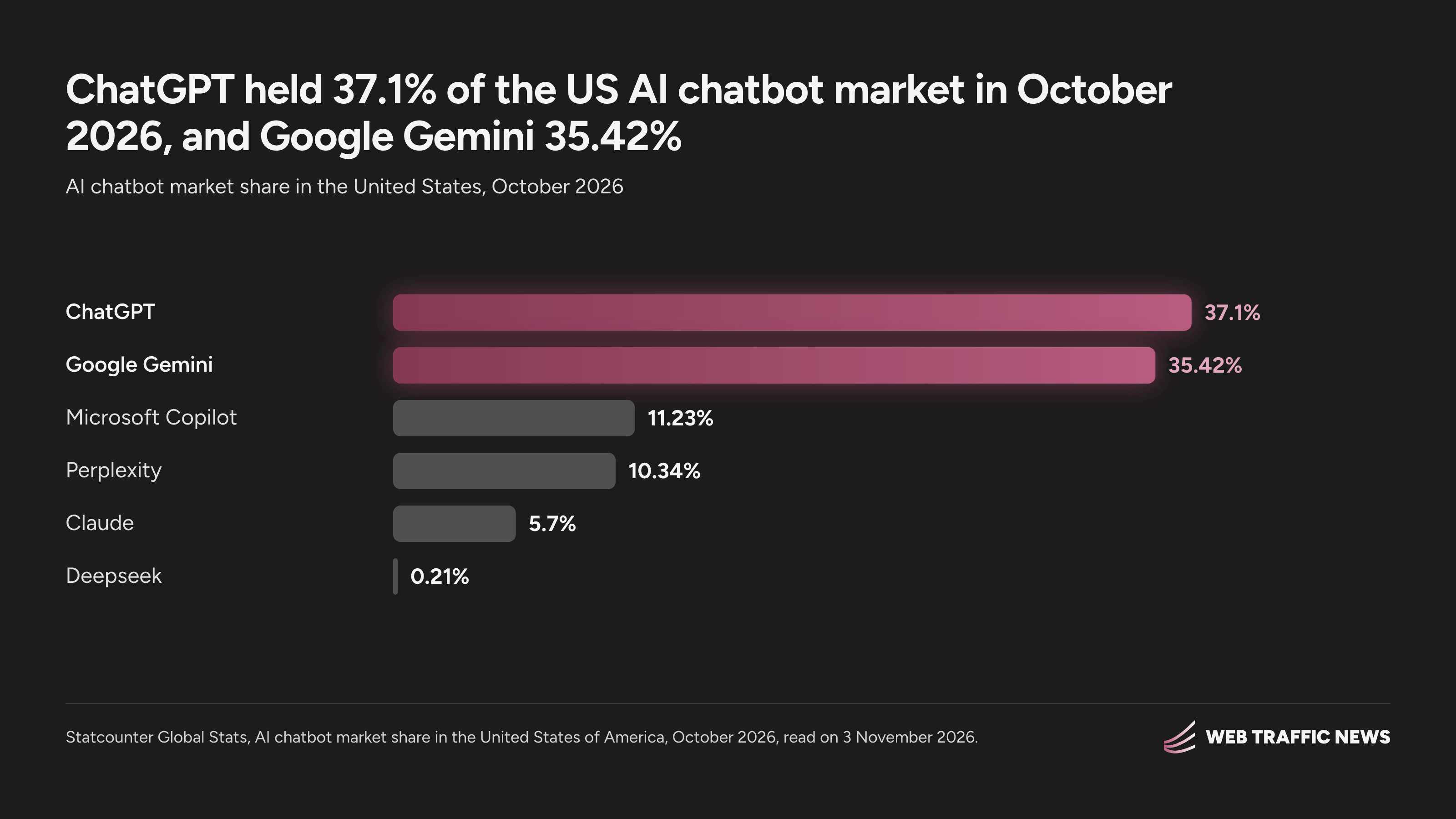
ChatGPT held 37.1% and Google Gemini 35.42%, ahead of Microsoft Copilot at 11.23%, Perplexity at 10.34%, Claude at 5.7% and Deepseek at 0.21%. Each engine also cites different websites, as the sources ChatGPT, Google AI Overviews and Perplexity cite most show, so a gain on one says little about another.
Retrieval and citation rate
Retrieval and citation rate show whether AI engines use a brand’s own pages, and retrieval moves first, since a page is pulled in before it is cited. Peec AI’s metrics overview counts retrieval as the share of chats that used at least one URL from the domain as a source. Citation rate is the average number of explicit references to the domain in each answer that used it.
Retrieval alone proves little. In Peec AI’s February 2026 study of over 1 million citations, 64% of the URLs Perplexity retrieved were never cited in its answers, and in the same study the 6% of Perplexity URLs with a citation rate above 2.0 carried just under half of its citations:
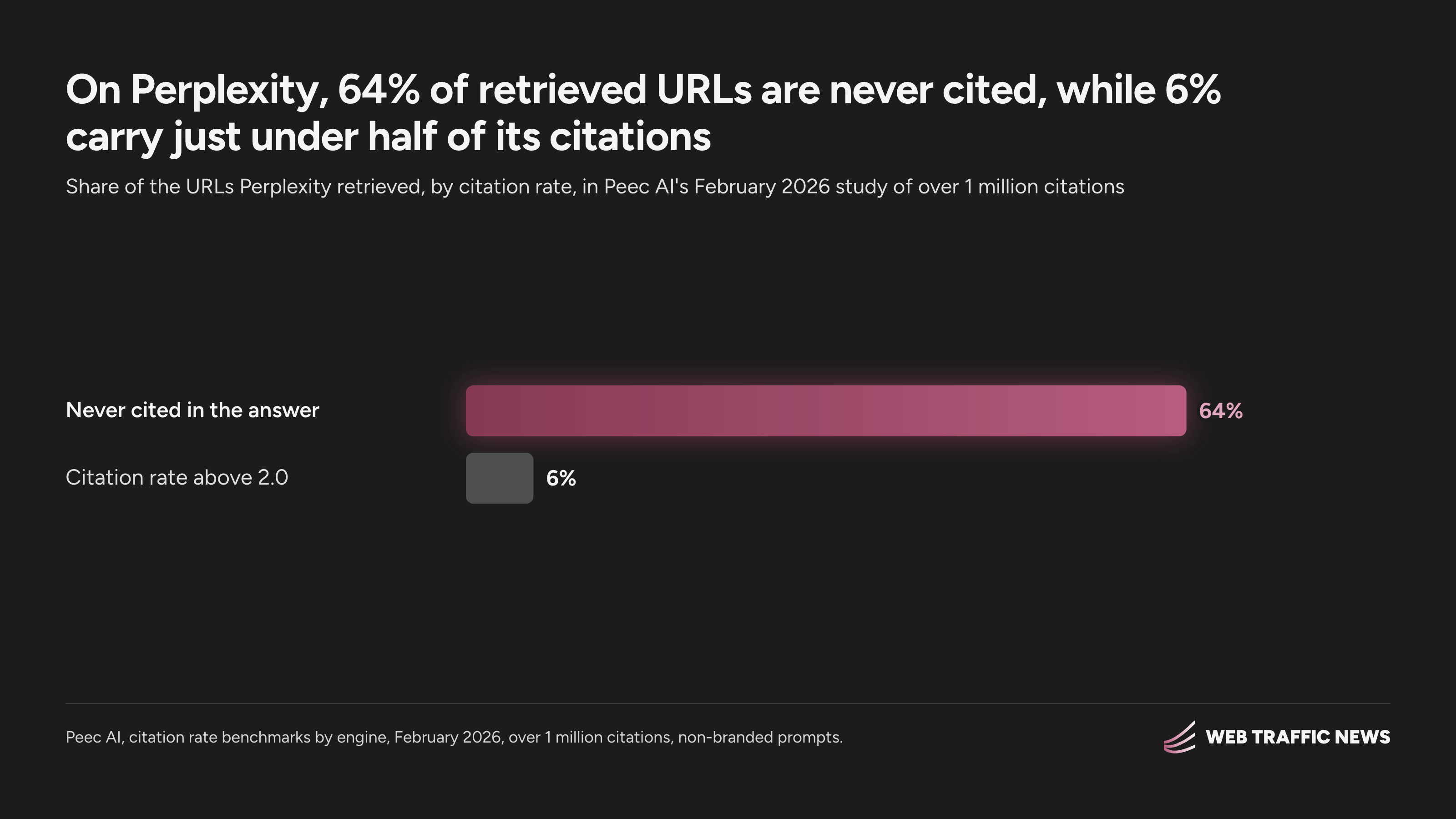
Perplexity credits a few pages heavily and ignores most of the rest. The gap between a page read and a page credited is explained in how AI visibility tracking shows whether ChatGPT cited a site.
Peec AI’s targets for a good citation rate, by engine:
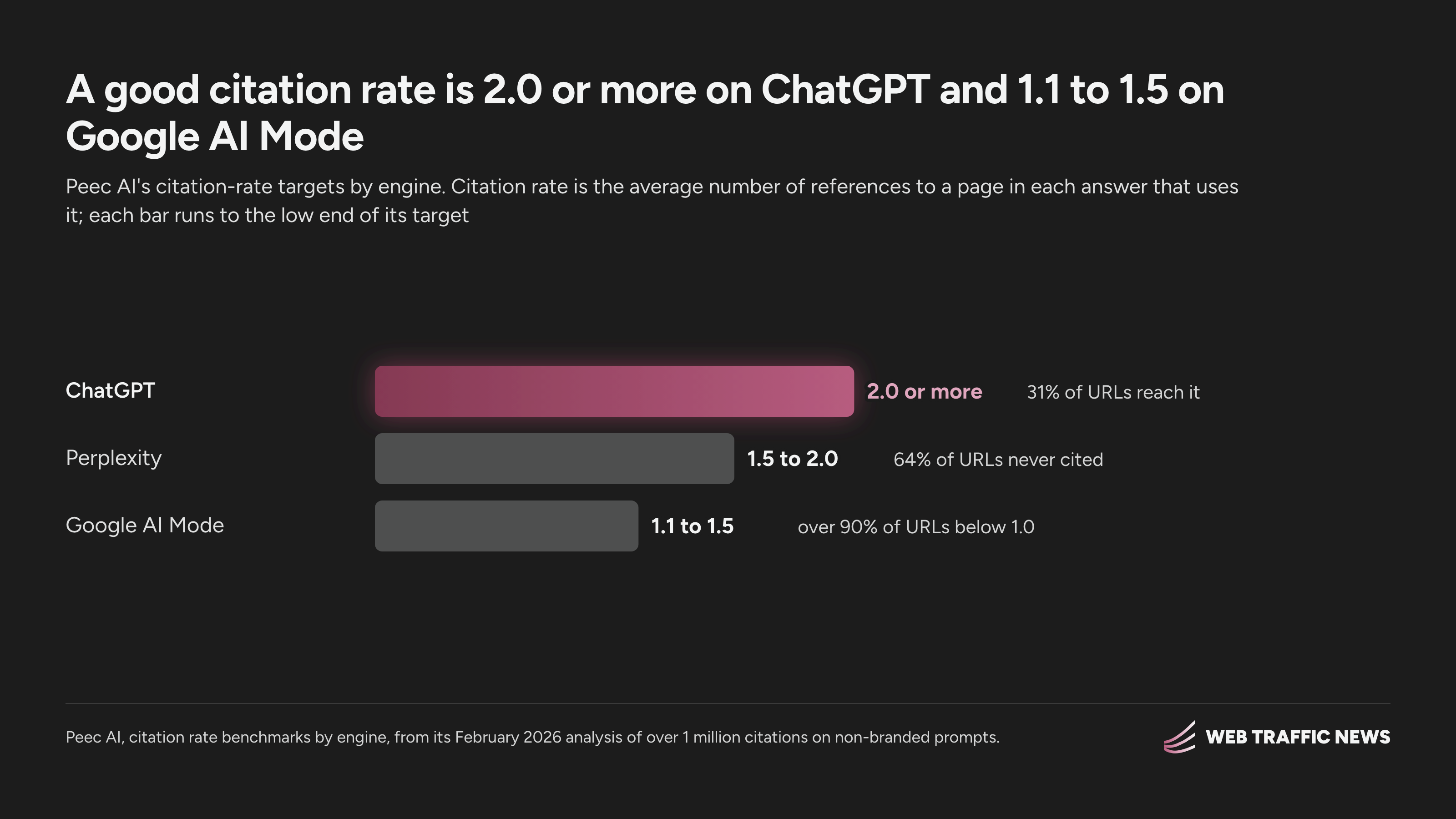
The targets run from 2.0 or more on ChatGPT to 1.5 to 2.0 on Perplexity and 1.1 to 1.5 on Google AI Mode.
Peec AI’s benchmarks come from its February 2026 analysis of over 1 million citations, which used only non-branded prompts. On ChatGPT, 31% of URLs reached 2.0 or more, while over 90% of Google AI Mode URLs stayed below 1.0. A page’s rate therefore compares only with other pages on the same engine.
AI sessions and attributed revenue
AI sessions and attributed revenue are the numbers that reach the business, and both undercount AI search. A buyer who met the brand in an answer often returns later through Google or a direct visit. Few people click out of an answer at all, as the Growth Memo’s AI referral data shows, so the AI sessions count is a floor.
Attributed leads come from asking every new buyer, on the contact form and in the first sales call, how they found the company. The answers naming an AI assistant give three monthly figures: leads, their value at the usual pipeline value per lead, and revenue from the deals that closed. Those buyers count as AI search even when analytics shows Google or direct.
Revenue is the slowest of the eight to read. A GEO measurement guide on agenzy.lt sets the threshold for a revenue verdict at 30 to 50 leads that name an AI assistant. A company getting a few such leads a week needs one to two quarters to reach it, and only leads arriving after the work begins count.
What a first quarter shows
A healthy first quarter of GEO work ends with a first move against the baseline on at least one engine, though which engine moves first cannot be known in advance. The baseline is two to four weeks of daily answers recorded before anything goes live, compared with a window of the same length afterwards. Answers change from one run to the next, as Ahrefs’ study of citation stability measured.
A few tracked questions stay untouched as a check, and when they move as much as the targeted ones, the engines most likely caused the change. Each new page also waits for its first citation, a wait measured in how long GEO takes to show up in ChatGPT answers. A healthy quarter, month by month:
- Month one: The baseline covers every engine, AI crawlers reach the site, analytics counts AI visits, and forms and calls ask how buyers heard of the company.
- Month two: Retrieval rises as the engines pull in the new pages, while citations lag behind.
- Month three: Some targeted questions move on at least one engine, sentiment holds and the first buyers name an AI assistant. A rise on every engine, and enough leads to judge revenue, come later.
What it means
The founder or CMO who pays for GEO should set the measurement up before the work begins and read it in this order:
- Ask for two to four weeks of daily baseline on each engine before anything ships, with a few tracked questions left untouched.
- Ask for every number per engine, and weigh most the engines your own buyers name.
- Add “how did you hear about us?” to the contact form and the first sales call, and agree a pipeline value per lead with sales.
- Look for rising retrieval in month two and a first move against the baseline on one engine by month three.
- Judge revenue once 30 to 50 leads have named an AI assistant.
FAQ
What is a good AI visibility score?
A good AI visibility score beats the tracked competitors on the same questions and engine, since the questions chosen set the score. Broad question sets lift it, because those answers list many brands, and narrow sets lower it. The spread across 90 European brands is in how much AI search visibility European brands have.
Why can a brand rank first and still go unseen?
Position averages only the answers that name the brand, so a brand named in 2 of 1,000 answers, first both times, has a position of 1 and almost no visibility. Peec AI’s position documentation counts every brand detected in an answer, tracked or not, so a position of 3 means two brands come before it on average.
What does a low sentiment score mean?
A low sentiment score means the answers describe the brand in critical terms, and those answers need reading before the brand chases more mentions. Peec AI’s sentiment documentation scores tone from 0 to 100 and says most scores fall between 65 and 85. A wrong price or a bad review inside an answer costs deals, so a low score gets fixed first.
Sources
- docs.peec.ai/metrics-overview
- docs.peec.ai/research/retrieval-vs-citation
- docs.peec.ai/research/citation-rate-benchmarks-by-engine
- docs.peec.ai/metrics/…/position
- docs.peec.ai/metrics/…/sentiment
- help.ahrefs.com/en/…/15501968-ai-visibility-metrics
- gs.statcounter.com/ai-chatbot-market-share/…/united-states-of-america
- agenzy.lt/blog/geo-metrics
The week in AI search, in one email
One email a week with what changed in ChatGPT, Google AI Mode, Perplexity and Gemini, and the week's data piece.
Up next
0.5
%
of all visits came from AI referrals across 10,000 domains each in the US and France, in Similarweb data analyzed by the Growth Memo.
Growth Memo data puts AI referral traffic at 0.5% of total visits
Brief
37
%
fall in GA4 sessions from ChatGPT across a few hundred websites from 9 October 2026, as ChatGPT's links lost their tracking tag.
OpenAI's GPT-6 rollout hides a week of ChatGPT referral traffic
Brief
0.9
%
estimated click-through rate of one site's Google AI Overviews and AI Mode impressions, measured by opting the site out of Google's AI features.
Opt-out test puts Google AI Overviews and AI Mode CTR at about 0.9%
Brief