The SEO work that still counts in AI search and what GEO adds
Crawler access, indexing in Google and Bing and pages worded like the buyer's question carry into AI search, while rank reports and link counts carry little.
 By Emilis Zabilius · · 7 min read
The SEO work that still counts in AI search is the groundwork that gets a page found and read: crawler access, indexing in Google and Bing, and pages worded like the buyer’s question. AI engines pick their sources from search indexes, so that groundwork carries over, while rank reports, link volume and keyword pages carry little and mentions on other sites count for more.
TL;DR
- Crawler access, indexing in Google and Bing, and pages worded like the buyer’s question are the SEO work that carries into AI search answers.
- Ahrefs found that 12% of AI assistant citations ranked in Google’s top 10 for the same query, against 76% of Google AI Overviews citations.
- A founder whose SEO agency says it covers AI search should ask for tracking per AI engine, fan-out query work and earned mentions.
SEO work that carries over
Agencies now sell GEO SEO packages, and the part that carries over is the groundwork that lets an engine find and read a page, because AI engines cite pages a search system has already found. Google’s guide to optimizing for generative AI features, last updated on 10 July 2026, says a page must be indexed and eligible to show with a snippet to appear in AI Overviews or AI Mode, as how Google AI Overviews choose pages explains.
OpenAI’s crawler documentation says, as of 12 November 2026, that sites opted out of OAI-SearchBot will not be shown in ChatGPT search answers. In Seer Interactive’s study of more than 500 citations, published on 6 February 2025, more than 87% of ChatGPT search citations matched Bing’s top 20 results, against 56% for Google.
ChatGPT also runs its own index, and Peec AI’s Tomek Rudzki reported on 4 September 2026 that ChatGPT pulls from at least eight other providers on top of it, Microsoft’s Web IQ among them, as where ChatGPT gets its information explains.
Krishna Madhavan, Principal Product Manager at Microsoft Bing, wrote on 8 October 2025 in Microsoft’s guidance on AI search answers that titles, descriptions and H1 tags signal a page’s purpose to AI systems, and that “Crawlability, metadata, internal linking, and backlinks remain essential for ensuring your content is discoverable.” Google’s guide adds that its AI systems understand synonyms, so a site needs no page for every long-tail variation.
Google rankings and AI citations
The plainest SEO vs GEO difference is in rankings, because a page’s Google position for a buyer’s question says little about whether an AI assistant cites it. Ahrefs ran 15,000 long-tail queries through Google and four AI assistants, in a study published on 11 August 2025: on average, 12% of the assistants’ citations ranked in Google’s top 10 for the same query, and 80% ranked nowhere in Google for it.
Google AI Overviews follow the rankings far more closely, with 76% of their citations from top-10 pages in an earlier Ahrefs study cited on the same page:
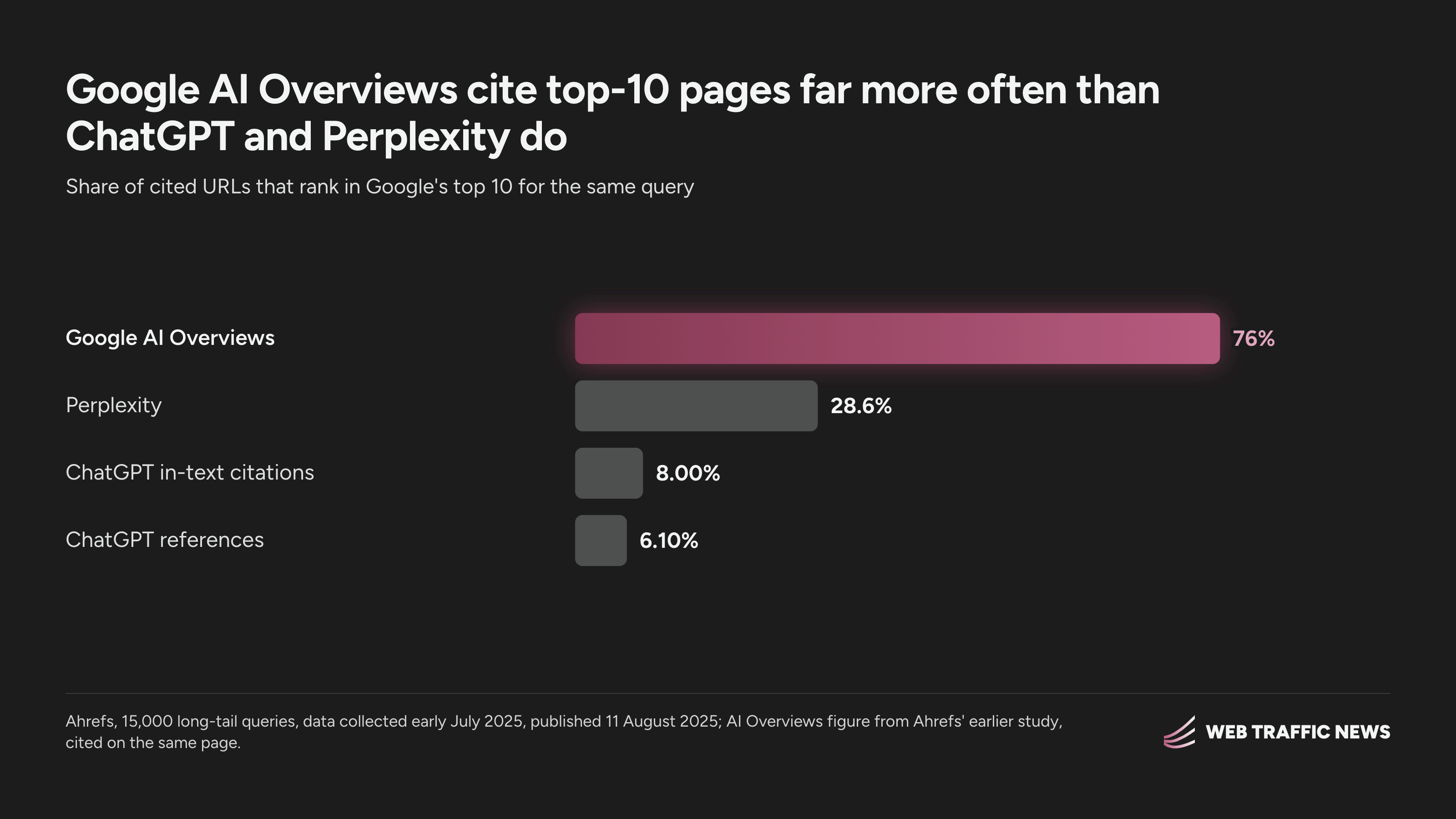
Perplexity sat closest to Google among the assistants at 28.6%, against 8.00% for ChatGPT’s in-text citations and 6.10% for its references.
Ahrefs traces the gap to query fan-out: assistants retrieve pages for several variations of a question, so a cited page may never rank for the question itself. That is why the eight GEO metrics that show whether AI search brings in buyers read each engine separately.
Links and mentions
The GEO vs SEO split is widest on links, because link counts track AI visibility weakly while mentions of a brand on other sites track it strongly. Ahrefs studied 75,000 brands in research published on 26 May 2025, measuring how closely each factor moved with a brand’s mentions in Google AI Overviews:
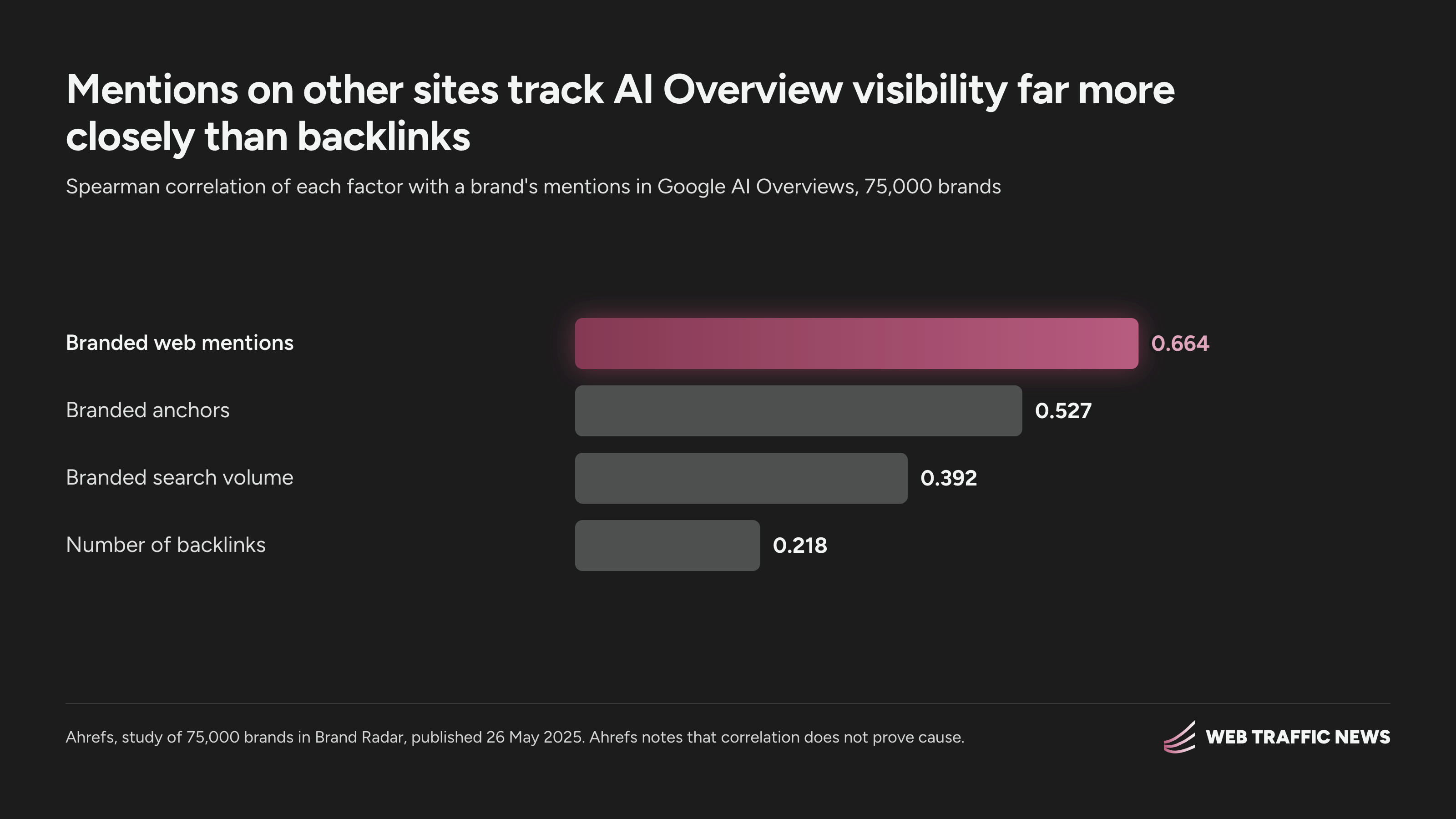
Branded web mentions scored 0.664 and backlinks 0.218, with branded anchors at 0.527 and branded search volume at 0.392. Ahrefs notes that correlation does not prove cause. Links still help pages get found, so they stay in the groundwork, and earned mentions on other sites become new work with their own budget.
Which other sites count depends on the engine. Google AI Overviews takes 10.8% of its citations from user-generated content against Perplexity’s 3.8%, while Perplexity takes 13.6% from news and media against AI Overviews’ 5.2%, Agenzy’s 2026 study of 2,283,923 AI citations found (n=137 and 133 business projects). Over the study window, 1 January 2025 to 7 September 2026, the two source types split this way:
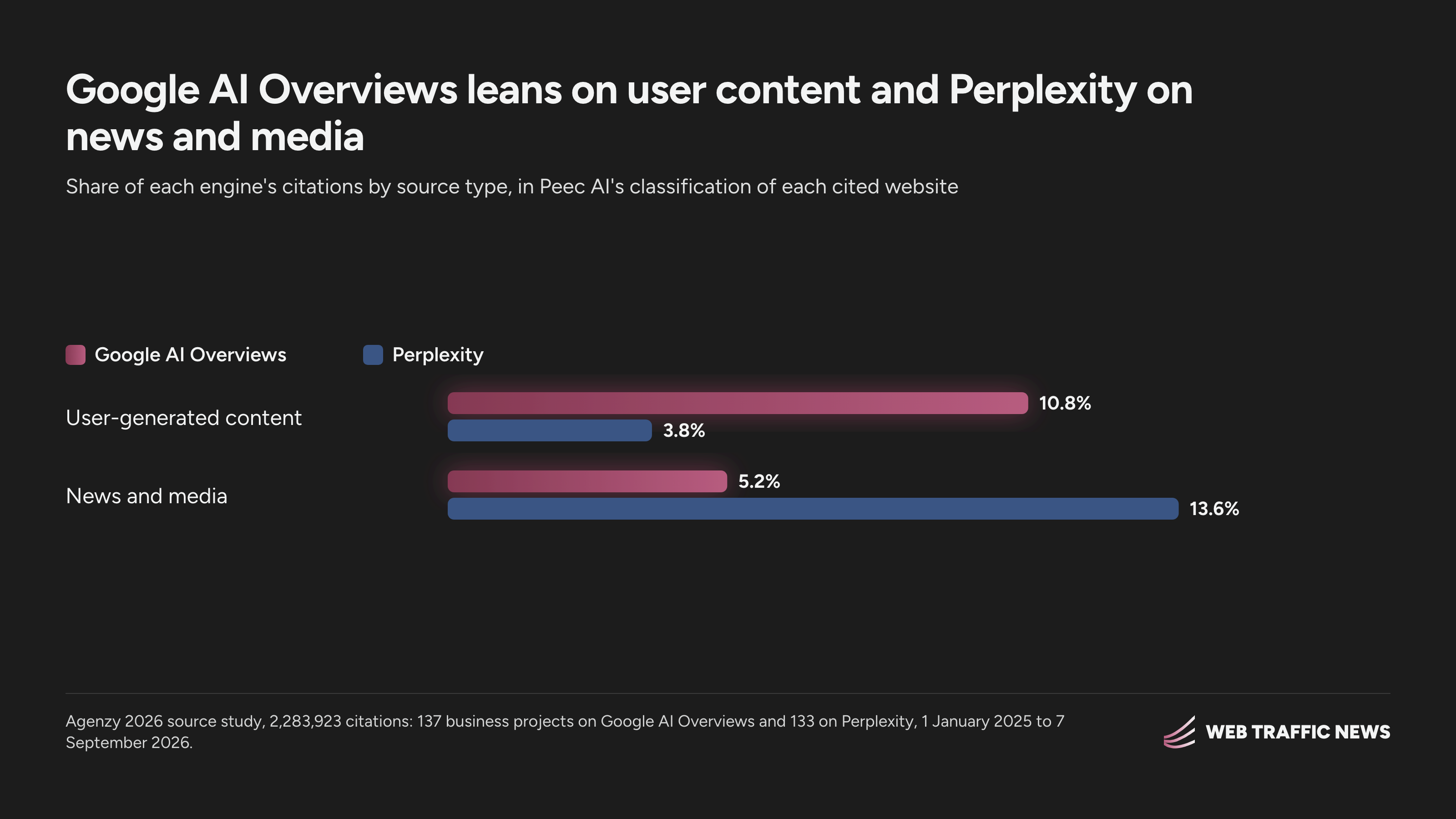
Forums and review sites weigh more for AI Overviews and news sites for Perplexity, as the lists in which websites ChatGPT, Google AI Overviews and Perplexity cite most show.
What is new in AI search
Three jobs are new in GEO vs traditional SEO: tracking each AI engine on its own, writing for the fan-out queries engines send, and reading the citations inside answers. Google’s guide defines fan-out queries as related queries the model generates to fetch more results, and Seer Interactive found that ChatGPT appears to shorten a question about auto loan lenders to “best auto loan lenders bad credit” before it searches.
Bing Webmaster Tools’ AI Performance report, launched in public preview on 10 February 2026, lists such searches as grounding queries, with citation counts per page for Microsoft Copilot and AI summaries in Bing. Google reports its AI features in Search Console, so a view across ChatGPT, Gemini, Perplexity and Claude comes from tracking fixed buyer questions on each engine, as what GEO means for brands sets out.
What it means
A founder or head of marketing whose SEO agency says it covers AI search should check the work in this order, and avoid a retainer that only renames SEO as GEO:
- Confirm that the main pages are indexed in Google and Bing, and that robots.txt and the CDN let the search crawlers and OAI-SearchBot in.
- List cited pages and grounding queries from the AI reports in Search Console and Bing Webmaster Tools.
- Rewrite the title, H1 and opening of each buyer-question page in the buyer’s words.
- Track a fixed set of buyer questions on each AI engine in place of the rank report.
- Move part of the link budget to earning mentions on the sites each engine cites.
- Compare each engine’s numbers every month with the baseline from before the changes.
FAQ
Is SEO dead now with AI?
No. Google’s guide says SEO best practices stay relevant because AI Overviews and AI Mode rest on Google’s core ranking systems, and it files work sold as GEO under SEO. Vendors’ labels for the extra work are compared in the other names for optimizing for AI answers.
How fast does a robots.txt change reach ChatGPT search?
About a day. OpenAI’s crawler documentation says it can take around 24 hours after a robots.txt update for its search results to adjust. Each OpenAI bot has its own setting, and the AI crawlers list shows what each one feeds and which to allow.
Does publishing more pages raise AI visibility?
Rarely, going by the correlations. Ahrefs’ follow-up study of 75,000 brands, published on 12 December 2025, found almost no relationship between a site’s number of pages, at about 0.194, and brand mentions in ChatGPT, Google AI Mode and AI Overviews.
Do YouTube mentions count for AI visibility?
Yes, in the correlations. In Ahrefs’ December 2025 study, YouTube mentions correlated with AI visibility at about 0.737, more than any other factor across ChatGPT, AI Mode and AI Overviews, the two Google surfaces that cite YouTube more than any other domain.
Does paid search help a brand appear in AI answers?
Only weakly, by Ahrefs’ May 2025 data. Across 75,000 brands, branded ad traffic correlated with AI Overview mentions at 0.216 and branded ad cost at 0.215, about level with the 0.218 for backlinks and far below the 0.664 for branded web mentions.
Can AI assistants read content in tabs, PDFs or images?
Unreliably, according to Microsoft. Its October 2025 guidance says AI systems may not render content hidden in tabs or expandable menus, PDFs often lack the headings and metadata of HTML, and facts placed only in images lose accuracy, so critical details belong in HTML.
Does Bing Webmaster Tools show ChatGPT citations?
Microsoft’s announcement does not name ChatGPT. The AI Performance report covers Microsoft Copilot, AI-generated summaries in Bing and select partner integrations, Microsoft wrote on 10 February 2026, so ChatGPT citations come from tracking the same buyer questions in ChatGPT itself.
Does IndexNow help pages appear in AI answers?
IndexNow helps AI answers use the current version of a page. Microsoft’s AI Performance announcement of 10 February 2026 says IndexNow notifies participating search engines when content is added, updated or removed, so AI systems reference the latest version of a page.
Does local business information matter for AI answers?
Yes, for businesses that serve a place. Microsoft tells local businesses to register with Bing Places for Business so address, hours and contact details stay current for AI responses, and Google’s guide names Merchant Center feeds and Google Business Profiles.
Can an SEO agency handle GEO?
Partly, since an SEO agency already does the groundwork AI search depends on. A retainer that renames that work as GEO and still reports rankings and links is the one to avoid, and choosing a GEO agency when all the proposals look alike lists the questions to ask.
How long does GEO take to show results?
About three months for a first verdict and six for the full picture, and early numbers swing on small samples. A new page can be cited within days or weeks, as how long GEO takes to show up in ChatGPT answers measures, and no agency controls when a model names a brand.
Sources
- ahrefs.com/blog/ai-search-overlap
- developers.google.com/search/…/ai-optimization-guide
- developers.openai.com/api/…/bots
- seerinteractive.com/insights/87-percent-of-searchgpt-citations-match-bing…
- peec.ai/blog/chatgpt-built-its-own-search-index
- about.ads.microsoft.com/en/…/optimizing-your-content-for-inclusion-in-ai-…
- ahrefs.com/blog/ai-overview-brand-correlation
- agenzy.lt/blog/which-sources-ai-engines-cite-2026
- blogs.bing.com/webmaster/…/Introducing-AI-Performance-in-Bing-Webmaster…
- ahrefs.com/blog/ai-brand-visibility-correlations
The week in AI search, in one email
One email a week with what changed in ChatGPT, Google AI Mode, Perplexity and Gemini, and the week's data piece.