How long GEO takes to show up in ChatGPT answers
How long GEO takes in ChatGPT varies by page, and at the typical business 37% of new pages went their first 30 days without a ChatGPT citation.
 By Emilis Zabilius · · 7 min read
When ChatGPT cited a newly published page at all, the first citation came a median 9 days after the page went live, in Agenzy’s daily tracking of 236 new pages from 12 businesses in 2026 (n=83 cited pages). For the typical business in Agenzy’s 2026 tracking, 37% of newly published pages went their first 30 days without a single ChatGPT citation (median across 10 businesses and 189 pages).
TL;DR
- ChatGPT cited 83 of 236 new pages in daily 2026 tracking, and those 83 got their first citation a median 9 days after going live.
- Across 10 businesses tracked daily in 2026, the typical one saw 37% of its new pages go 30 days without a ChatGPT citation.
- Marketing leads should publish GEO pages early, check that ChatGPT uses them as sources, and wait 30 days before judging any page.
Days to a first ChatGPT citation
A first ChatGPT citation came between 1 and 101 days after publication for the 83 new pages ChatGPT cited out of 236 tracked. The middle half of those pages took between 2 and 19.5 days, and the median of 9 days held when Agenzy’s own site was left out (n=55).
Peec AI, an AI search tracking tool, ran each business’s tracked prompts, a fixed set of questions, daily on each engine. The pages came from 11 Agenzy clients and Agenzy’s own site and went live between 29 April and 22 October 2026. Answers ran through 28 October 2026, or 15 October 2026 for four paused projects. A first citation is the first answer to a tracked prompt that cited the page, so earlier citations for untracked questions are missed.
Profound has published a faster figure. Josh Blyskal of Profound’s founding team wrote on LinkedIn on 11 May 2026 that he “dug through billions of logs” to find about 900 newly published marketing pages. They took a median 6.81 days from publishing to a citation in ChatGPT or Claude, and 75% were cited within 18.68 days. Both medians count only pages that were cited.
Both medians sit on the same axis here:
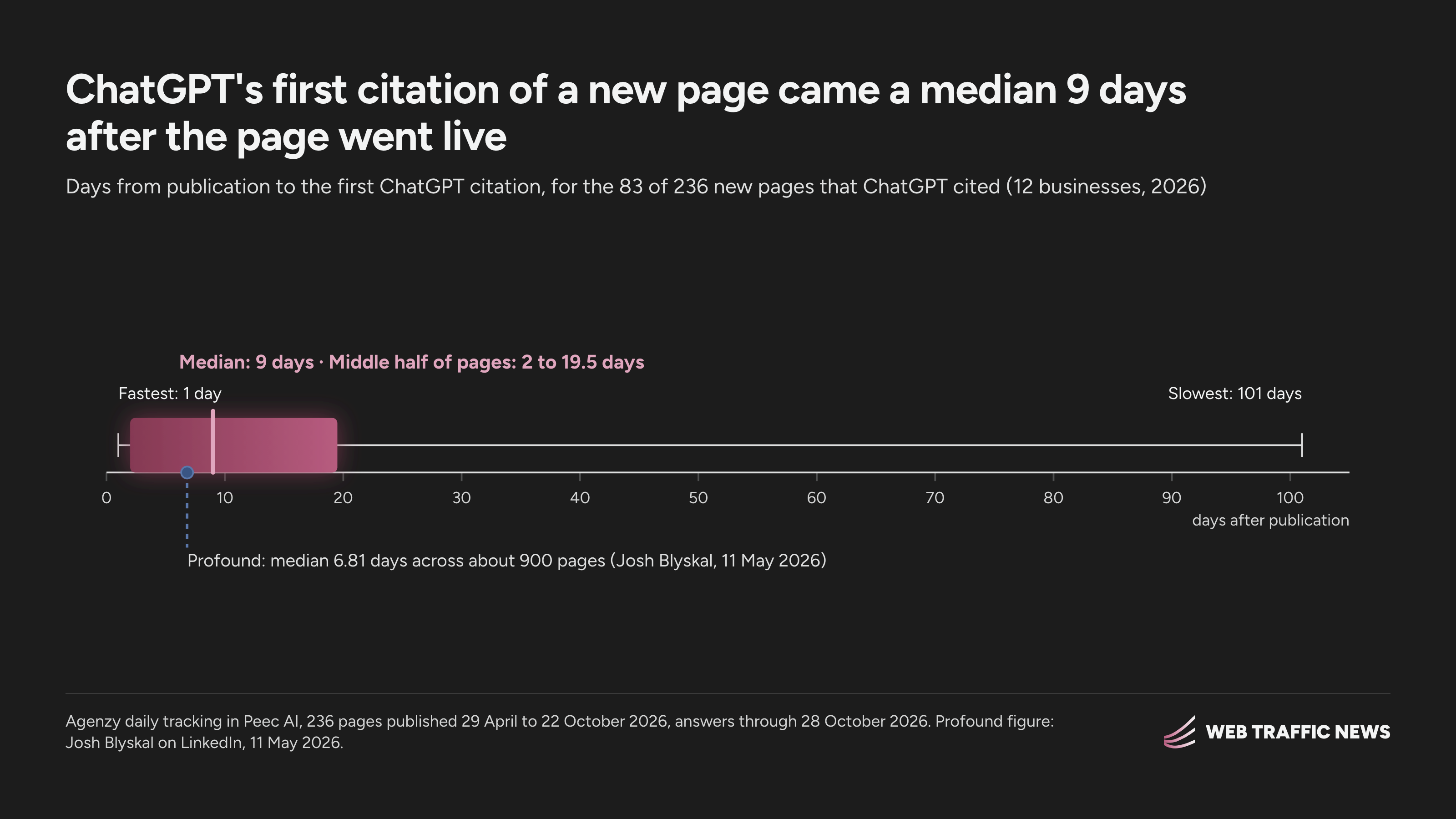
The red band holds the middle half of Agenzy’s 83 cited pages, from day 2 to day 19.5, and Profound’s 6.81-day median falls inside it.
ChatGPT citations in the first week
Fewer than one in five new pages (41 of 233) earned a ChatGPT citation in their first week, in Agenzy’s daily tracking of 11 businesses in 2026. The fastest were cited the day after they went live. One business supplied 87 of the 236 pages, and without it the first-week share was 26.0% (38 of 146).
A test by Semrush found almost the same first-week rate. Semrush’s test, published on 10 December 2025, put 81 FAQ-style pages live on the company’s blog, which it rates strong for SEO, and tracked ChatGPT search daily for 30 days. ChatGPT search had cited 14 of the pages (17%) by day seven and 34 (42%) by day 30.
Google AI Overviews and ChatGPT compared
Google AI Overviews was the quickest engine to cite a new page, a median 4 days after publication against 9 days for ChatGPT, in Agenzy’s 2026 tracking of 236 new pages (n=109 and 83 cited pages). Google AI Overviews also cited new pages at more of the businesses, all 12 of them, against 9 for ChatGPT.
The three engines Agenzy tracked, by median days to the first citation:
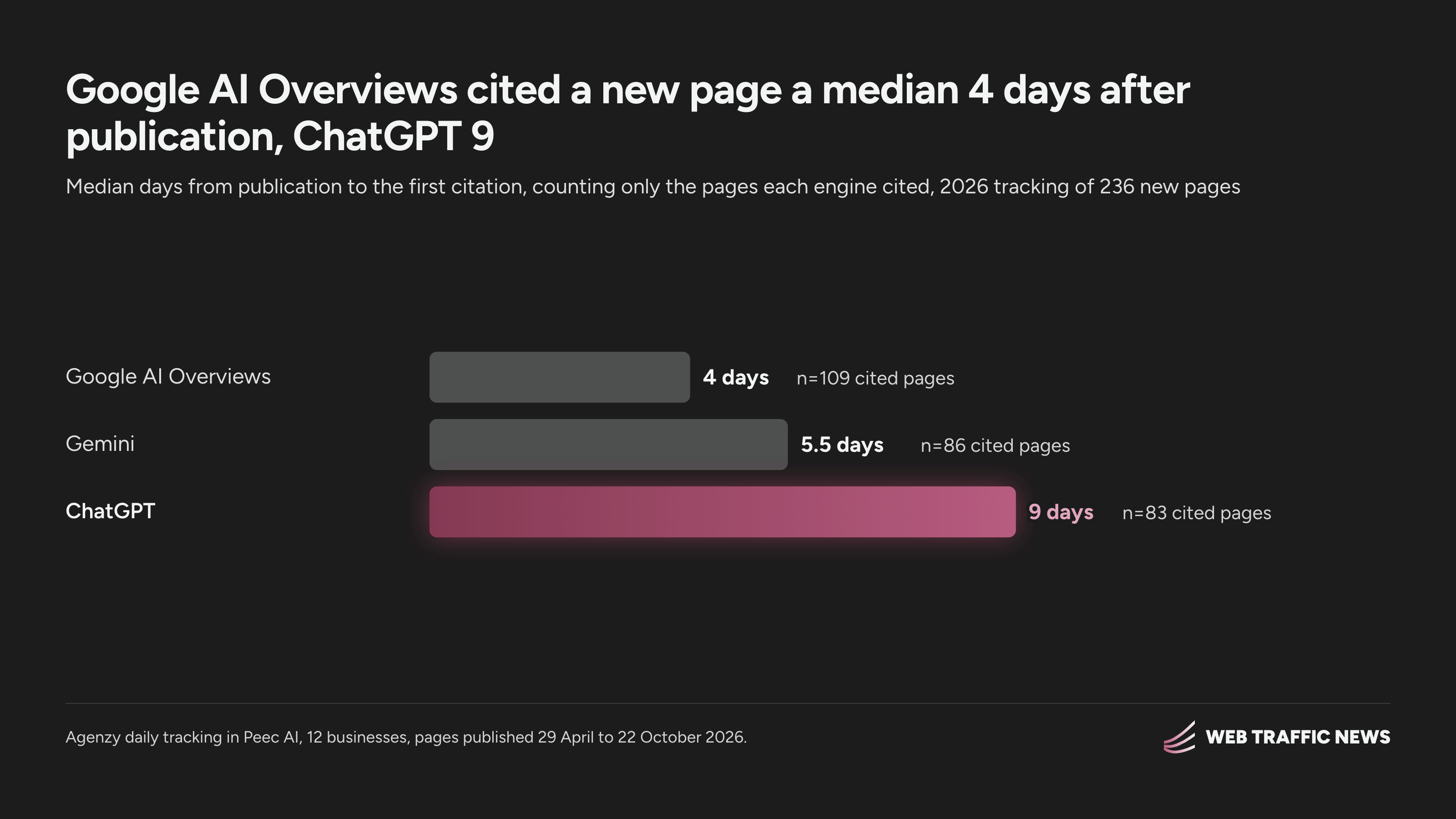
Google AI Overviews was fastest at 4 days, Gemini took 5.5 and ChatGPT 9, each counting only the pages that engine cited.
Semrush’s December 2025 test of 81 pages on its own blog found the same order with Google AI Mode. By day seven, Google AI Mode had cited 45 of the pages (56%) and ChatGPT search 14. Google AI Mode then dropped many, and only 21 (26%) were still cited on day 30, while ChatGPT search generally kept the pages it cited.
The two engines cross between day 7 and day 30:
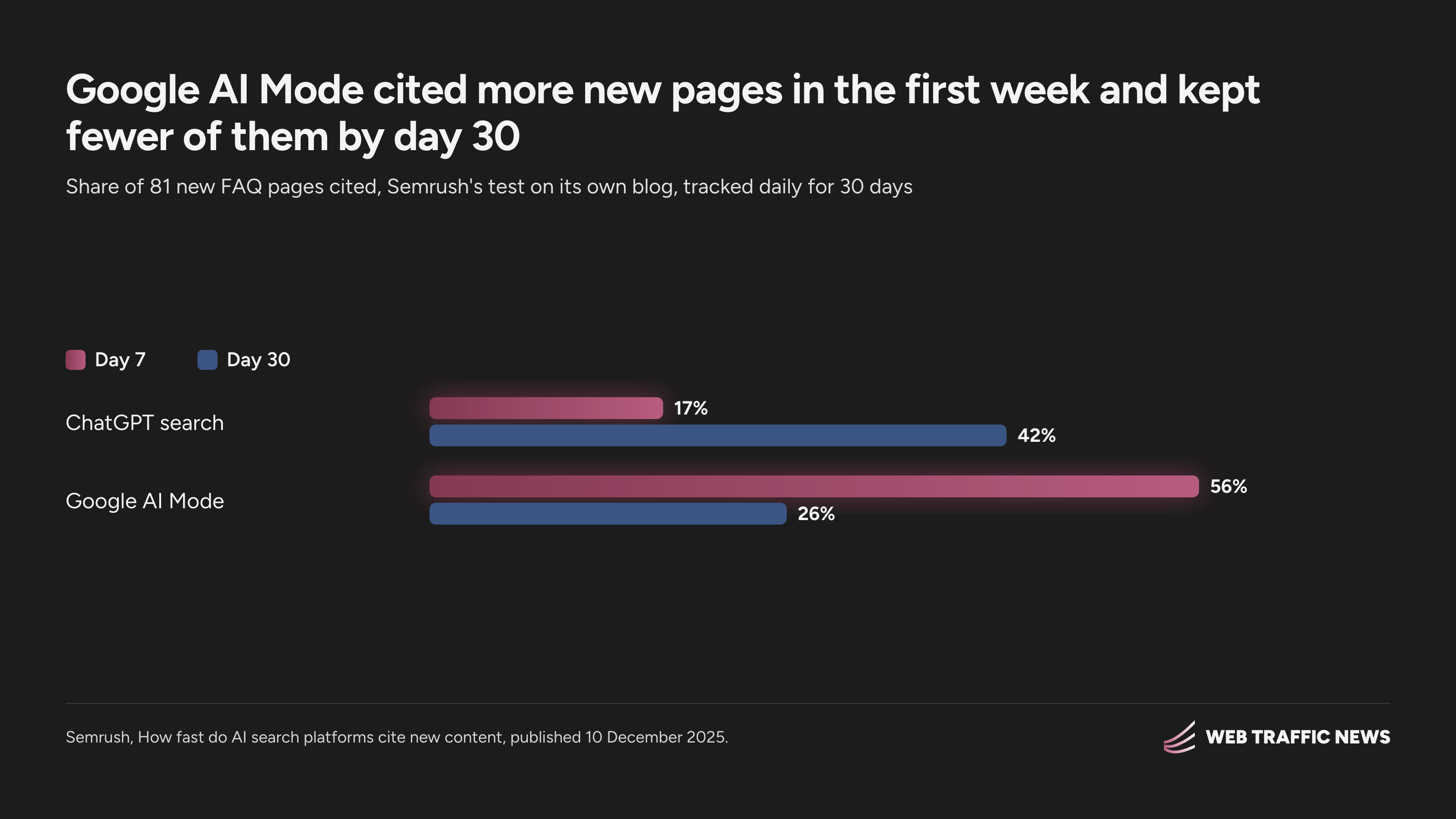
Google AI Mode cited 45 of the 81 pages in the first week and 21 on day 30, while ChatGPT search went from 14 to 34.
Retrieval and citation in ChatGPT
Once ChatGPT first used a new page as a source, it cited that page the same day in 57% of cases (47 of 83 pages), in Agenzy’s 2026 tracking across 9 businesses. For the rest, ChatGPT used the page in at least one earlier answer without citing it.
Peec AI’s documentation defines a source as a URL an AI model opens while writing its answer, and a citation as a source the finished answer names. Among cited pages, the median gap between ChatGPT’s first retrieval and first citation was 0 days. A retrieved page still competes for the citation with a long tail of other websites, the subject of how often LLM citations include a brand’s own website.
Retrieval also needs access. OpenAI’s crawler documentation says sites that block OAI-SearchBot, the crawler behind ChatGPT search, are left out of ChatGPT’s search answers. It adds that a robots.txt change can take about 24 hours to reach search results. Two sites in the tracking had hosting that blocked ChatGPT’s crawlers for part of the period. Without them, the median time to a first ChatGPT citation stayed at 9 days (n=78).
The GEO timeline by business
The share of new pages that went 30 days without a ChatGPT citation ran from 0% to 100% across the 10 businesses with pages old enough to count. The ten shares were 0%, 0%, 14%, 33%, 37%, 38%, 61%, 93%, 100% and 100%, so the median business sat at 37%. Both ends include businesses with only a handful of pages old enough to count.
The ten businesses, one bar each:
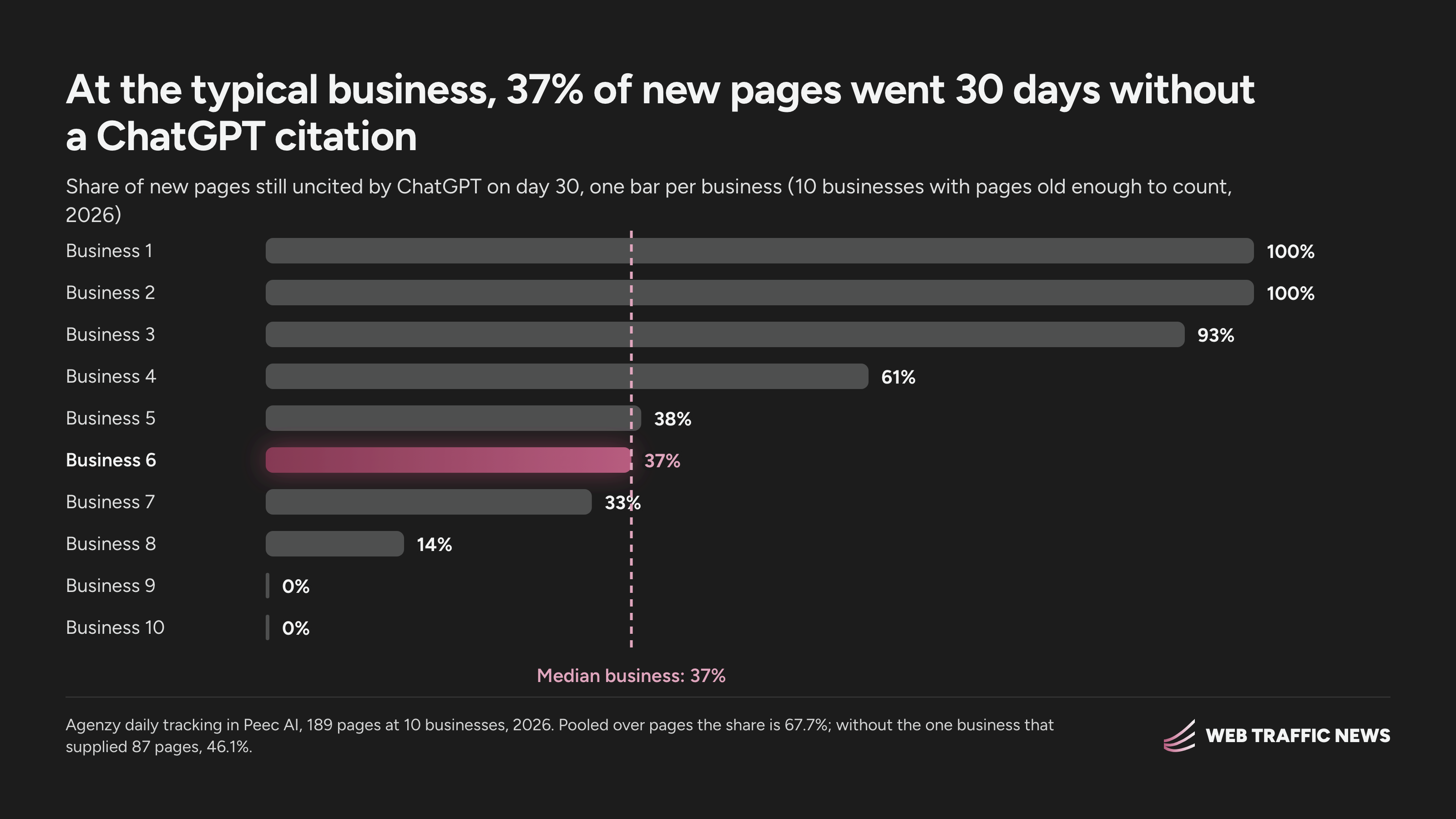
Two businesses had every new page uncited at day 30, two had none, and the median business sat at 37%.
Pooled over pages, the share is 67.7% (128 of 189). One business supplied 87 of those 189 pages, and without it the pooled share is 46.1% (47 of 102).
At the two businesses at 100%, no new page got a ChatGPT citation by the end of the tracking. Google AI Overviews and Gemini cited some of the same pages within days. ChatGPT rarely used the first site as a source at all. It read the second site regularly but never pulled its new articles, which had no internal links.
What it means
Marketing leads who buy or run GEO work should publish early and judge each page after a month, in this order.
- Publish the pages early in the engagement, since the pages ChatGPT cited took from one day to 101 days to get there.
- Write each page for the tracked prompt it has to answer, because a page that answers no tracked prompt cannot show up in tracking.
- Check retrieval before citation: confirm that OAI-SearchBot can reach the page and that ChatGPT uses it as a source, then look for the citation.
- Give every page 30 days before judging it, since at the typical business 37% of new pages were still uncited at day 30.
- Promise your team no date for a single page, even if a GEO proposal says 90 days or three to six months, and report the monthly share of pages cited.
FAQ
How long does GEO take in Gemini?
Gemini cited new pages faster than ChatGPT and slower than Google AI Overviews in the 2026 tracking of 236 new pages. Gemini, tracked at 11 of the 12 businesses, first cited a new page a median 5.5 days after publication, counting only the pages it cited (n=86 cited pages). In Peec AI’s data, Gemini cites almost every page it retrieves, so its first retrieval and first citation of a page nearly always fall on one day.
Why do some new pages never get cited?
Two causes showed up in the 2026 tracking of 236 new pages: prompt scope and retrieval without citation. A page that no tracked prompt asks about cannot appear in tracking, and the slowest first citations often came after the tracked prompts changed. A retrieved page can also be passed over, with no guarantee of a citation. Peec AI’s documentation adds that AI models read only HTML, so text that needs JavaScript to load stays out of reach.
How can you check your own pages?
Compare the pages an engine uses as sources with the pages it cites, for the questions each page was written to answer. A tracking tool such as Peec AI records both lists every day for a fixed set of prompts. Without a tool, put the same questions to ChatGPT once a month and note whether your page appears among the sources the answer cites.
Sources
The week in AI search, in one email
One email a week with what changed in ChatGPT, Google AI Mode, Perplexity and Gemini, and the week's data piece.
Up next
85.5
%
of 138 business projects saw ChatGPT cite the brand's own website, at a median rank of 12 on its list of sources.
How often LLM citations include a brand's own website
Data
AEO vs GEO is mostly a naming question, since both terms, like AI SEO and LLMO, mean work that gets a brand named and cited in AI answers.
AEO vs GEO and the other names for optimizing for AI answers
Explainer
Ahrefs measured AI citation stability for 20 days and found half or more of citations gone the next day, so a single check misreads a brand's AI visibility.
Ahrefs study of AI citation stability finds half gone the next day
Brief