ExplainerMeasurement
How to measure AI search revenue when analytics credits Google
AI search revenue shows up when every buyer is asked how they found the company, because analytics files most of those buyers under Google or Direct.
 By Emilis Zabilius · · 7 min read
AI search revenue is measured from each buyer’s own answer to how they found the company, asked on the form and again on the first sales call. Analytics records only the visit that brought the buyer in, which after an AI recommendation is often a Google search for the brand, so the report names Google.
TL;DR
- Similarweb’s US desktop panel found that 55.9% of visits after a ChatGPT brand recommendation arrived through search, against 40.4% of other visits.
- The buyer’s answer to how they found the company, given on the form and again on the first call, is the record that names AI search.
- Revenue from AI search counts only confirmed deals with leads that named an AI assistant after the work began, and open leads stay in lead value.
Why analytics misses AI search buyers
Analytics misses most AI search buyers because it records only how the browser reached the site. A buyer who read a ChatGPT recommendation often returns later through a Google search for the brand. Few readers click out of an AI answer, as the Growth Memo’s AI referral traffic data shows.
Similarweb’s study of what happens after AI recommends a brand was published on 14 October 2026 and covers US desktop users in its opted-in panel from July to December 2025. Each user was followed for seven days after ChatGPT recommended a brand, and users who had named the brand or visited its site in the previous four weeks were left out:
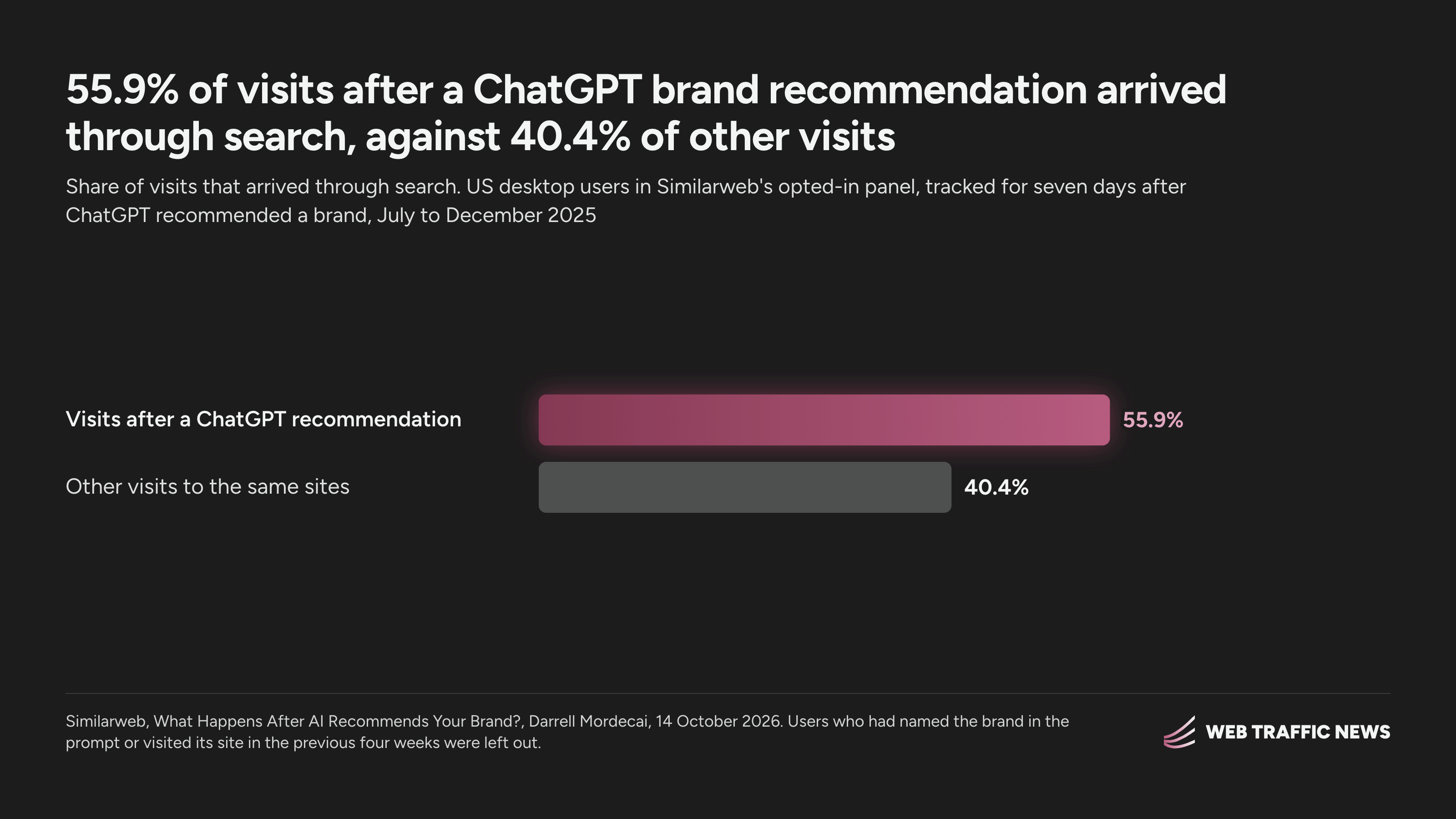
55.9% of the visits that followed a recommendation came through search, against 40.4% of other visits to the same sites, so the report files the AI recommendation under search.
The recommendation also decided which brand got the visit, in each of the six brand pairs Similarweb tested across three sectors:
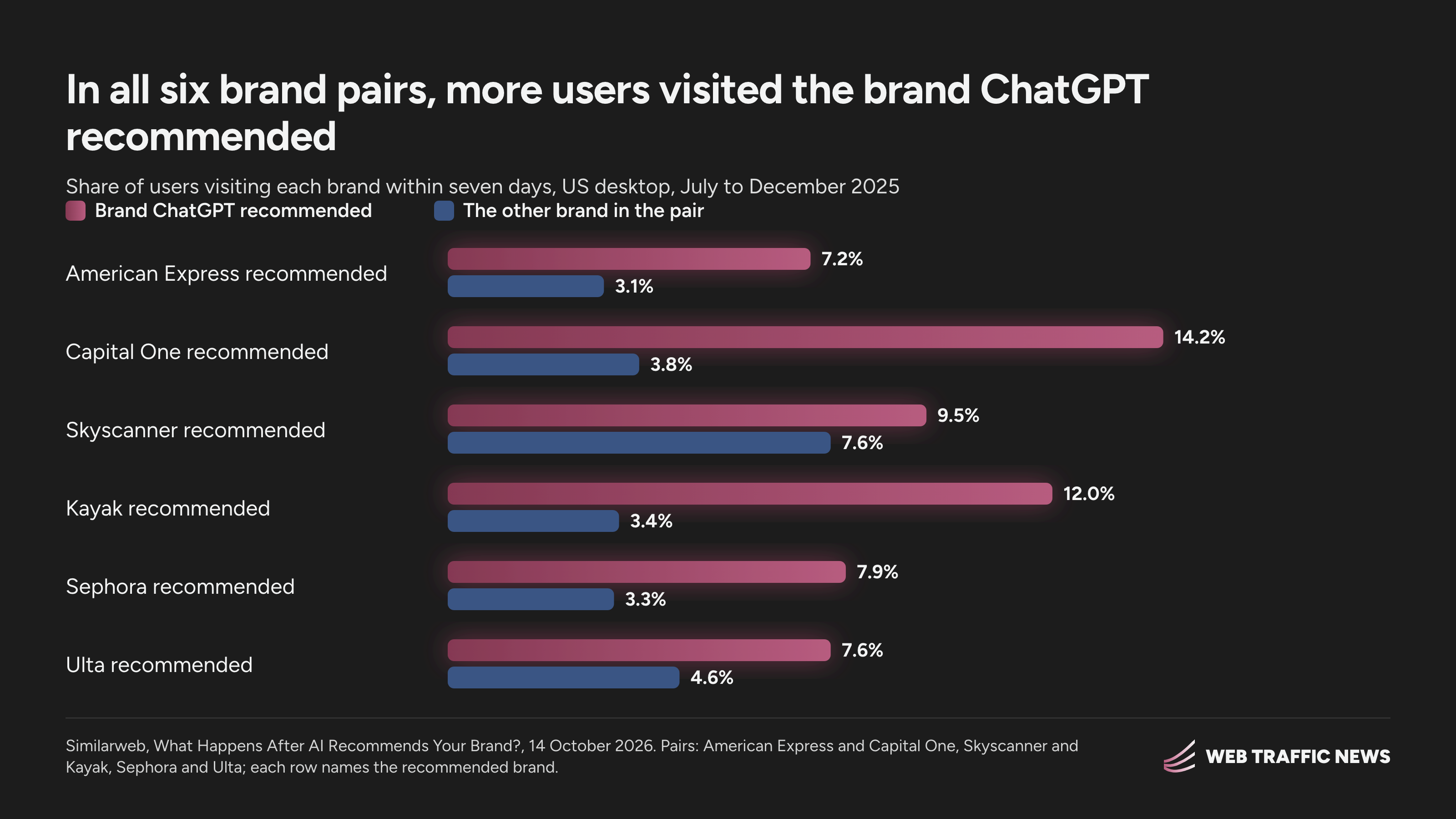
When ChatGPT recommended Kayak, 12.0% of users visited Kayak and 3.4% visited Skyscanner, while Skyscanner showed the smallest gap, at 9.5% against 7.6% for Kayak.
The AI channel in GA4
Google Analytics 4 sorts clicks from AI assistants into a channel of their own. Google’s default channel group definitions put visits from sources like ChatGPT, Gemini, Deepseek, Copilot or Grok into an AI Assistant channel whenever the referrer matches Google’s list of AI assistants.
Clicks from Google’s own AI Overviews and AI Mode count as Organic Search. Google Search Central’s page on AI features says sites appearing in them are included in the overall search traffic in Search Console. The opt-out test of AI Overviews click rates therefore had to estimate those clicks.
Google’s help page on custom channel groups allows 2 custom groups on a standard property and 5 on a 360 property. Each group applies to past reports and files a visit under the first channel it matches. An AI channel at the top of a custom group, matching sources such as chatgpt.com and perplexity.ai, counts those visits first.
The sessions that channel counts convert least, in Similarweb’s data on US desktop shopping sessions in June 2026:
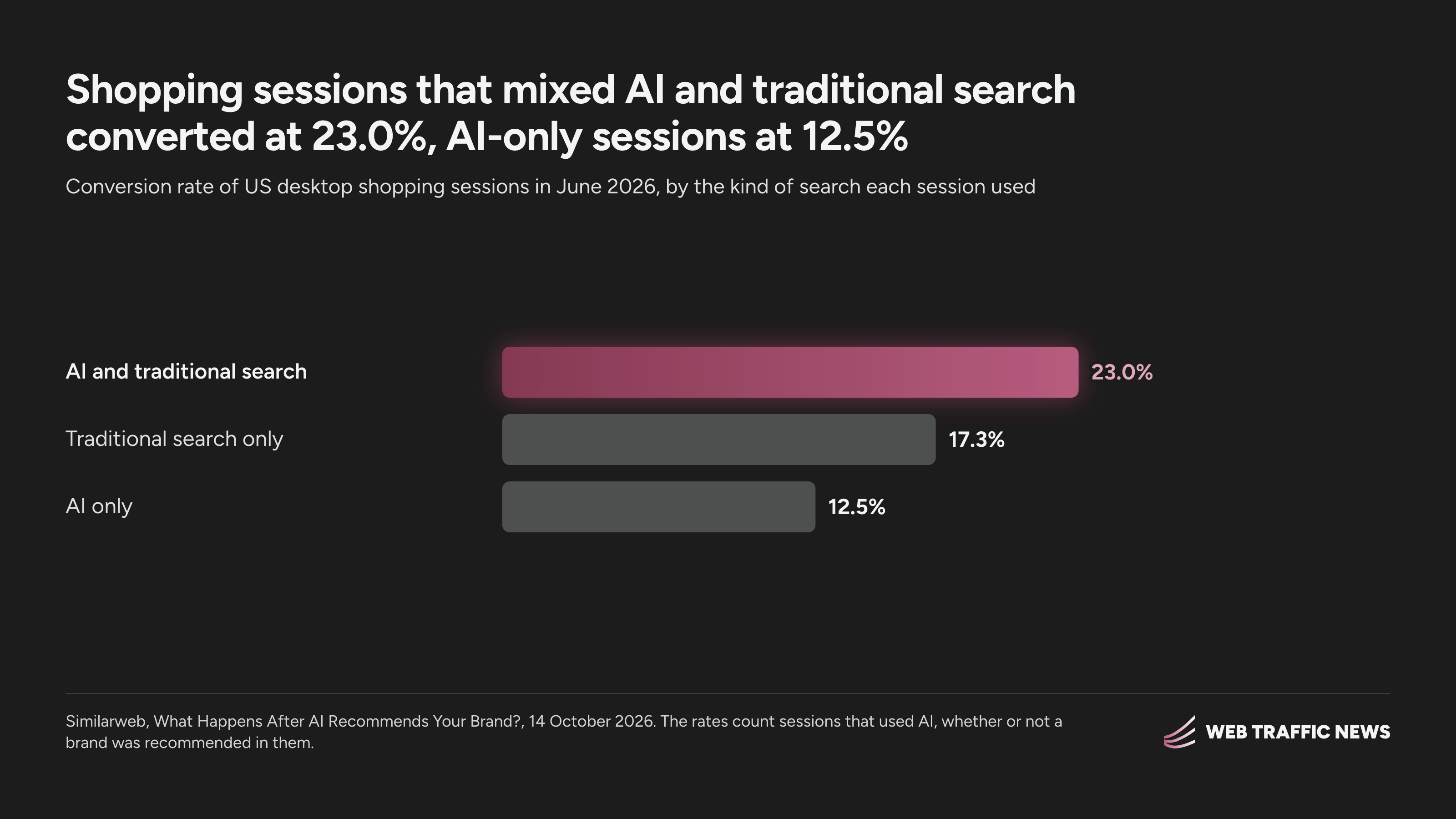
Sessions that combined AI with traditional search converted at 23.0%, search-only sessions at 17.3% and AI-only sessions at 12.5%, so the AI channel’s line is a floor. The other free checks are in how AI visibility tracking shows whether ChatGPT cited a site.
Asking buyers how they found you
Asking every buyer “how did you hear about us?” on the form and again on the first sales call gives the one record that sees the AI answer. A revenue measurement guide on agenzy.lt makes the question one mandatory field near the end of each lead form and shop checkout, with the same five options everywhere:
- ChatGPT or other AI models
- Recommendation
- Social media
- Other
The field carries no examples or helper text, because an example printed beside it becomes the most picked answer, and its wording stays fixed so one month compares with the next.
On the first call the salesperson asks the same question in their own words. The agenzy.lt guide notes that a buyer picking from a dropdown tends to choose Google, the last step taken. The same buyer telling a salesperson the story often starts with the question put to ChatGPT.
The CRM’s automatic source field records clicks too. HubSpot’s traffic source documentation sets the Original Traffic Source to the first web source it knows for a contact. HubSpot labels a visit AI Referrals only after a click on a link from an AI assistant such as chatgpt.com. The buyer’s answer needs its own field, made required in HubSpot’s pipeline settings for a deal moving into the next stage.
When the records disagree
AI search attribution follows a fixed order of trust when the call, the form and analytics name different sources for one buyer. The agenzy.lt revenue guide ranks the call answer first, the form answer second and analytics third, and settles the three common conflicts this way:
- Buyer names AI, analytics shows Google or Direct: The lead counts as AI search.
- Analytics shows AI, the buyer names nothing: The visit counts as a touch, and the deal goes to whatever the buyer named.
- Call and form differ: The call answer wins, and the salesperson’s note goes into the CRM word for word.
Traffic trends make a weaker witness than the buyer. On 19 October 2026, Kevin Indig reported 632 tests comparing four brands’ AI visibility with later branded search and Direct traffic, and could not establish a reliable link. “The better way to measure the impact of AI Visibility is a mix of self-reported attribution and triangulation of leading indicators,” wrote Kevin Indig, author of the Growth Memo newsletter.
Counting lead value and revenue
Attributed leads give two money figures, kept apart because one is pipeline and the other is closed business. Lead value prices the AI-attributed leads at the pipeline value the company already uses, such as an average deal size. Revenue is what the closed deals from those leads were worth, as the company confirms them. Four rules decide what enters each figure:
- Only leads whose call or form answer names an AI assistant count.
- Only leads that arrived after the GEO work began count, so deals already in the pipeline stay out.
- Only deals the company confirms as closed count as revenue, since a stage change or a sent proposal is no sale.
- Open leads stay in lead value and move into revenue in the month they close.
In e-commerce the two figures merge, because the checkout answer and the sale arrive with the same order. The monthly revenue from AI search can then be checked against the shop’s own order list.
Visibility, the share of AI answers to tracked buying questions that name the brand, is the intermediate number, and revenue is the result. Both sit in one report with the other eight GEO metrics that show whether AI search brings in buyers, read engine by engine.
What it means
The head of marketing should set up the buyer’s answer before the GEO work starts and judge revenue from it, in this order:
- Add the five-option “how did you hear about us?” field near the end of every lead form and the checkout.
- Give sales one call question, and make its CRM field required before a deal leaves the first stage.
- Put an AI channel at the top of a custom GA4 channel group and read its sessions as a floor.
- Each month, settle conflicts call first, form second and analytics third, and report lead value and revenue apart with their lead counts.
- Check the setup with a test form entry and a test deal the CRM refuses to move without an answer.
FAQ
How many leads does the revenue figure need?
The revenue figure needs about 30 to 50 leads that name an AI assistant. The agenzy.lt revenue guide puts that at one to two quarters of normal volume for most B2B companies. A shop gets there sooner, since its checkout asks every buyer, while new pages wait for their first citation, as how long GEO takes to show up in ChatGPT answers measures.
How do you know the sale would not have happened anyway?
For a single deal, no attribution method can prove it, in AI search or any other channel. The buyer’s answers support a count of buyers who say an AI assistant named the company and who joined the pipeline after the work began. A causal read on one change needs a controlled test, with a few of the questions tracked to measure how often AI answers mention a brand left untouched as a holdout.
Do ChatGPT’s link tags fix attribution?
ChatGPT’s link tags label only the visits that click, and Similarweb found that most AI recommendations produce no click. Tags also fail: from 8 to 16 October 2026 many ChatGPT links lost their utm_source tag and the visits landed in Direct, as OpenAI’s GPT-6 rollout week of hidden ChatGPT referral traffic showed.
Sources
- aisearch.similarweb.com/blog/after-ai-recommends-your-brand
- support.google.com/analytics/…/9756891
- developers.google.com/search/…/ai-features
- support.google.com/analytics/…/13051316
- agenzy.lt/blog/how-we-measure-ai-search-revenue
- knowledge.hubspot.com/properties/understand-traffic-source-properties
- knowledge.hubspot.com/object-settings/set-up-and-customize-pipelines
- growth-memo.com/p/does-ai-drive-more-direct-traffic
The week in AI search, in one email
One email a week with what changed in ChatGPT, Google AI Mode, Perplexity and Gemini, and the week's data piece.
Up next
64
%
of the URLs Perplexity retrieved were never cited in its answers, in Peec AI's February 2026 study of over 1 million citations.
Eight GEO metrics that show whether AI search brings in buyers
Explainer
0.5
%
of all visits came from AI referrals across 10,000 domains each in the US and France, in Similarweb data analyzed by the Growth Memo.
Growth Memo data puts AI referral traffic at 0.5% of total visits
Brief
37
%
fall in GA4 sessions from ChatGPT across a few hundred websites from 9 October 2026, as ChatGPT's links lost their tracking tag.
OpenAI's GPT-6 rollout hides a week of ChatGPT referral traffic
Brief