ExplainerMeasurement
How to choose a GEO agency when all the proposals look alike
How to choose a GEO agency: judge how it tracks prompts, ties AI answers to leads and dates its client results, since most proposals list the same work.
 By Emilis Zabilius · · 7 min read
Buyers working out how to choose a GEO agency should judge each candidate on how it works: who writes and freezes the tracked prompts, how leads from AI answers reach the CRM, and whether its client cases carry dated figures at both ends. Proposals rarely tell agencies apart, because most list the same audit, content, technical and digital PR work.
TL;DR
- A September 2026 review of 22 GEO agencies found 17 naming an AI visibility audit and 3 publishing a named client with before-and-after AI figures.
- Buyers should judge a GEO agency on prompt tracking, lead attribution, dated client cases and published tests, with technical files such as llms.txt counting least.
- A company hiring a GEO agency should request last month’s report and tracked prompt list first, and drop any agency that guarantees results.
Why GEO agency proposals look alike
GEO agency proposals look alike because most agencies sell the same four deliverables, and the business model behind each GEO proposal is rarely stated. A September 2026 review of 22 GEO and AEO agencies, published on agenzy.lt, covered North America, Britain, continental Europe and Asia and counted the deliverables each agency names on its own public pages:
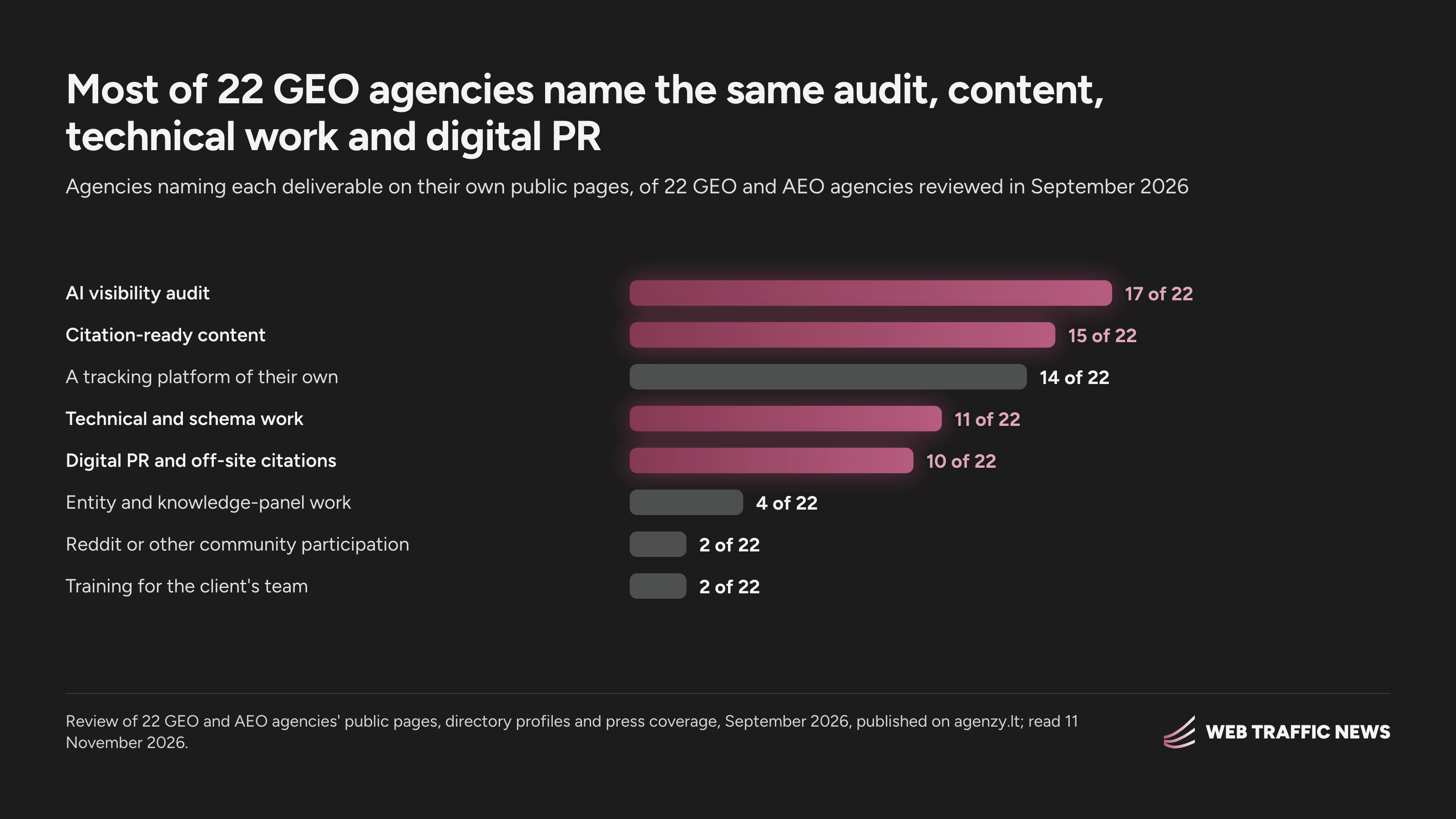
Seventeen of the 22 named an AI visibility audit, 15 citation-ready content, 14 a tracking platform of their own, 11 technical and schema work and 10 digital PR. Entity and knowledge-panel work appeared at 4 agencies, and community participation such as Reddit and training for the client’s team at 2 each.
The business model decides who works on the account, so it separates GEO agencies more than the deliverables do. The review sorted the 22 agencies into four models:
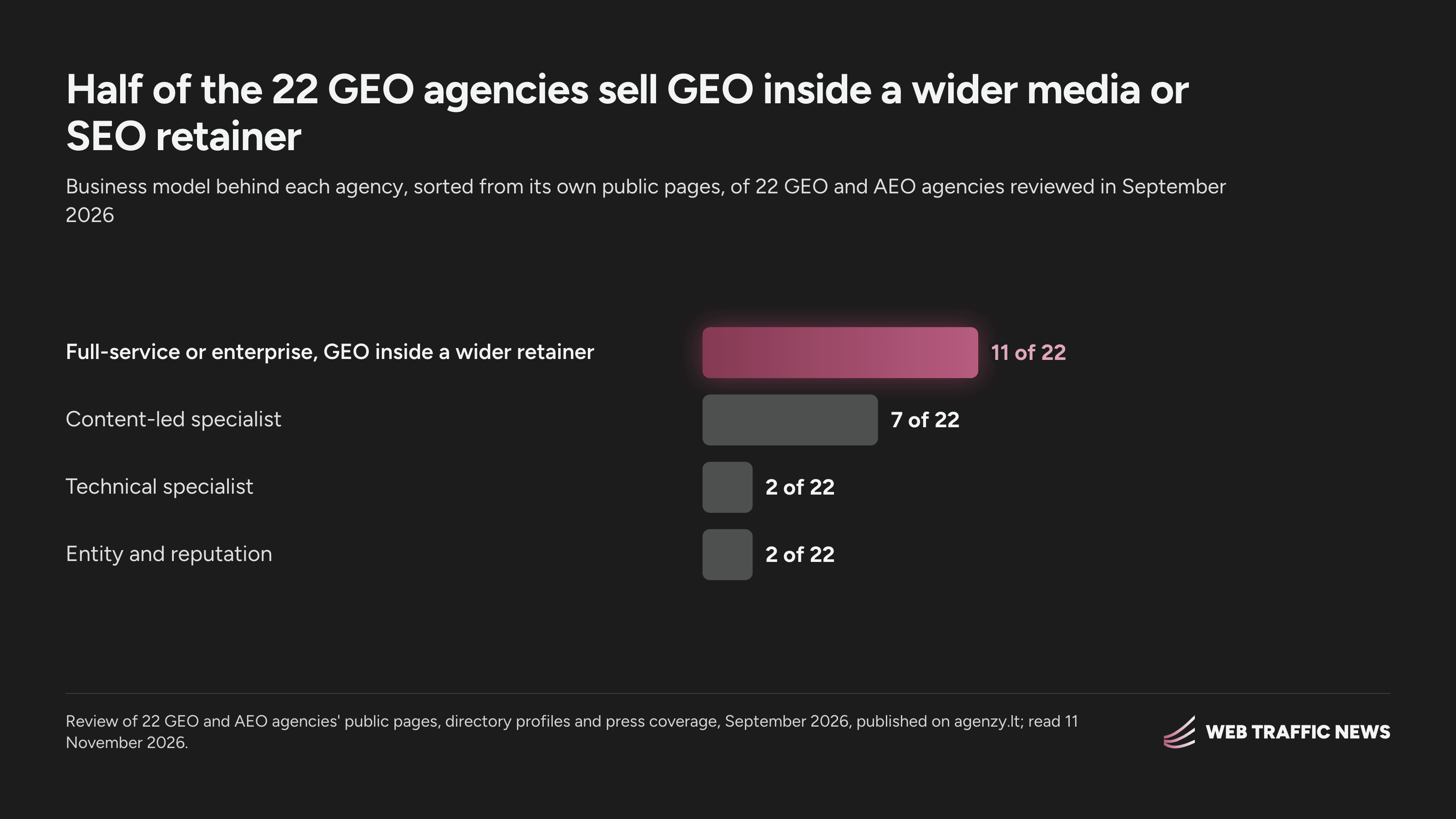
Eleven of the 22 sell GEO inside a wider media or SEO retainer, where the work shares a large team’s time and its budget can move back to paid media. Seven are content-led specialists, 2 are technical specialists who leave the writing to the client, and 2 work on entity and reputation.
Judging how a GEO agency works
A GEO agency, or any firm selling AI SEO services, is judged by how it works: its specialization, prompt tracking, lead attribution, dated client cases, published method, recorded tests and speed of change after model releases.
Technical files are a poor basis for the choice. Robots.txt access and structured data matter first, because a blocked crawler cannot read the site, but they are a small part of the whole job. More frequent recommendations come from content and from mentions on other sites.
Google’s guide to optimizing for generative AI features, last updated on 10 July 2026, tells site owners they can ignore “chunking” content and unnecessary AI text files for Google Search. What llms.txt is and who reads it shows how little the most familiar of those files adds.
An SEO retainer sold under a new name shows three gaps: no tracked prompt set, no attribution of AI-sourced leads in the CRM and no figures for each AI engine. The names for optimizing for AI answers say little about which work sits inside a proposal.
Proof to request before a call
Before a first call, a buyer should request two things that take weeks of daily tracking to produce. One is a client case with AI figures dated at both ends and the tool that read them. The other is last month’s report for a real client with its tracked prompt list, checked against what a monthly GEO report from an agency should show.
Few GEO agencies publish that evidence. The September 2026 review counted what a buyer can check on the 22 agencies’ own pages:
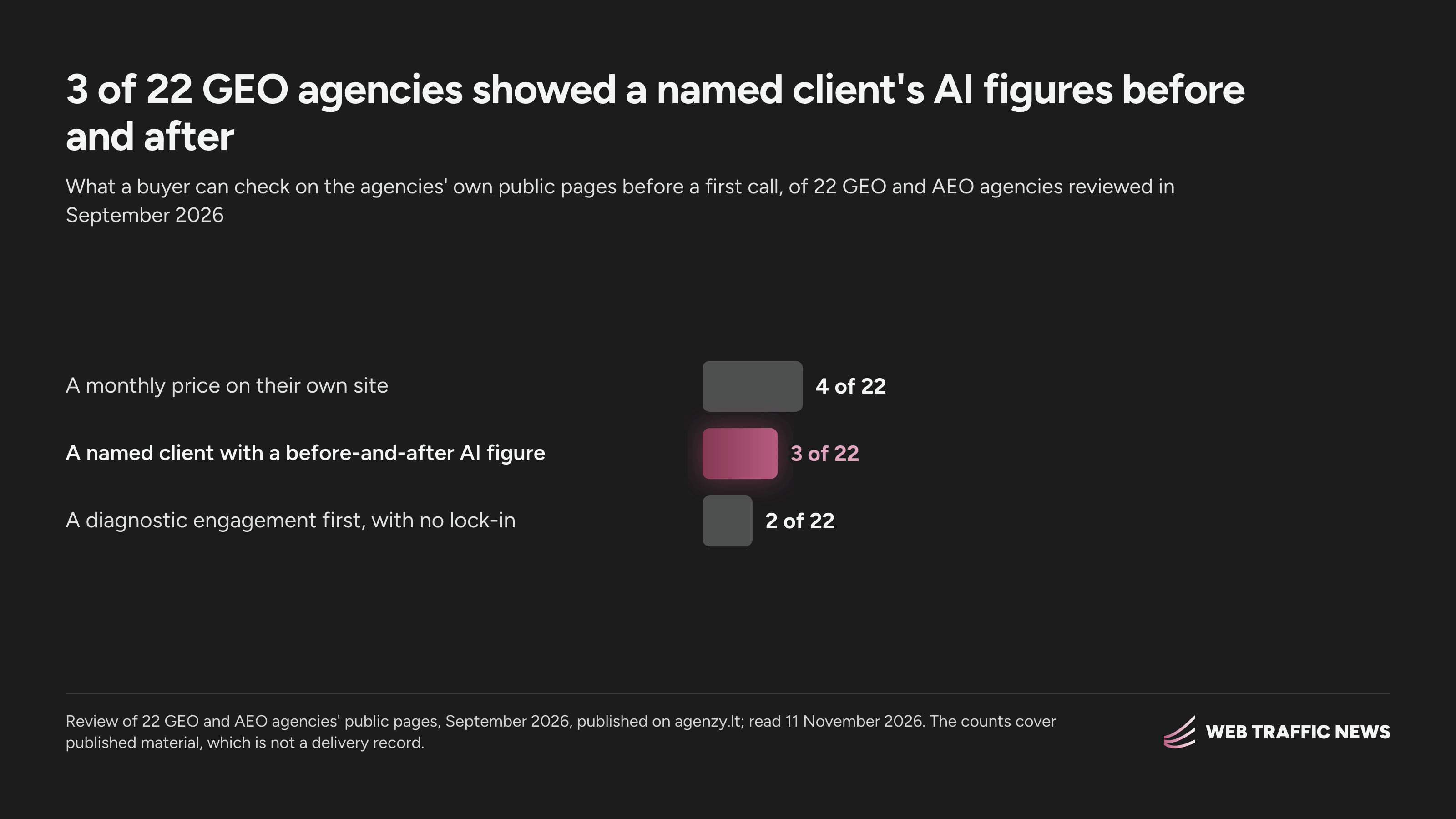
Four of the 22 published a monthly price, 3 a named client with a before-and-after AI metric, and 2 a diagnostic engagement sold first with no lock-in. The counts cover published pages only, so an agency with little online can still answer well on a call.
A screenshot of one AI answer proves only that the answer appeared once. In SparkToro’s study published on 27 January 2026, 600 volunteers ran 12 prompts through ChatGPT, Claude and Google’s AI answers a combined 2,961 times, and the tools rarely gave the same list of brands twice. “These tools are probability engines: they’re designed to generate unique answers every time,” wrote Rand Fishkin, co-founder and CEO of SparkToro.
Questions for the sales call
Seven questions on the sales call test how a GEO agency works, and a passing answer names a tool, a field, a date or a number:
- Specialization: Ask what share of revenue and clients comes from GEO, and which adjacent work the agency turned down this year.
- Prompts: Ask who writes the tracked prompts, how many, in which tool and when the company approves them, with no prompt naming the company, as building a prompt set for AI visibility tracking explains.
- Attribution: Ask which CRM field records a lead that came from an AI assistant and who builds it in month one, as measuring AI search revenue when analytics credits Google describes.
- Tracking data: Ask which tracker and AI engines feed the reports, how often the prompts run, and whether the company gets a login and an export.
- Own tracking: Ask how many prompts the agency tracks for itself and how many name the agency.
- Failed tests: Ask for one test that did not work, with its baseline and comparison, and what the agency stopped doing afterwards.
- Model releases: Ask what the agency changed after a named model release, and on what date.
Run frequency matters because AI citations change daily. Ahrefs followed about 37,500 citations across five AI tools every day for 20 days and found 50 to 83% of them gone the next day, in a study published on 29 October 2026. About 75% of the lost citations came back within the 20 days, so a single weekly reading can catch a prompt on a good or a bad day.
Contract terms and the first review
A GEO contract should name the term, the notice period, who owns the prompts, data and content, and the first review date, and it should carry no guarantee of a position or visibility level. In the September 2026 review, 12 months was the standard term at the premium end and six months in the middle.
The tracked prompt set, the reports, the raw data and the content deployed on the site belong to the company paying for them. The contract should also name who does the off-site work and whose developers make the technical changes.
A guaranteed result is a reason to walk away. Google’s guide to hiring an SEO, last updated on 5 June 2026, says nobody can promise a site the top position on Google and asks whether an agency’s AEO or GEO advice matches Google’s own guidance. Google’s guidance on third-party SEO tools adds that outside tools cannot see Google’s internal ranking data.
The first review compares the latest figures with a baseline measured before work began, on the same prompts and AI engines, using the eight GEO metrics that show whether AI search brings in buyers engine by engine.
What it means
The founder or head of marketing choosing a GEO agency should take these steps in order:
- Ask each shortlisted agency for a dated client case and last month’s report with its prompt list before booking calls.
- Drop any agency that promises a position, a visibility level or a date for a result.
- Note the business model behind each remaining proposal.
- Ask the seven questions on each call, and keep the agencies whose answers name a tool, a field, a date or a number.
- Write ownership, the notice period, the baseline date and the first review date into the contract.
FAQ
Should a company hire a GEO agency or do GEO in house?
In-house GEO works when the company already has a developer who can change robots.txt, structured data and page templates, someone publishing every week, and a tracking subscription. An agency earns its fee where off-site work or publishing pace is the bottleneck, and a split also works, with the agency running tracking and off-site work while the in-house team writes.
How much does a GEO agency cost?
Most GEO agencies leave the price for the proposal: 4 of the 22 agencies in the September 2026 review publish a monthly price on their own site. The prices that US agencies do publish are compared in the ranking of US GEO agencies on what they publish.
How long before a GEO agency shows results?
A GEO program needs about three months for a first verdict and about six for the full picture, and early numbers swing on small samples. A new page can be cited within days or weeks, as how long GEO takes to show up in ChatGPT answers measures, but no agency controls when a model names a brand.
Sources
The week in AI search, in one email
One email a week with what changed in ChatGPT, Google AI Mode, Perplexity and Gemini, and the week's data piece.