ExplainerMeasurement
What a monthly GEO report from an agency should show
A monthly GEO report should show each AI engine, every tracked prompt and the evidence behind the work, so the buyer sees what moved and what did not.
 By Emilis Zabilius · · 7 min read
A monthly GEO report should show the company paying for the work what moved since the last report, what stayed flat and what the agency did, engine by engine and prompt by prompt. Those figures compare from one month to the next only while the prompt set, the AI engines and the time window stay the same, so the report states all three before its first number.
TL;DR
- A monthly report from a GEO agency states its prompt set, AI engines and time window before any figure, since a changed prompt set breaks the comparison with last month.
- In Peec AI’s 2026 study of 37,804 AI responses, a ranking prompt gave about 20% more average visibility than an open-ended question.
- A company paying for GEO should ask for figures per engine, every tracked prompt including zeros, evidence links for the work and a list of unfinished items.
What the report states first
The top of a monthly report fixes the scope every figure is read against: how many prompts are tracked, on which AI engines, against which competitors and over which dates. A figure without that block cannot be checked against last month’s, and a rise measured across two different prompt sets reflects the new questions as much as the answers.
Wording alone moves the result. In Peec AI’s 2026 study of 1,754 prompts and 37,804 AI responses on five AI engines, a prompt’s style changed how often brands appeared:
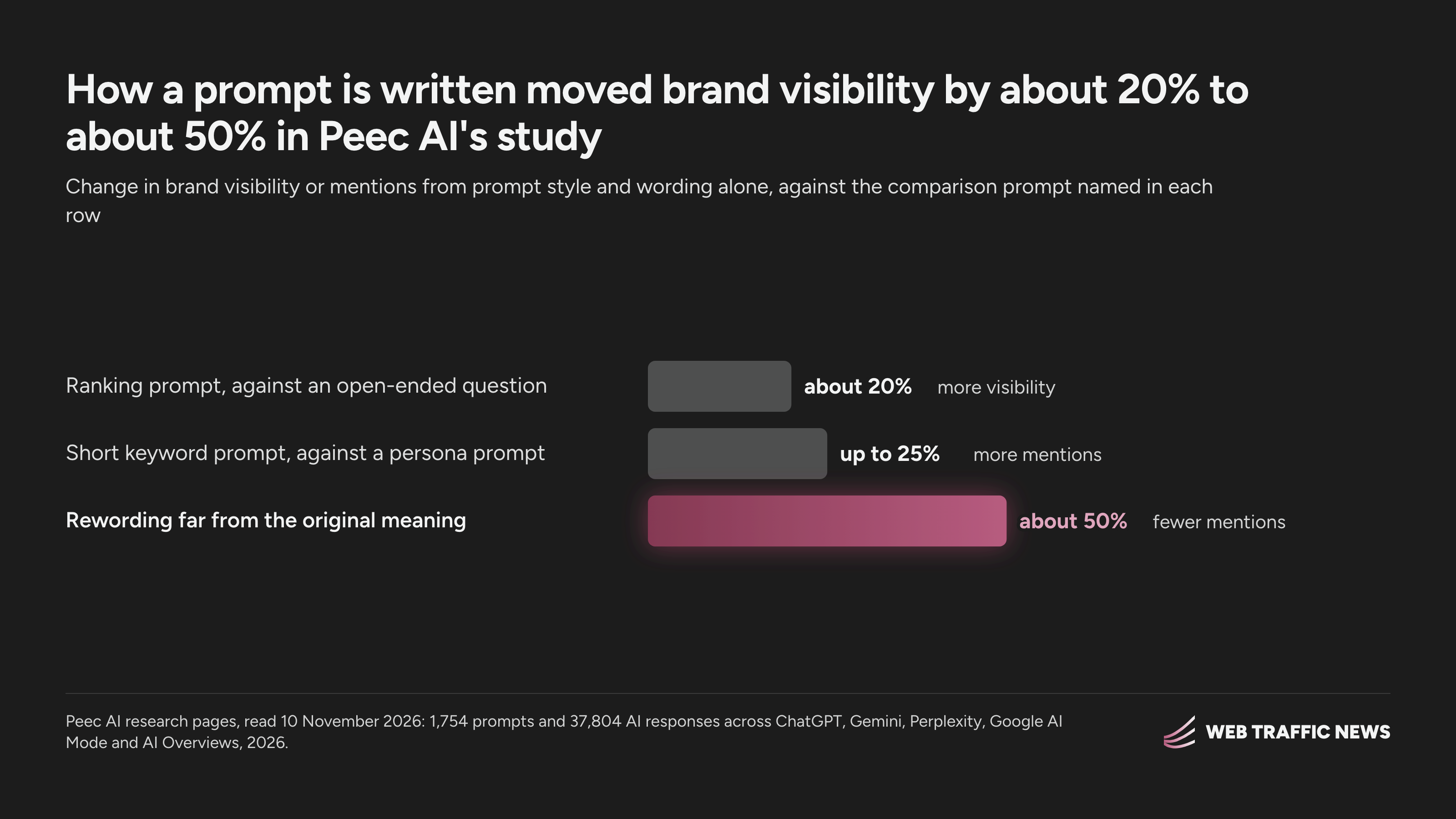
A prompt asking for a ranking added about 20% average visibility over an open-ended question, and short keyword prompts gave up to 25% more brand mentions than prompts written in a persona’s voice. The wording half of the same Peec AI study found mentions fell roughly 50% once a rewording drifted far from the original meaning.
The prompt set is therefore frozen in writing before the baseline, as building a prompt set for AI visibility tracking sets out, and the report gives the date of the freeze. Peec AI’s brand insights chart flags the days new prompts were created or an AI model changed, and a report’s trend line needs the same markers.
Figures for each AI engine
A monthly report gives each AI engine its own first figure and latest figure, because an average across engines can hold steady while one engine falls. Agenzy’s 2026 study measured a median 5.1x visibility gap between a brand’s best and worst AI engine, and 30% of visible brands were completely invisible on at least one engine (n=86 brands visible somewhere, 2026-04 to 2026-08).
The competitor table follows the same split, with each tracked brand’s figure on each engine and the leader’s figure printed beside the buyer’s own, using the eight GEO metrics that show whether AI search brings in buyers.
AI engines also differ in how long they keep a source. Ahrefs’ study of about 37,500 citations, published on 29 October 2026, followed five AI tools daily for 20 days and found few citations lasting a week:
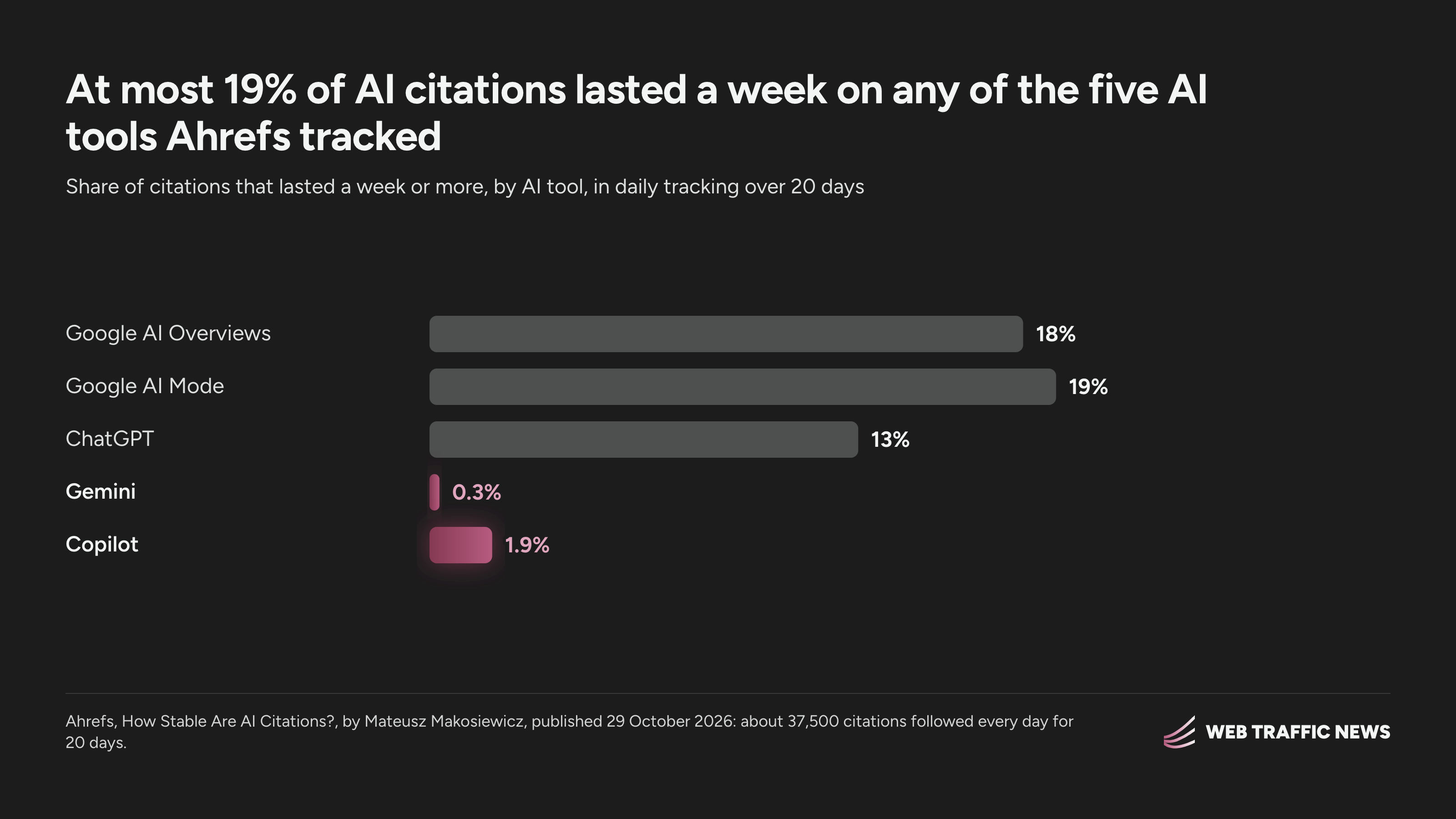
In the Ahrefs data, 18% of Google AI Overviews citations and 19% of Google AI Mode citations lasted a week or more, against 13% on ChatGPT, 1.9% on Copilot and 0.3% on Gemini. “Count how many of the last seven days you were cited,” wrote Mateusz Makosiewicz, SEO and marketing educator at Ahrefs, so a report reads each engine over a window of days.
Every tracked prompt and source
A monthly AI visibility report lists every tracked prompt on its own row, with its figure for the month and the last week, and keeps the rows at zero. Each figure is visibility, the share of answers that name the brand. The bottom rows are read first, because movement there shows whether new pages reached the questions they were written for, and the zeros show what next month’s work is for.
Each prompt row also notes what the answers say about the brand. A wrong price, an old product name or a bad review inside an answer costs deals whatever the visibility figure, so the report flags it beside the prompt that produced it.
The source table lists the domains the engines opened while answering, with the brand’s own pages named, and how often LLM citations include a brand’s own website gives a benchmark. Engines open different pages partly because they run different searches before answering, called fan-outs. Peec AI’s analysis of 5 million query fan-outs from 1 to 21 April 2026 counted them per prompt:
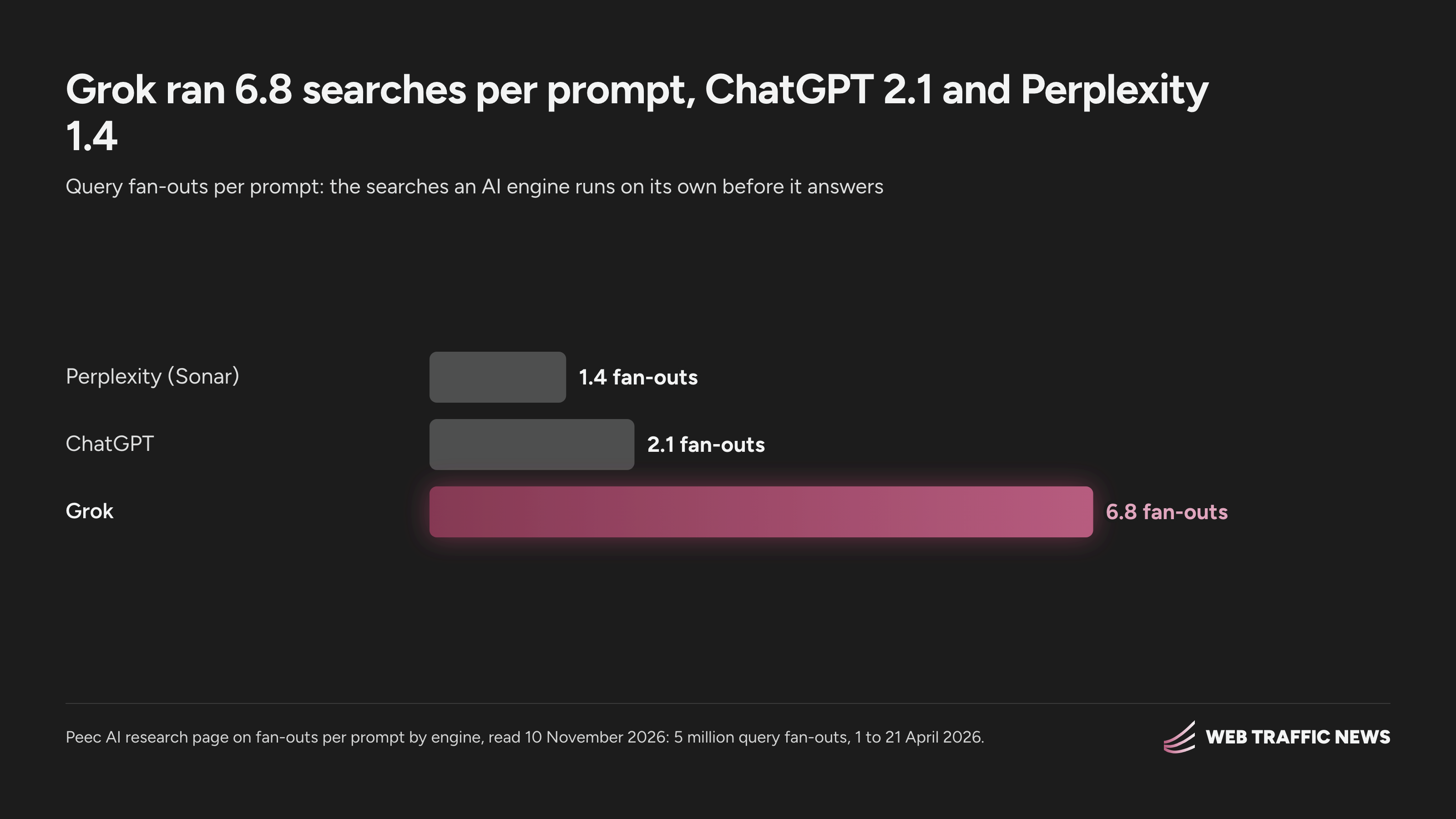
Perplexity ran 1.4 fan-outs per prompt, ChatGPT 2.1 and Grok 6.8, so a page one engine opens can go unread by another, and the source table needs reading engine by engine.
Work log, open items and leads
The work section lists every change shipped since the last report, one per line, each linked to evidence: the live robots.txt file, the markup validator’s output or the published page. A link to the home page proves nothing. A change the agency reversed, such as a wrong product claim it published, is named with the month it came down.
An open-items list names the pages too new to judge and the changes whose effect has not arrived. New pages take days to weeks to reach AI answers, as how long GEO takes to show up in ChatGPT answers measures, so the report marks any figure resting on them as provisional.
The leads row counts the buyers who said an AI assistant sent them, from one question on the form or at checkout. That count is a floor, because analytics files most of those buyers under Google or Direct, as measuring AI search revenue when analytics credits Google explains. A report without a leads row states why it has none.
Signs a report hides weakness
A monthly report hides weakness when a number on it leads to no decision, and one email settles each sign. A guide to GEO agency reports on agenzy.lt names the first four:
- One blended score as the headline: Each engine’s figure for the first and the latest month shows what the average covers.
- No figures per engine: Each engine’s share of answers shows which engine the next page should target.
- No source table: Retrievals and citations per domain, with the brand’s top pages named, show whether the engines read the site.
- No leads row and no reason: A count of buyers who named an AI assistant shows whether the work reaches revenue.
- A prompt count that changed since signature: The frozen list, with the date of each change, shows whether a rise came from new questions.
- Only winning prompts printed: The full prompt table, read from the zeros up, shows where the month was lost.
- Work lines that land on the home page: The file, page or validator output behind each line shows the work exists.
Which US agencies publish a prompt set, attribution and a report per engine is scored, from each agency’s own website, in the ranking of US GEO agencies on what they publish.
What it means
The founder or head of marketing who pays for GEO should read each monthly report in this order:
- Check the prompt count, engines and dates against the set frozen at signature.
- Compare the first and latest figure on each engine, and weigh most the engines your buyers use.
- Read the prompt rows from the zeros up, with any wrong facts the answers state about your brand.
- Find your own pages in the source table, then open two work lines at random.
- Read the open items and the leads row, and treat the leads count as a floor.
- Send every sign of hidden weakness to the agency in one email.
FAQ
How often should a GEO agency report?
A GEO agency should report once a month, while the tracking underneath it runs daily, because one day’s answers move too much to act on. Peec AI’s documentation compares each window with the previous period of the same length, so two monthly reports compare cleanly when both cover the same number of days.
Can you check the agency’s numbers yourself?
Partly, from your own accounts. Google Search Console’s generative AI performance report, rolled out to all websites as of 31 August 2026, shows impressions in AI Overviews and AI Mode by page. Bing Webmaster Tools’ AI Performance report, in public preview since 10 February 2026, counts Microsoft Copilot citations from a sample. The steps are in how AI visibility tracking shows whether ChatGPT cited your site.
What does a good month look like in the agency’s report?
A good month shows movement on the prompts and engines the previous report named as the next work, with at least one line that went the wrong way printed beside it. A rise on every row at once needs a check: a few tracked prompts left untouched by the work show whether the engines moved everything.
Sources
- docs.peec.ai/research/prompt-style-and-brand-visibility
- docs.peec.ai/research/prompt-wording-and-ai-visibility
- docs.peec.ai/brand-insights
- agenzy.lt/blog/ai-search-visibility-study-2026
- ahrefs.com/blog/how-stable-are-ai-citations
- docs.peec.ai/research/fanouts-per-prompt-by-engine
- agenzy.lt/blog/geo-agency-report-example
- support.google.com/webmasters/…/16984139
- blogs.bing.com/webmaster/…/Introducing-AI-Performance-in-Bing-Webmaster…
The week in AI search, in one email
One email a week with what changed in ChatGPT, Google AI Mode, Perplexity and Gemini, and the week's data piece.