ExplainerMeasurement
How to build a prompt set for AI visibility tracking
Build a prompt set for AI visibility tracking from buyers' own questions, test each prompt on the engines for a week and freeze the set before the baseline.
 By Emilis Zabilius · · 7 min read
To build a prompt set for AI visibility tracking, collect buyers’ questions in their own words, write each as a short request that makes AI engines name vendors, and test every prompt before it counts. The set decides what visibility, the share of answers naming a brand, means, since questions worded like a brand’s own marketing inflate it.
TL;DR
- A prompt set for AI visibility tracking takes its wording from search data, customer conversations, public forums and the searches AI engines run.
- Each segment of topic and buying stage needs 5 to 10 prompts, so seven topics across three stages make 105 to 210 prompts.
- Every tracked prompt passes a test by hand and a seven-day trial, and the set is frozen before a baseline of two to four weeks.
Where buyer questions come from
A prompt set draws its questions from four sources of buyer language, because Google data misses most AI prompts. In iPullRank’s comparison of 16,310 users, published on 29 October 2026, for 96% of AI prompts the same user did not search that topic on Google within 30 minutes.
The prompt-set method published on agenzy.lt reads these four sources before any prompt is written:
- Search data: Search Console, GA4 and keyword tools show which questions bring visitors and volume, and long questions with impressions but almost no clicks read as AI engines’ searches.
- The company’s own conversations: Support tickets, sales calls and an interview with whoever hears customer questions first give buyers’ exact words, ranked by frequency.
- Public buyer conversations: Reddit, Quora, forums and review sites show how buyers describe the problem to each other.
- The engines’ own searches: Google’s guide to AI features says AI Overviews and AI Mode may use query fan-out, several related searches across subtopics and data sources before answering.
The method counts each theme across the four sources: one source makes a hypothesis, three or more make a prompt cluster, and a topic only the founder cares about is left out. How ChatGPT splits one question into several searches is in where ChatGPT gets its information when it searches the web.
How a tracked prompt is worded
A tracked prompt reads like a buyer’s request: 6 to 20 words, at most one detail about the buyer’s situation, and an ask that makes the engine name vendors, such as “what’s the best” or “does it work with”. A prompt that only describes a problem gets advice without brands, and a job-title preamble or a pasted deadline is cut.
Every phrase in a prompt has to come from one of the four sources. A coined term from the brand book is cut, because the engines find the company’s own pages for its own phrase and the score measures the wording. In a made-up illustration, a firm selling “revenue continuity software” would track “what tool reminds customers to pay overdue invoices”.
AI prompts run longer than Google searches for the same need, in iPullRank’s November 2024 panel of US desktop users, also covered in what changed in AI search, 25 to 30 October 2026:
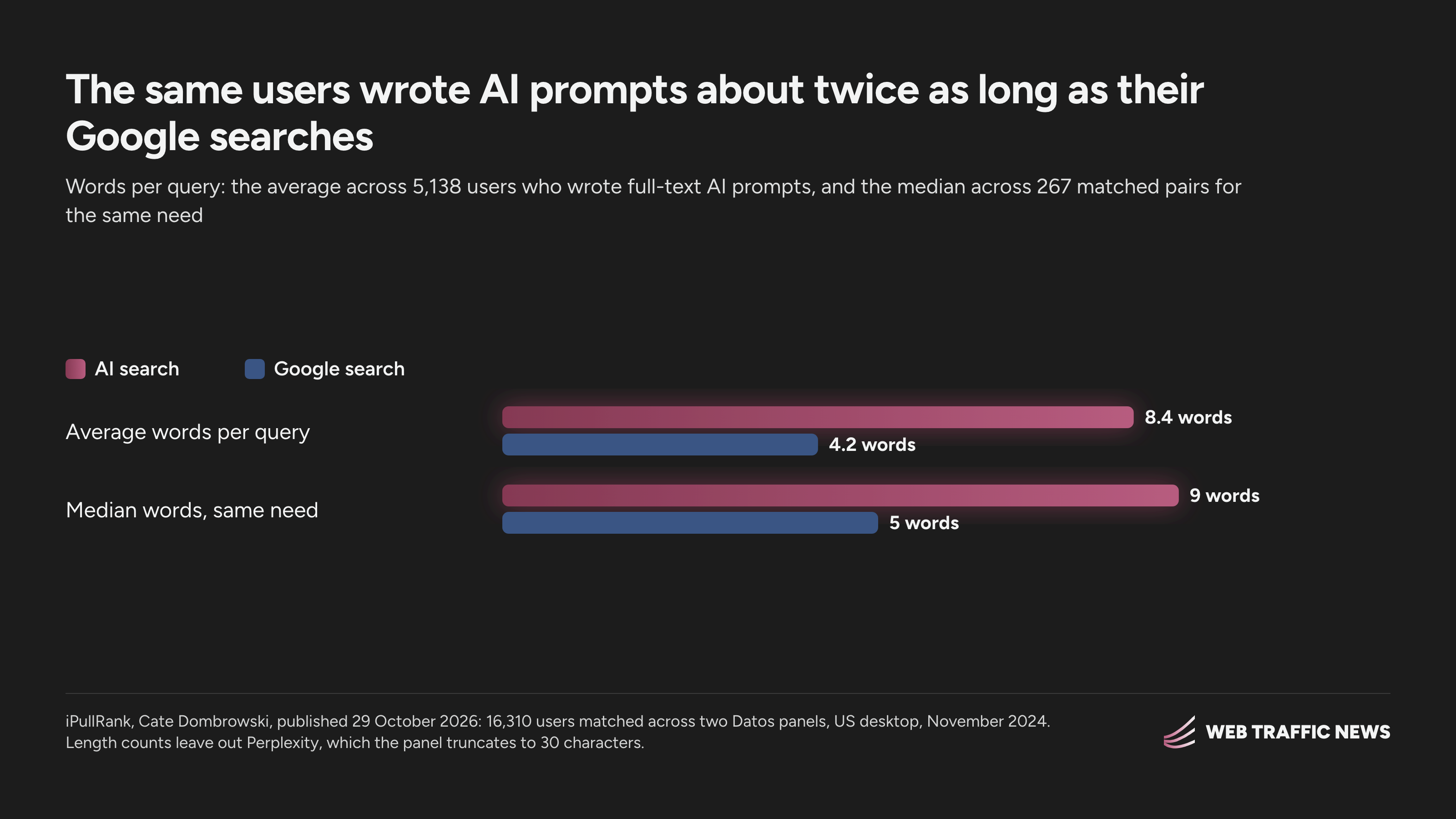
The same users averaged 8.4 words in AI search and 4.2 on Google, and 9 against 5 at the median for 267 matched needs. The typical user still wrote about 3 words on both, so iPullRank researcher Cate Dombrowski wrote that “a prompt set should carry both shapes: the quick lookup and the detailed version the same person writes when the need gets specific.”
Buying stages, personas and markets
A prompt set covers every stage of one buyer’s questions, since purchase questions alone miss where a brand is usually least visible. Top-of-funnel prompts state the problem, mid-funnel prompts ask for the best options and bottom-funnel prompts ask about fit, price and comparisons. Each persona gets variants, and each market and language its own set.
Peec AI’s prompt guide says the location a prompt runs from can change the answer, and its prompt discovery tool starts from a fixed mix:
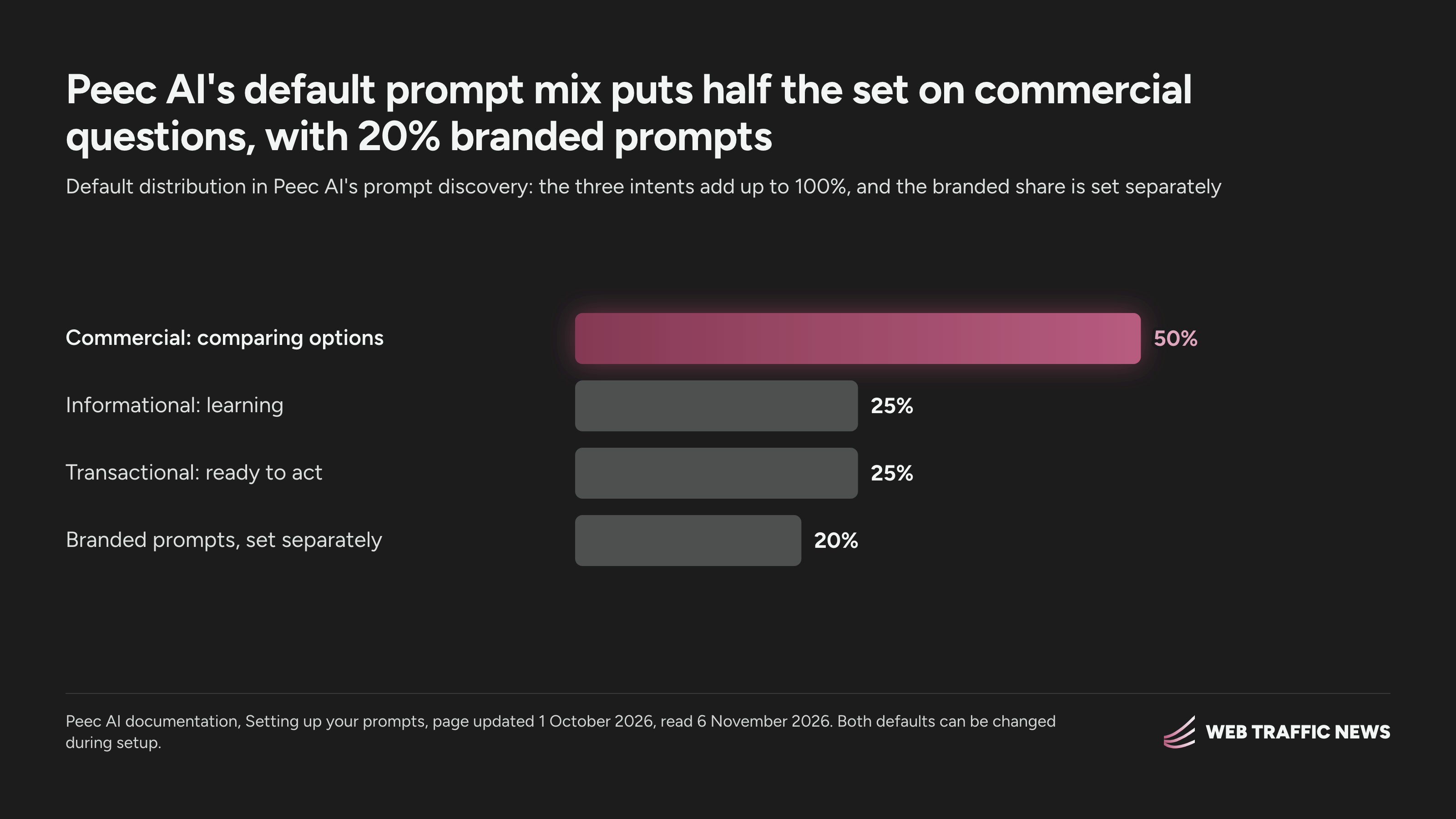
Peec AI, a tool that runs a project’s prompts daily, defaults to 20% branded prompts and a 25/50/25 intent split, both adjustable. The agenzy.lt method moves the mix toward the stage where the company’s buyers decide.
Branded prompts, which name the brand or a competitor, sit in their own lane outside the headline visibility number, since a question naming the brand gets an answer naming it almost every time. The branded lane still shows how the engines describe the brand, how it fares against competitors and how fast a new feature appears.
Peec AI’s guide to organizing a setup labels each prompt branded or non-branded and allows one topic and many tags per prompt. Each prompt gets its topic and its stage, persona and market tags before the first run, so the baseline splits by segment.
How many prompts to track
The number of prompts to track follows from the number of segments, each one topic at one buying stage for one persona and market, and each segment gets 5 to 10 prompts. Under five, one odd answer moves the segment’s number, and above ten the segment is measured twice. Seven topics across three stages make 21 segments and 105 to 210 prompts:
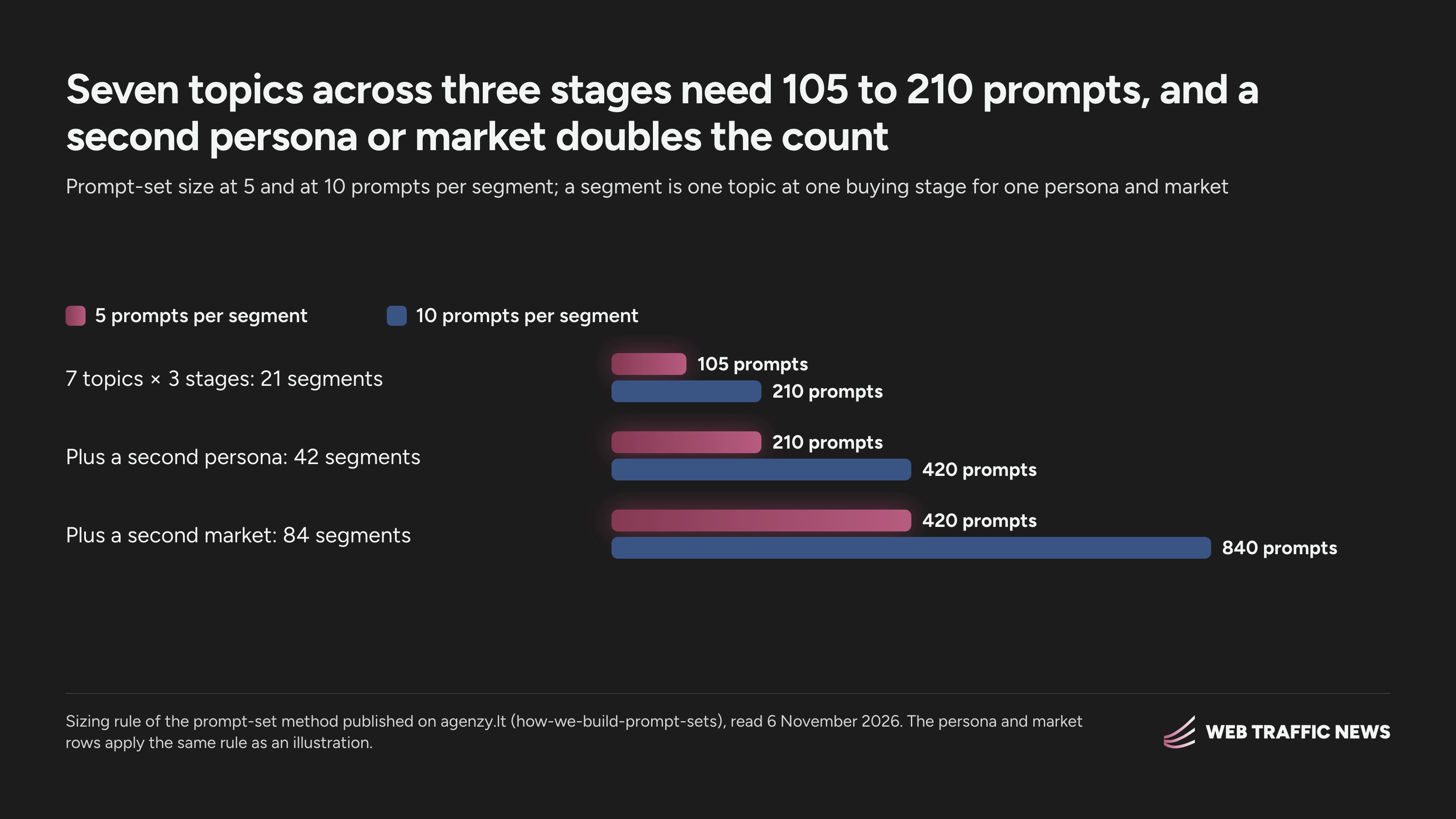
In this illustration of the rule, a second persona doubles the set to 42 segments and 210 to 420 prompts, and a second market to 84 segments and 420 to 840. Tools that run such sets daily are compared in how AI visibility tracking shows whether ChatGPT cited a site.
Several prompts per segment also absorb how differently people word one need. In SparkToro’s research of 27 January 2026, 142 prompts people wrote about headphones for a traveling family member had an average semantic similarity of 0.081, yet Bose, Sony, Sennheiser and Apple appeared in 55 to 77% of 994 answers.
Testing prompts before tracking starts
Every candidate prompt passes a test by hand and a seven-day trial before it is tracked. By hand, each prompt runs two or three times in ChatGPT, Perplexity and Google AI Overviews. Prompts that return advice with no vendor get a sharper ask or are cut, and prompts answered from memory with no web search are cut, since site work cannot change them.
The survivors run daily for seven days. Ahrefs’ study of about 37,500 citations, published on 29 October 2026, found 50 to 83% of citations gone the next day and about 75% of those back within 20 days. Each prompt is read engine by engine, as the brief on how stable AI citations are explains.
Prompts that named no brand all week are cut, since nobody can win them. Prompts where the company already appears in over 30% of answers, far above what most European brands score in AI search, stay only when buyers ask that way, because prompts the company already wins leave the number little room to rise.
The set is then scored on eight kinds of bias: wording that echoes the company’s marketing, its strongest channel or feature, its home language and market only, one funnel stage, its favorite persona, industries it already wins, missing “X vs Y” or “alternatives to” framing, and wording a year out of date. A set that scores high measures the company’s positioning and is rebalanced.
What it means
The marketing lead who owns AI visibility should finish the prompt set before any GEO work ships, in this order:
- Gather buyer wording from search data, sales and support, forums and the engines’ searches.
- Write prompts of 6 to 20 words in that wording, 5 to 10 per segment, each asking for vendors.
- Tag every prompt by topic, stage, persona and market, and keep branded prompts in their own lane.
- Test each prompt by hand and for seven days, cut what no brand wins and recheck prompts above 30%.
- Have sales and support review the set, freeze it in writing and record the baseline.
- Check that each segment holds 5 to 10 prompts and no unbranded prompt names a brand.
FAQ
Can prompts change once tracking starts?
No, a confirmed prompt set stays fixed for as long as it is tracked, since a set that changes makes this month’s number incomparable with last month’s. A new market, product line or segment is tracked as a second set with its own baseline, and both are reported side by side.
How long does a baseline take?
A baseline for AI visibility tracking needs two to four weeks of daily runs once the prompt set is confirmed, and its start and end dates are recorded before anyone changes the site. It records visibility, position, sentiment and cited domains per engine and per topic, as in the eight GEO metrics that show whether AI search brings in buyers.
Who should review the prompts before the freeze?
The people who talk to buyers, usually sales and support, should review the set by topic and stage. They usually correct a phrase no customer would use and flag a growing segment that past data underweights. Rewritten prompts are tested again before the set is confirmed in writing.
Sources
The week in AI search, in one email
One email a week with what changed in ChatGPT, Google AI Mode, Perplexity and Gemini, and the week's data piece.
Up next
55.9
%
of the visits that followed a ChatGPT brand recommendation arrived through search, in Similarweb's US desktop panel of July to December 2025.
How to measure AI search revenue when analytics credits Google
Explainer
64
%
of the URLs Perplexity retrieved were never cited in its answers, in Peec AI's February 2026 study of over 1 million citations.
Eight GEO metrics that show whether AI search brings in buyers
Explainer
0.5
%
of all visits came from AI referrals across 10,000 domains each in the US and France, in Similarweb data analyzed by the Growth Memo.
Growth Memo data puts AI referral traffic at 0.5% of total visits
Brief