BriefMeasurement
Growth Memo data puts AI referral traffic at 0.5% of total visits
AI referral traffic grew 5.6x in the US in two years and is still 0.5% of visits, so the recommendation inside the answer is what brands should track.
 By Emilis Zabilius · · 4 min read
TL;DR
- Kevin Indig’s Growth Memo found on 26 October 2026 that AI referrals make up 0.5% of visits to 10,000 US and 10,000 French domains.
- Brands that ChatGPT recommends win follow-up visits within a week, mostly through search, while brands that judge AI by referral clicks underrate the channel.
- Heads of marketing should track how often AI answers recommend the brand on buying questions and ask every new customer how they found the company.
What changed
Kevin Indig’s Growth Memo published an analysis of Similarweb traffic estimates on 26 October 2026 showing that AI referral traffic, visits that arrive from a link in an AI tool, reaches only 0.5% of total visits. The data covers 10,000 domains in each of the US and France from September 2023 to August 2026.
Indig notes that the Similarweb figures are modeled visits and do not measure people, spending or revenue. AI referrals equaled 2.85% of organic search visits in the US and 2.44% in France.
In a note on 30 October 2026, Indig wrote that AI referrals grew 5.6x in the US and 6.4x in France over two years. “What matters much more is exposure: how often are you recommended in the way you want to be?” wrote Kevin Indig, author of the Growth Memo newsletter.
Datos and SparkToro’s State of Search Q2 2026 report measured AI use from the user’s side, as a share of desktop activity in a Datos panel of tens of millions of active desktop users from April 2025 to June 2026. AI tools took 1.83% of US desktop activity in Q2 2026, up from 1.37% in Q2 2025. The Q2 2026 shares by region:
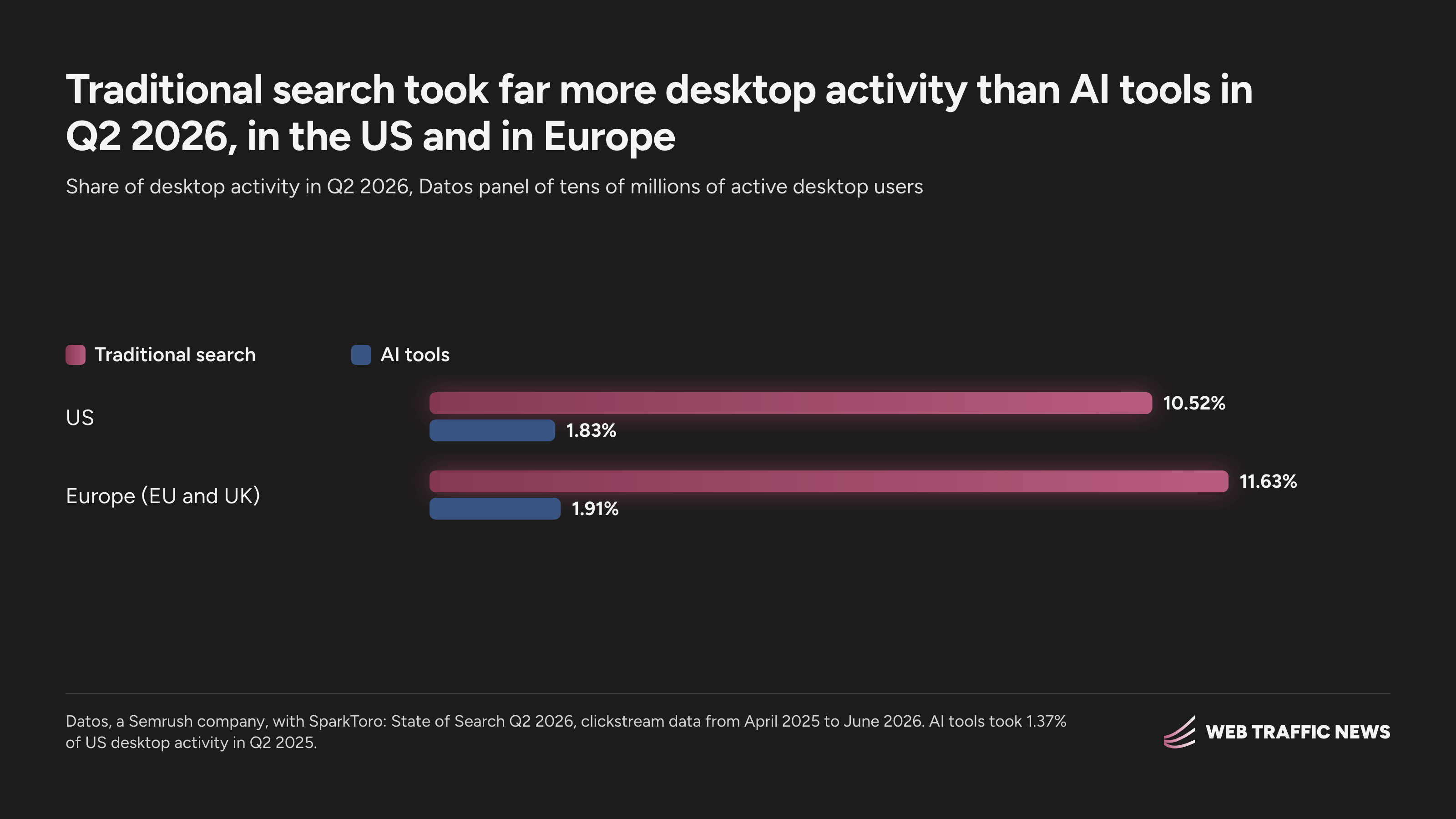
Traditional search took 10.52% of US desktop activity and 11.63% in Europe, where AI tools reached 1.91%. Indig read the US chart as roughly 34% growth for AI tools in a year, with traditional search almost 6x larger.
Why it happened
AI referrals stay small because an AI answer recommends a brand without sending the click, and the buyer visits later through another channel. Similarweb published a study on 14 October 2026 of US desktop users who saw ChatGPT recommend a brand between July and December 2025, counting only users who had not named the brand in their prompt or visited its site in the previous four weeks.
Within seven days the recommended brand won the visit in all six brand pairs Similarweb tested. After ChatGPT recommended Capital One, 14.2% of those users visited Capital One within the week and 3.8% visited American Express. In the Similarweb study, 55.9% of the follow-up visits arrived through search, against 40.4% of other visits, so analytics credit them to search or direct.
What it changes for GEO
The Growth Memo’s 0.5% figure for AI referrals counts the clicks that follow an AI answer, so it measures the smallest part of what AI search does for a brand. Buyers describe a need to an AI assistant and get a recommended solution, and that recommendation is the most valuable moment in the purchase. Brands that AI answers recommend gain, since Similarweb’s panel found the recommended brand winning the follow-up visit in every pair it tested.
The competitor the answer left out loses that visit. Brands that read the 0.5% referral share as a reason to wait lose buyers their referral report never shows, and most brands are missing from AI answers today. Agenzy’s 2026 study of 187,810 AI answers found the median European SMB brand appears in just 5% of AI answers about its own product category (n=90 tracked market projects, 2026-04 to 2026-08).
Analytics undercount AI because buyers who met a brand in an answer arrive later through Google or direct. Branded search lift shows the effect across a large panel and is hard to isolate for one company. On 19 October 2026, Kevin Indig reported 632 tests on four brands that compared weekly AI visibility with branded search and Direct traffic up to six weeks later, and he could not establish a reliable link.
The reliable measures for a CMO are the recommendation itself and the customer’s own answer. AI visibility tracking should read the brand’s recommendation rate engine by engine, on buying questions that bring revenue, since a broad or flattering prompt set inflates it. With AI tools at 1.83% of US desktop activity in Q2 2026, brands that optimize for AI search first tend to keep the recommendation, because models keep recommending the brand they learned is the answer.
What to do
The head of marketing should add two measures this quarter and report AI search on them, with the AI referral line kept as a minor signal. First, the marketing team lists the buying questions that bring revenue and tracks how often AI answers mention the brand for each, in ChatGPT, Gemini and Google AI Overviews separately, week by week.
Second, sales adds “How did you hear about us?” to every form and first call, with AI assistants as an answer option. Branded search and direct traffic go on the same report, though Kevin Indig could not link them reliably to AI visibility in 632 tests on four brands. The check runs quarterly: the brand’s recommendation rate and the share of new customers who name an AI assistant should move together.
Sources
- growth-memo.com/p/organic-traffic-is-down-but-its-not
- substack.com/@kevinindig/…/c-370777743
- datos.live/wp-content/…/Preview-State-of-Search-Q2-2026.pdf
- substack.com/@kevinindig/…/c-372342261
- aisearch.similarweb.com/blog/after-ai-recommends-your-brand
- growth-memo.com/p/does-ai-drive-more-direct-traffic
- agenzy.lt/blog/ai-search-visibility-study-2026
The week in AI search, in one email
One email a week with what changed in ChatGPT, Google AI Mode, Perplexity and Gemini, and the week's data piece.
Up next
37
%
fall in GA4 sessions from ChatGPT across a few hundred websites from 9 October 2026, as ChatGPT's links lost their tracking tag.
OpenAI's GPT-6 rollout hides a week of ChatGPT referral traffic
Brief
0.9
%
estimated click-through rate of one site's Google AI Overviews and AI Mode impressions, measured by opting the site out of Google's AI features.
Opt-out test puts Google AI Overviews and AI Mode CTR at about 0.9%
Brief
1,900
characters
of a typical 14,600-character page reach the model that writes Claude's answer, Peec AI measured through the Claude API.
Peec AI finds Claude search uses Brave and reads an eighth of a page
Brief