BriefChatGPT
OpenAI's GPT-6 rollout hides a week of ChatGPT referral traffic
ChatGPT referral traffic was counted as Direct from 8 to 16 October 2026, so GA4 reports for those days undercount ChatGPT and need a note.
 By Emilis Zabilius · · 4 min read
TL;DR
- OpenAI began rolling out GPT-6 in ChatGPT on 7 October 2026, and many ChatGPT links lost their utm_source tag from 8 to 16 October.
- Brands reading GA4’s ChatGPT line lost a week of credit to Direct, while ChatGPT put a direct website link in 42% of its answers.
- Heads of marketing should have the analytics owner annotate 8 to 16 October in GA4 and read ChatGPT and Direct sessions together for that week.
What changed
ChatGPT referral traffic was counted as Direct from 8 to 16 October 2026, because many ChatGPT links lost their tracking tag, Profound’s timeline of the missing UTM tags shows. A UTM tag is a label at the end of a link, here utm_source=chatgpt.com, that tells analytics where a visitor came from, so a visit with no tag or referrer lands in Direct.
Profound, an AI search analytics company, tracked how many ChatGPT answers with cited links carried a tagged link. The share was about 99% before the decline, 97% at 18:30 UTC on 8 October, about 75% across 9 October and 67% on 14 October before 19:00 UTC, then 5% at 19:30 UTC and 5 to 12% for roughly 27 hours:
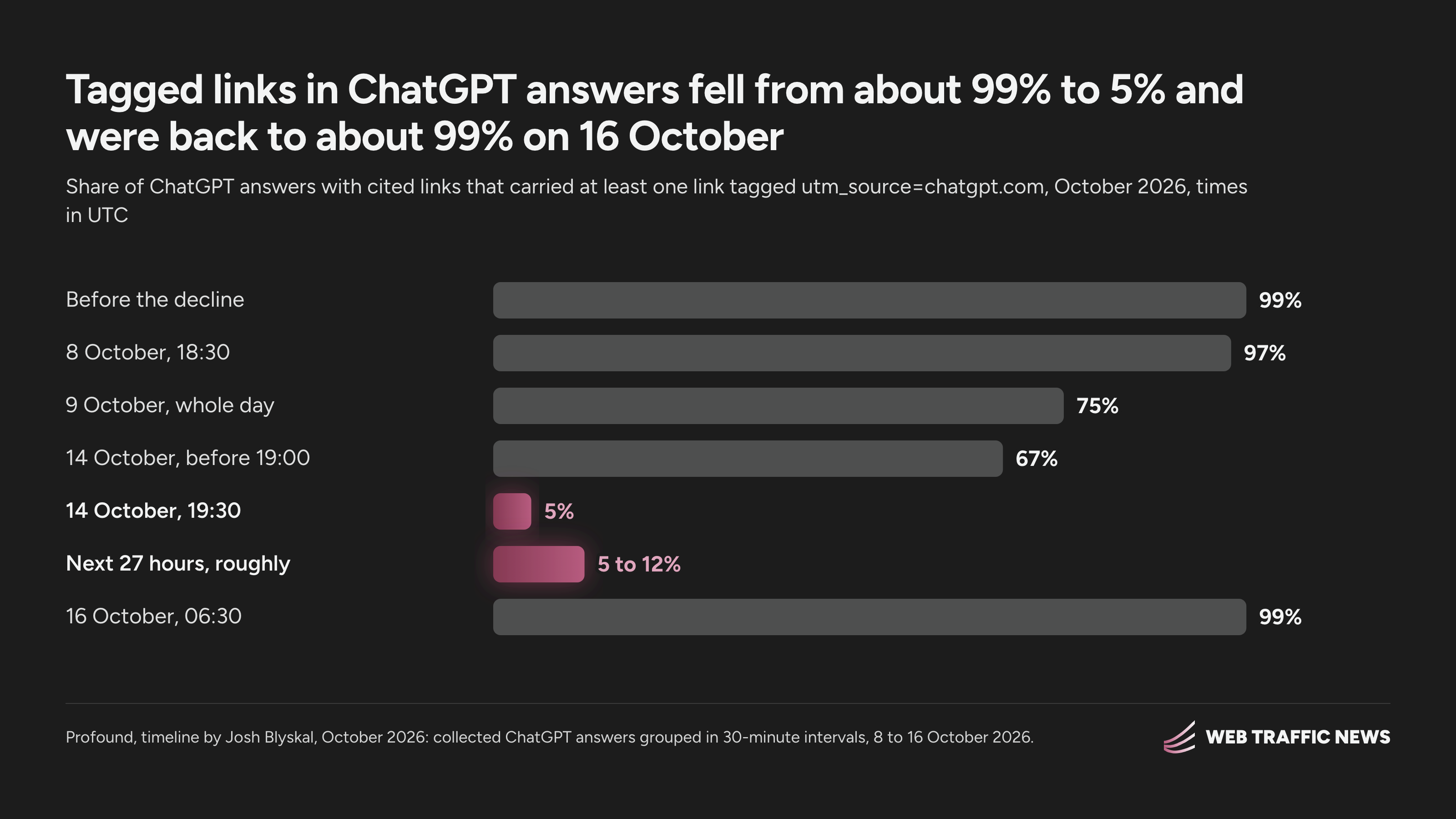
Profound measured the tag share back at about 99% at 06:30 UTC on 16 October.
Peec AI, an AI search tracking company, found GA4 sessions from ChatGPT fell 37% from 9 October across a few hundred websites, and Direct traffic rose on 87% of those sites. Cedric Huesler, who leads a product management team at Adobe, wrote that “ChatGPT visits we could attribute drop to about a third of normal within hours.”
Tomek Rudzki of Peec AI ran the same 1 million prompts from 2 to 7 October and from 9 to 13 October, counting ChatGPT answers with a direct website link:
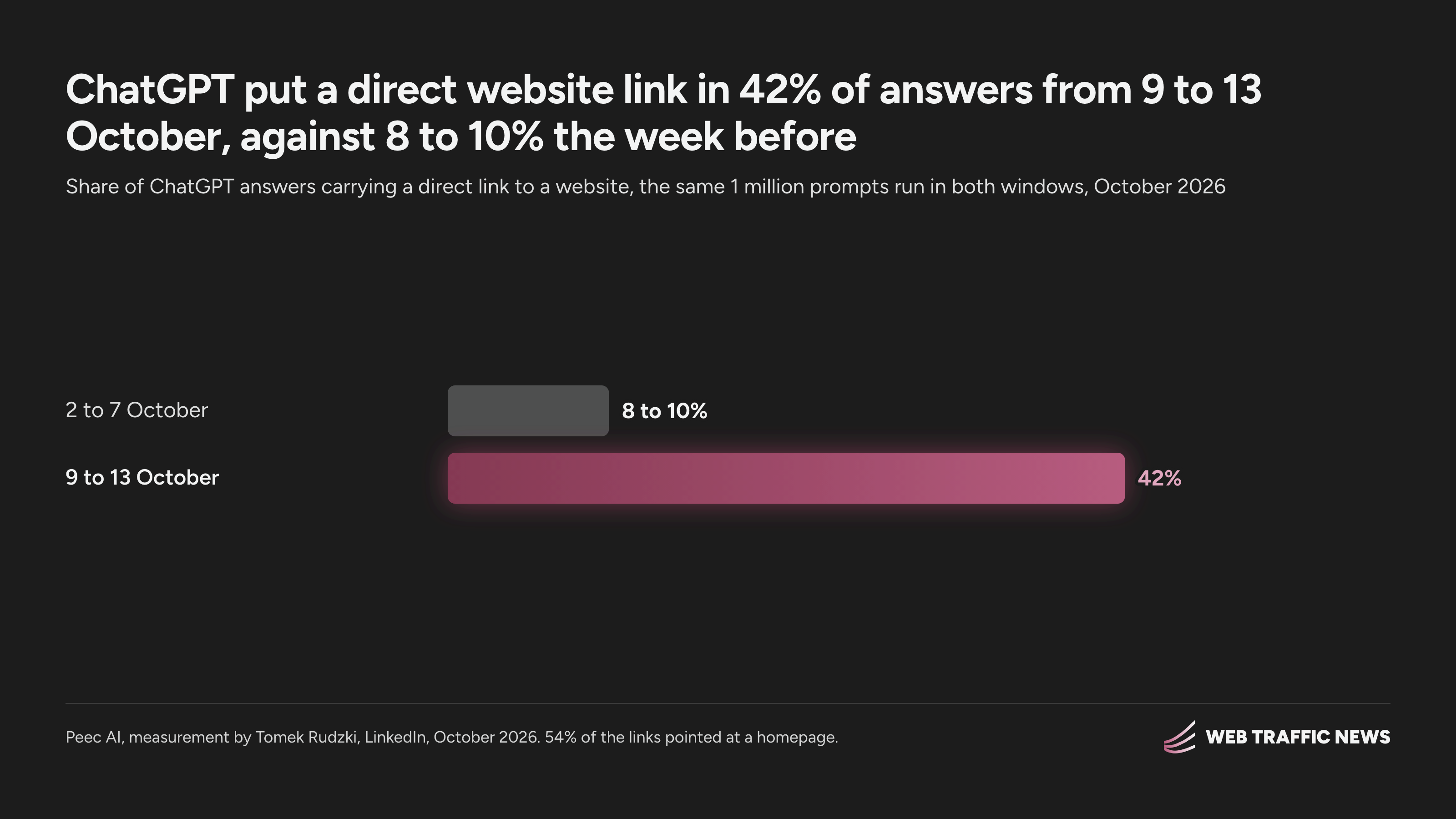
Direct website links appeared in 42% of ChatGPT answers in Peec AI’s count, up from 8 to 10%. 54% of those links pointed at a homepage, and none carried a utm_source tag or referrer.
Why it happened
OpenAI announced on 7 October 2026 that GPT-6 was rolling out to ChatGPT users worldwide together with Intelligent UI, an answer format with visuals and interactive elements. Peec AI’s tracking of the model ChatGPT names in each response shows GPT-5.6 as the default until 8 October, GPT-6 behind 85% of responses on 9 October and 99.99% from 10 October.
Cedric Huesler of Adobe dates the lost tag to about 2pm Pacific time on 8 October, when GPT-6 stopped adding it. He wrote that OpenAI confirmed a known bug on 14 October and began rolling out a fix at about 2am Pacific time on 15 October.
Josh Blyskal, a member of technical staff at Profound, tied the missing tags to Intelligent UI instead, which grew from 2% to 35% of the answers Profound collected between 8 and 14 October, and wrote that the change was separate from the model version.
What it changes for GEO
The October week shows how fragile GA4’s ChatGPT line is as a measure of AI search. Buyers who meet a brand in an AI answer often arrive later through Google or by typing the address, so the GA4 ChatGPT line undercounts AI search even in a normal week. In October, one change in ChatGPT’s links moved 37% of ChatGPT sessions in Peec AI’s sample into Direct.
Brands that judge their AI search work by the GA4 ChatGPT line lose twice: a drop that was a tagging fault, and an October report that reads worse than the month was. Brands that ask every customer how they found the company, and measure how often AI answers mention them engine by engine, kept an honest record, since neither depends on a tag.
One week of data is no verdict on a GEO program. A program needs about three months for a first verdict and six for the full picture, and early numbers swing on small samples. A founder who cuts AI search work over October’s GA4 line cuts it over a fault in ChatGPT’s links.
The 42% figure moves the click. People ask ChatGPT how to get a job done and get one recommended business, and in the week Peec AI measured, 42% of ChatGPT answers linked straight to a website. Brands that get cited in ChatGPT answers gain a path from the recommendation straight to their site, and brands missing from the answer gain nothing.
Homepages took 54% of ChatGPT’s direct links in Peec AI’s measurement, and a brand’s own site is the one source it controls. AI answers pick pages whose title and opening carry what the buyer’s question asks, so the brands that gain most rewrite the homepage’s title and opening around the questions their buyers ask.
What to do
The head of marketing should have the analytics owner add a GA4 annotation covering 8 to 16 October 2026 this week, converting Profound’s UTC times to the time zone the reports use. For those dates, the analytics owner reads ChatGPT and Direct sessions together on the pages ChatGPT used to send visitors to and on the homepage, and reports the two as one figure.
Next, the team adds a “how did you hear about us” question to the contact or checkout form, so the record of buyers who found the brand through AI does not depend on tags. Teams that use the ChatGPT referral tag as the first step of AI visibility tracking that shows whether ChatGPT cited a site check the result by comparing chatgpt.com sessions from 16 October onward with the week before 8 October.
Sources
- tryprofound.com/blog/chatgpt-missing-utm-tags
- linkedin.com/posts/tomekrudzki_edit-chatgpt-fixed-this-issue-th…
- linkedin.com/posts/cedrichuesler_relieved-it-was-a-bug-chatgpt-…
- linkedin.com/posts/tomekrudzki_many-people-noticed-chatgpt-cita…
- openai.com/index/gpt-6-for-everyone
- linkedin.com/posts/tomekrudzki_data-tracked-by-peec-ai-confirms…
- linkedin.com/posts/joshua-blyskal_if-youre-wondering-whats-up-w…
The week in AI search, in one email
One email a week with what changed in ChatGPT, Google AI Mode, Perplexity and Gemini, and the week's data piece.
Up next
0.5
%
of all visits came from AI referrals across 10,000 domains each in the US and France, in Similarweb data analyzed by the Growth Memo.
Growth Memo data puts AI referral traffic at 0.5% of total visits
Brief
0.9
%
estimated click-through rate of one site's Google AI Overviews and AI Mode impressions, measured by opting the site out of Google's AI features.
Opt-out test puts Google AI Overviews and AI Mode CTR at about 0.9%
Brief
72,000
requests
from ChatGPT-User in 30 days to a site of 50,000 invented statistics, months after Google deindexed its pages.
Peec AI researcher finds ChatGPT kept citing a fake statistics site
Brief