How often LLM citations include a brand's own website
Most brands' websites appear among LLM citations, around tenth on the list; in 34.8% of 138 business projects the site missed its category's top 30 sources.
 By Emilis Zabilius · · 6 min read
LLM citations usually include a brand’s own website, at around tenth place on the list of sources cited for its category. 34.8% of the businesses in Agenzy’s 2026 source study did not have their own website among the 30 sources AI engines cited most for their own category (n=138 business projects). The study counted the sources behind 394,180 AI answers collected between 1 January 2025 and 7 September 2026.
TL;DR
- A 2026 study found brands’ own websites missing from the 30 sources AI engines cited most for their category in 34.8% of 138 business projects.
- No website held more than 2.1% of 2,283,923 AI citations in a 2026 study of 138 business projects, and 1,057 websites covered half of them.
- Marketing leads should list the pages AI engines cite for their category, get named on those pages, and open their own pages with direct answers.
Where a brand’s own website ranks
AI answers cite a brand’s own website in most categories, usually around tenth on the list of sources. Across every source the engines cited, the own website appeared in 90.6% of the 138 business projects in Agenzy’s 2026 source study, at a median rank of 10. That 90.6% is a share of projects, so it says nothing about what share of single answers cite the site.
The share by engine, with the median rank of the own website on each engine’s list:
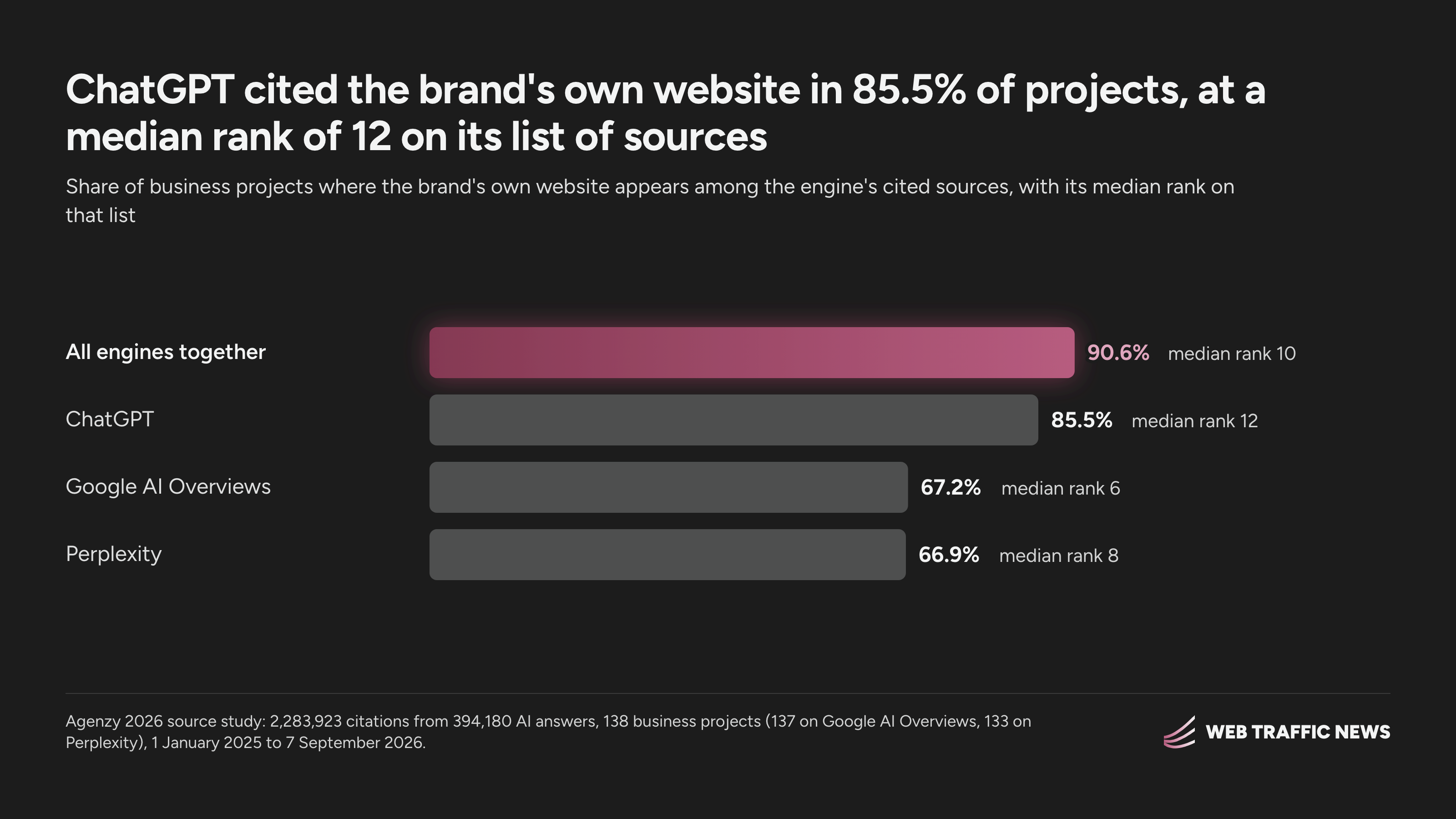
ChatGPT names the brand’s own website in the most projects and lowest on its list, at a median rank of 12, while Google AI Overviews names it in fewer projects and higher, at rank 6.
The answers came from ChatGPT, Google AI Overviews and Perplexity, plus Gemini in 16 projects. 104 of the 138 projects tracked Lithuanian businesses, so the figures describe that market first.
Yext, a listings software company, measured first-party sources in local searches, branded and unbranded. It counted 6.8 million citations from over 1.6 million answers on Gemini, OpenAI and Perplexity. Its research, published on 9 October 2025, put websites, the sources a brand fully controls, at 44% of those citations. Its questions took the searcher’s location into account, as in “best pourover coffee near me”, where Yext found the engines pulling from listings, review sites and local pages.
The long tail of cited websites
AI search citation share is spread across a long list of websites, so no single site dominates what the engines cite. No single website holds more than 2.1% of the 2,283,923 AI citations in Agenzy’s 2026 source study, and it takes 1,057 different websites to cover half of everything the AI engines cited (n=138 business projects).
Inside one business’s category the list is much shorter. In the same study, a median of 23 websites covered half of a single project’s citations. Each project tracked questions about one category in one market, so each had its own list, and that list is the one a marketing team can work through.
Reddit in ChatGPT citations
ChatGPT gives Reddit a larger share of its citations than Google AI Overviews or Perplexity does. Reddit is the single most cited domain in Agenzy’s 2026 AI source study, taking 2.1% of 2,283,923 citations and appearing in 92.8% of 138 business projects, with ChatGPT citing it 5.0x more heavily than Perplexity.
Per engine, Reddit took 3.0% of ChatGPT’s citations in that study, 1.7% of Google AI Overviews’ and 0.6% of Perplexity’s. For a brand, the threads worth joining are the ones ChatGPT already cites for its category, with a reply under the brand’s own name that a buyer can use.
Reddit’s share of each engine’s citations:
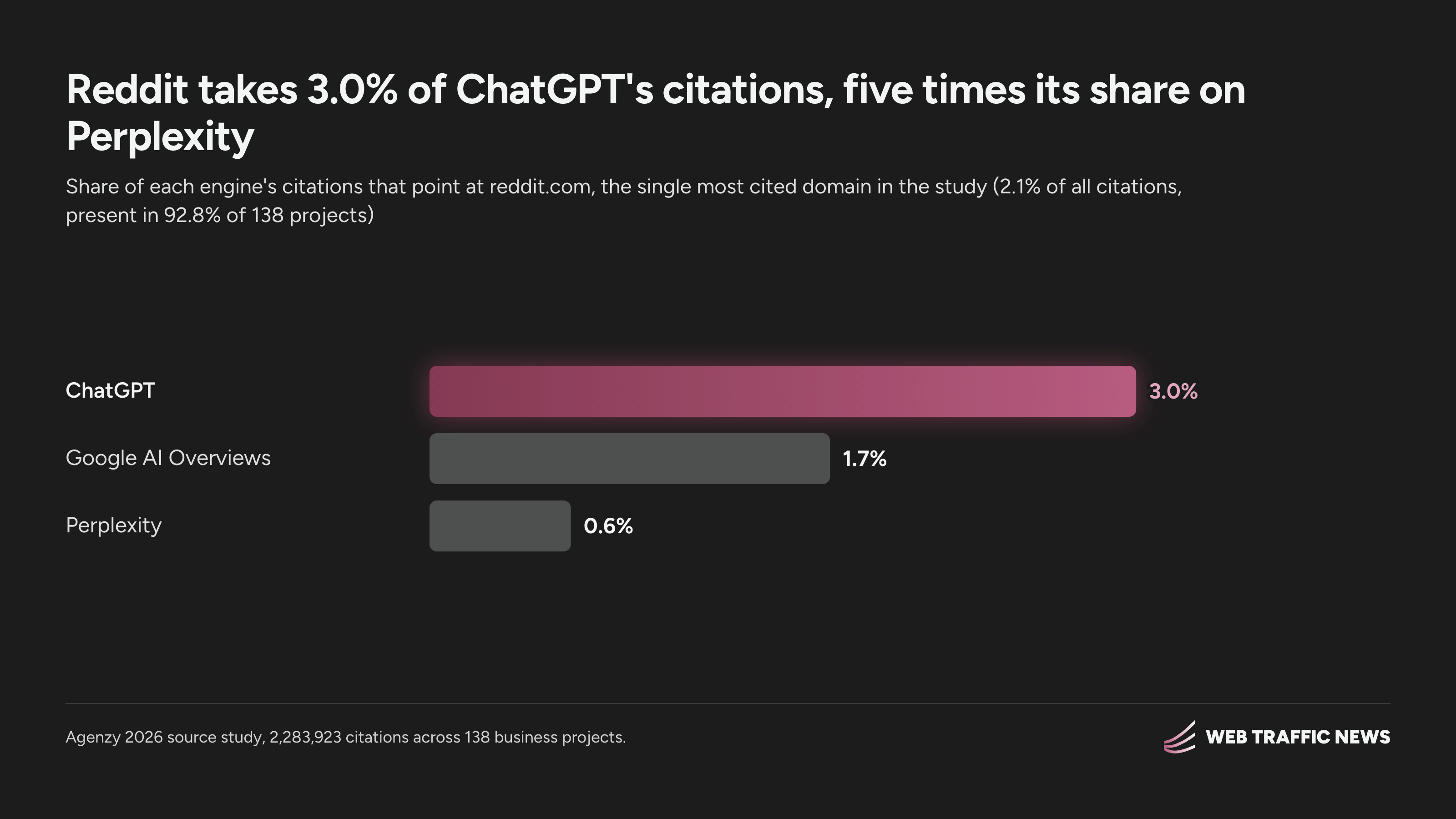
ChatGPT sends 3.0% of its citations to Reddit, Google AI Overviews 1.7% and Perplexity 0.6%.
YouTube in Google AI Overviews
Google AI Overviews cites YouTube far more than ChatGPT does, and a brand’s YouTube channel counts as a brand-owned source outside its website. YouTube earns 4.7% of Google AI Overviews citations and 0.03% of ChatGPT citations in Agenzy’s 2026 source study of 2,283,923 AI citations (n=137 and 138 business projects).
The gap between the two engines on YouTube:
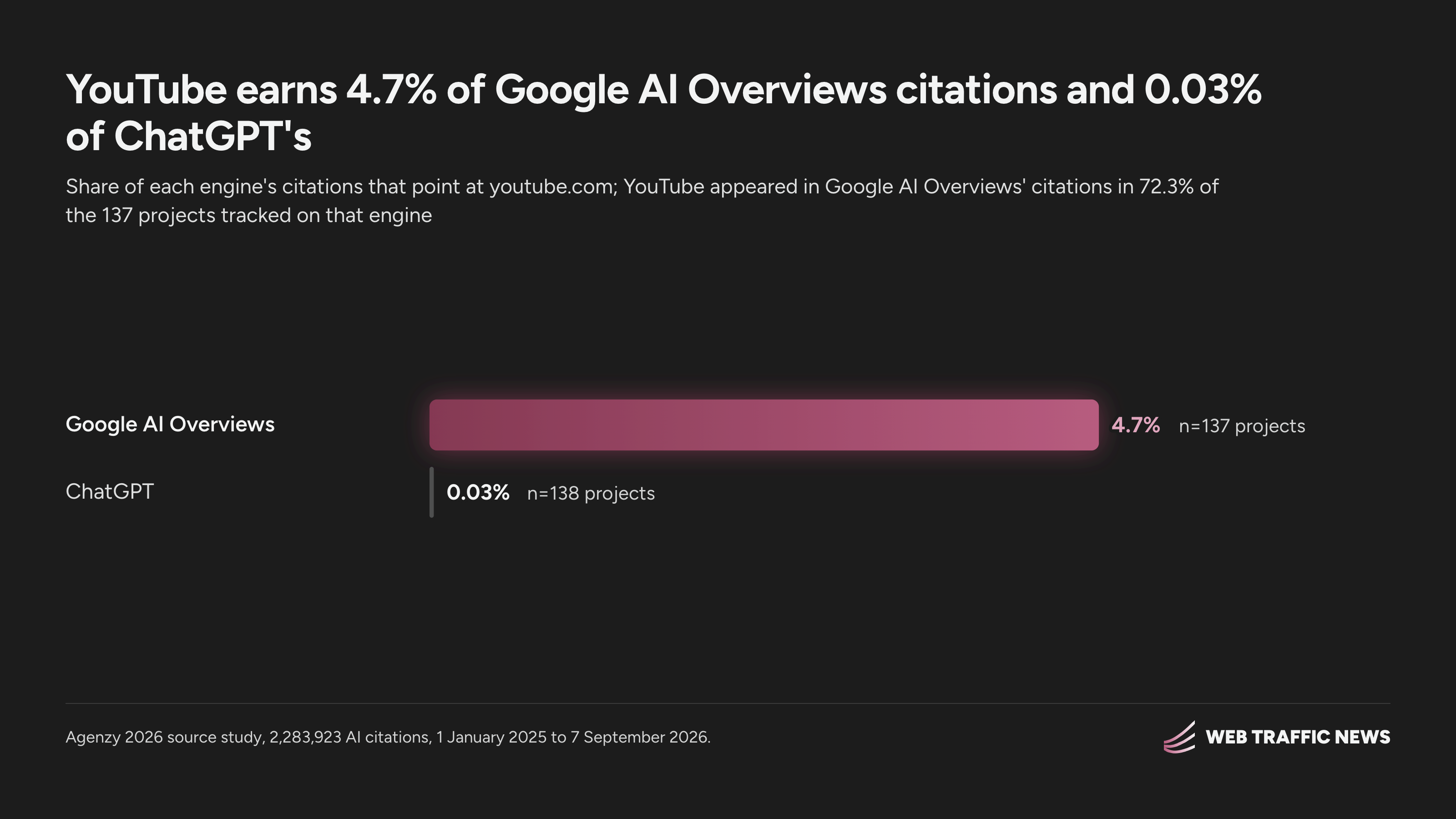
YouTube takes 4.7% of Google AI Overviews citations and 0.03% of ChatGPT’s, so the same video reaches one engine and barely the other.
In the same study, YouTube appeared among Google AI Overviews’ citations in 72.3% of the 137 projects tracked on that engine. A short video that answers one buyer question puts a page the brand controls on a site Google AI Overviews cites in most categories. On ChatGPT, the same video adds little.
Source types by AI engine
Perplexity citations lean toward news and media, while Google AI Overviews leans toward user-generated content, the forum threads, reviews and posts that users write themselves. Google AI Overviews takes 10.8% of its citations from user-generated content against Perplexity’s 3.8%, while Perplexity takes 13.6% from news and media against AI Overviews’ 5.2%, Agenzy’s 2026 study of 2,283,923 AI citations found (n=137 and 133 business projects).
The two source types where the engines differ most:
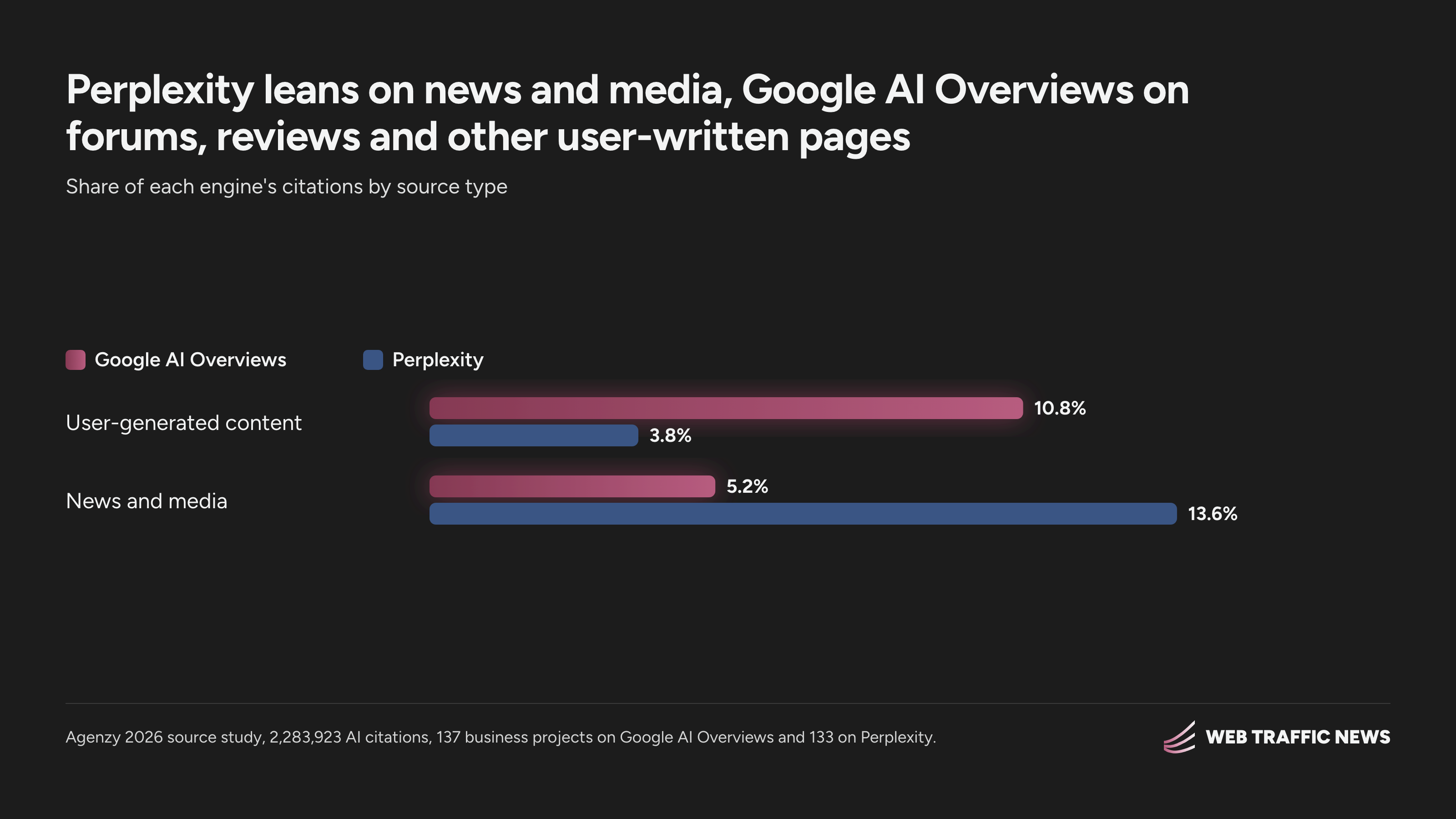
Google AI Overviews takes 10.8% of its citations from user-generated content against Perplexity’s 3.8%, and Perplexity takes 13.6% from news and media against 5.2%.
ChatGPT leans on institutional sites instead (government, health and EU bodies), taking 11.9% of its citations from them in the same study. So the third-party pages worth a brand’s time depend on the engine: news and media coverage for Perplexity, and forums and reviews for Google AI Overviews.
What it means
Marketing leads should work on the pages AI engines already cite for their category and on their own website, in this order.
- Put the three questions your buyers ask most to ChatGPT, Google AI Overviews and Perplexity, without your brand name, and list every domain the answers cite.
- Note whether your own website appears on each list and how far down it sits.
- Get onto the sources that recur: answer the Reddit threads ChatGPT cites, publish YouTube videos for Google AI Overviews, and pitch news and media sites for Perplexity.
- Open every page of yours that targets a buyer question with a one-sentence answer. Retrieval alone does not earn a citation: AirOps found that ChatGPT left 85% of the 548,534 pages it retrieved uncited, in a study published on 12 March 2026.
- Ask the same questions each month and check whether your site moves up the lists.
FAQ
Does the own-site share differ by AI engine?
Yes. In Agenzy’s 2026 source study, ChatGPT cited the brand’s own website in 85.5% of 138 projects, at a median rank of 12. Google AI Overviews cited it in 67.2% of 137 projects at rank 6, and Perplexity in 66.9% of 133 at rank 8. ChatGPT, Google AI Overviews and Perplexity share only 2 of their top 10 cited sources when answering the same questions about the same brand, according to Agenzy’s 2026 source study (n=109 business projects).
Does the own-site share change over time?
Source shares can shift within weeks. Agenzy’s 2026 source study shows no trend for the own site, because it pools everything each project ran between 1 January 2025 and 7 September 2026. Semrush tracked 230,000 prompts for 13 weeks in 2025. Luke Harsel, who leads content for Semrush’s product-led growth team, wrote that “ChatGPT cited Reddit in close to 60% of prompt responses in early August before collapsing to around 10% by mid-September.”
How can you check your own brand?
A manual check covers a few questions, and a tracking tool covers a fixed set every day. Agenzy’s 2026 source study used Peec AI, which runs the same buyer questions on each engine daily and records every source behind each answer. Peec AI’s documentation separates sources, the pages a model accessed while writing an answer, from citations, the sources the answer names. Your site can be read and still go uncited, so check both lists.
Sources
The week in AI search, in one email
One email a week with what changed in ChatGPT, Google AI Mode, Perplexity and Gemini, and the week's data piece.
Up next
9
days
from a new page going live to its first ChatGPT citation, the median across the 83 of 236 new pages ChatGPT cited.
How long GEO takes to show up in ChatGPT answers
Data
AEO vs GEO is mostly a naming question, since both terms, like AI SEO and LLMO, mean work that gets a brand named and cited in AI answers.
AEO vs GEO and the other names for optimizing for AI answers
Explainer
Ahrefs measured AI citation stability for 20 days and found half or more of citations gone the next day, so a single check misreads a brand's AI visibility.
Ahrefs study of AI citation stability finds half gone the next day
Brief