DataResearch
How much AI search visibility European brands have in 2026
AI search visibility for the median European brand is 5% of answers about its category, and 72% of 90 brands stay below 15% in their category.
 By Emilis Zabilius · · 8 min read
AI search visibility is low for most European brands, which appear in a small share of the AI answers about their own product category. Agenzy’s 2026 study of 187,810 AI answers found the median European SMB brand appears in just 5% of AI answers about its own product category (n=90 tracked market projects, 2026-04 to 2026-08). Of the 91 projects, 79 tracked the Lithuanian market, so the figures describe Lithuania first.
TL;DR
- The median European brand appeared in 5% of AI answers about its own category in a 2026 study across 90 tracked market projects.
- A brand’s best and worst AI engine differed by a median 5.1x in 2026 tracking, and 30% of 86 visible brands were invisible on at least one engine.
- Marketing leads should track each AI engine separately and publish comparison pages for buyer questions where AI names their brand but cites other sites.
How often AI answers name brands
The median brand in the 2026 visibility study was named in 5.0% of the AI answers about its category, and the brand at the 90th percentile reached 29.6%. Peec AI’s documentation, written for the tracking tool behind the study, calculates that visibility score as the responses mentioning a brand divided by all responses, times 100. The same metric is set out in how brands measure how often AI answers mention them.
The study put 4,903 tracked prompts, written as buyer questions, to ChatGPT, Google AI Overviews, Gemini and Perplexity every day and logged 187,810 answers for 85 businesses, tracked as 91 market projects. Most projects ran for one or two months between April and August 2026. Daily runs matter because the sources behind AI answers change from one day to the next, the subject of how stable AI citations are.
Own-brand visibility at each tenth of the 90 projects, with the 15% line marked:
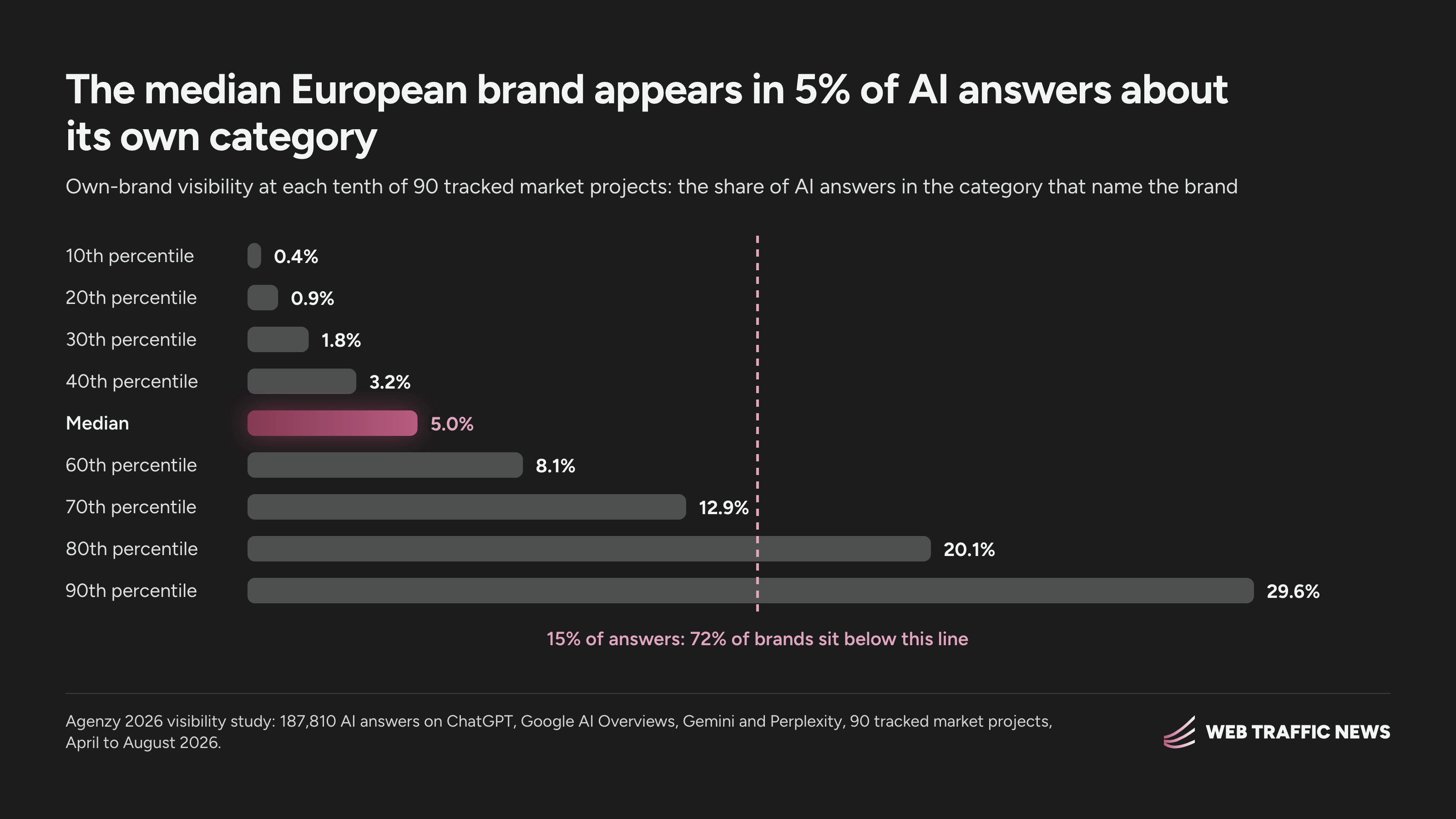
Every decile up to the 70th percentile, at 12.9%, sits under the 15% line, and the 80th percentile brand reaches 20.1%.
From the bottom up, the deciles run 0.4%, 0.9%, 1.8% and 3.2%, then 5.0% at the median and 8.1%, 12.9%, 20.1% and 29.6% above it. Of the 90 brands, 20 appeared in fewer than 1% of answers, and 4 were never named in their whole tracking window. A few strong brands lift the mean to 10.1%, about twice the median, so the median is the figure that describes the typical brand.
Brands with high AI visibility
High AI visibility was rare in the 2026 visibility study: 72% of the 90 brands appeared in fewer than 15% of AI answers in their category, and only 1 of 90 exceeded 40%, between April and August 2026. In counts, 65 brands sat below 15% and 24 between 15% and 40%. The one brand above 40% cleared the line by 0.1 points, so the study treats it as a single case.
Leading a category was rare as well. Only 18 of the 90 brands were the most visible brand in the set their project tracked, and the median brand ranked 6th. The study’s team picked each set and usually put the strongest local players in it, so that 6th place came against the strongest names in each market.
Once an engine names a brand, the brand usually sits near the top of the answer. Named brands had a median position of 3 in the answer’s list (n=83 brands), and 4.8% of them averaged worse than position 5. For most brands in the study, the step that fails is getting into the answer at all.
AI mentions and website citations
AI engines often name a brand while citing other websites as the source. In the 2026 visibility study, 39% of the brands that AI engines mentioned never had their own website among the top 30 sources those engines cited, 34 of 87 mentioned brands, between April and August 2026. The study logged mentions and citations as separate records for every answer.
A mention puts the brand’s name in the answer text. Peec AI’s guide to sources treats sources as the URLs a model reads while it writes, and citations as the sources the final answer refers to. An answer can therefore name a brand and draw every fact about it from other people’s pages, with the brand’s own site absent from the list.
In 38 of all 91 projects, the brand’s own domain was absent from the 30 most cited sources. Where the domain made the list, it ranked a median 6th, and 11 of the 91 projects had it as the single most cited source in their market. A larger sample of 138 projects is measured in how often LLM citations include a brand’s own website.
Where the citations went instead, by type of source, across 497,883 citations in the projects’ 30 most cited domains:
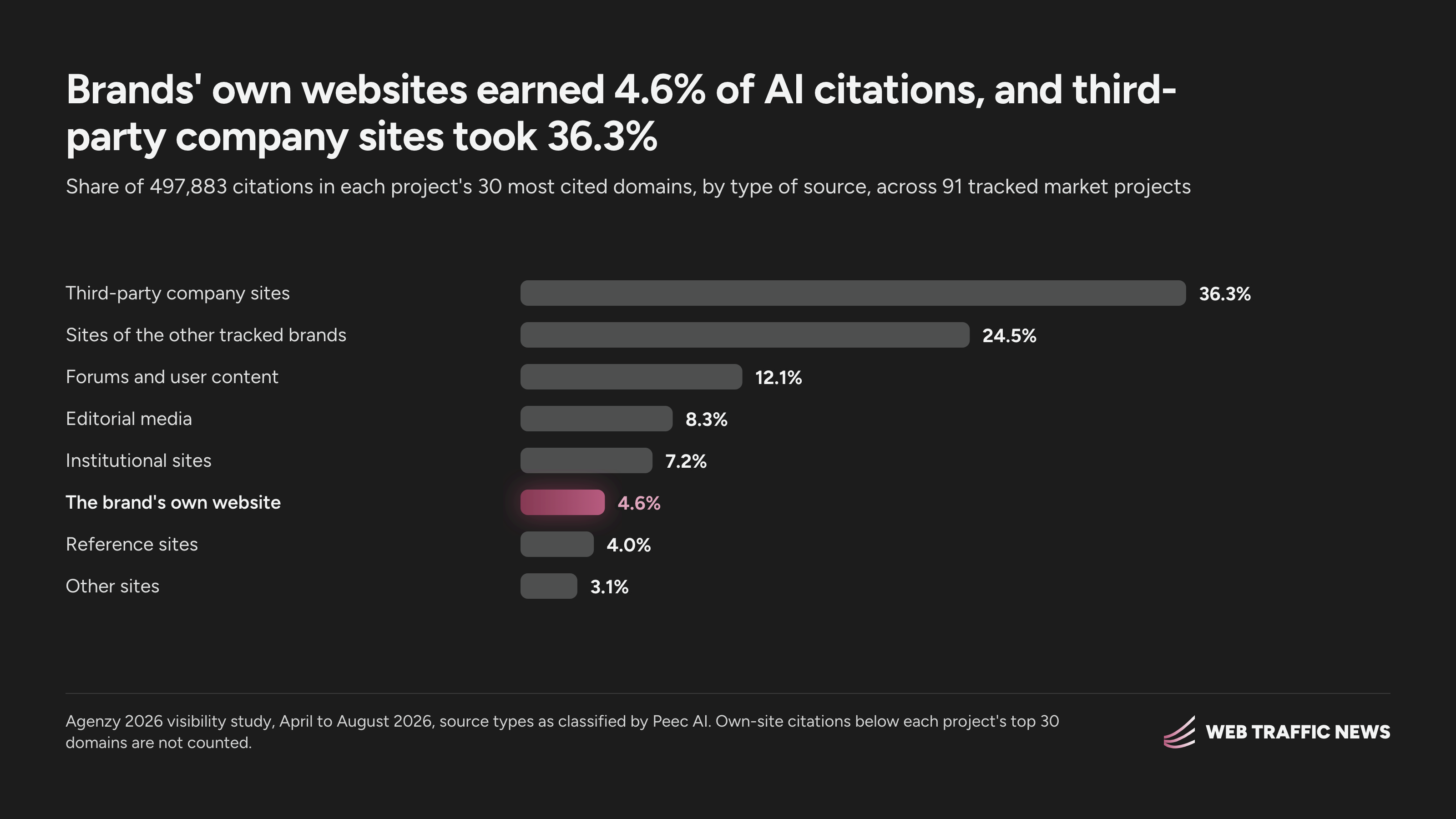
Third-party company sites took 36.3% of the citations and brands’ own websites 4.6%, sixth of the eight source types.
Sites of the other brands each project tracked took 24.5%, a share that moves whenever a project changes the brands it tracks. Forums and user content took 12.1%, editorial media 8.3%, institutional sites 7.2%, reference sites 4.0% and other sites 3.1%. The 4.6% counts only each project’s top 30 cited domains, so own-site citations further down the list go uncounted and the true share is slightly higher.
Visibility by AI engine
A brand’s AI visibility changes sharply from one engine to the next. In the 2026 visibility study, the median gap between a brand’s best and worst engine was 5.1x, and 30% of visible brands were completely invisible on at least one engine (n=86 brands visible somewhere, April to August 2026).
Of those 86 brands, 60 appeared on every engine their project tracked, and the 5.1x median comes from them, with 77% of the 60 showing a gap of 3x or more. The remaining 26 had at least one engine that never named them during the tracking window.
The median visibility on each engine, with the number of projects behind it:
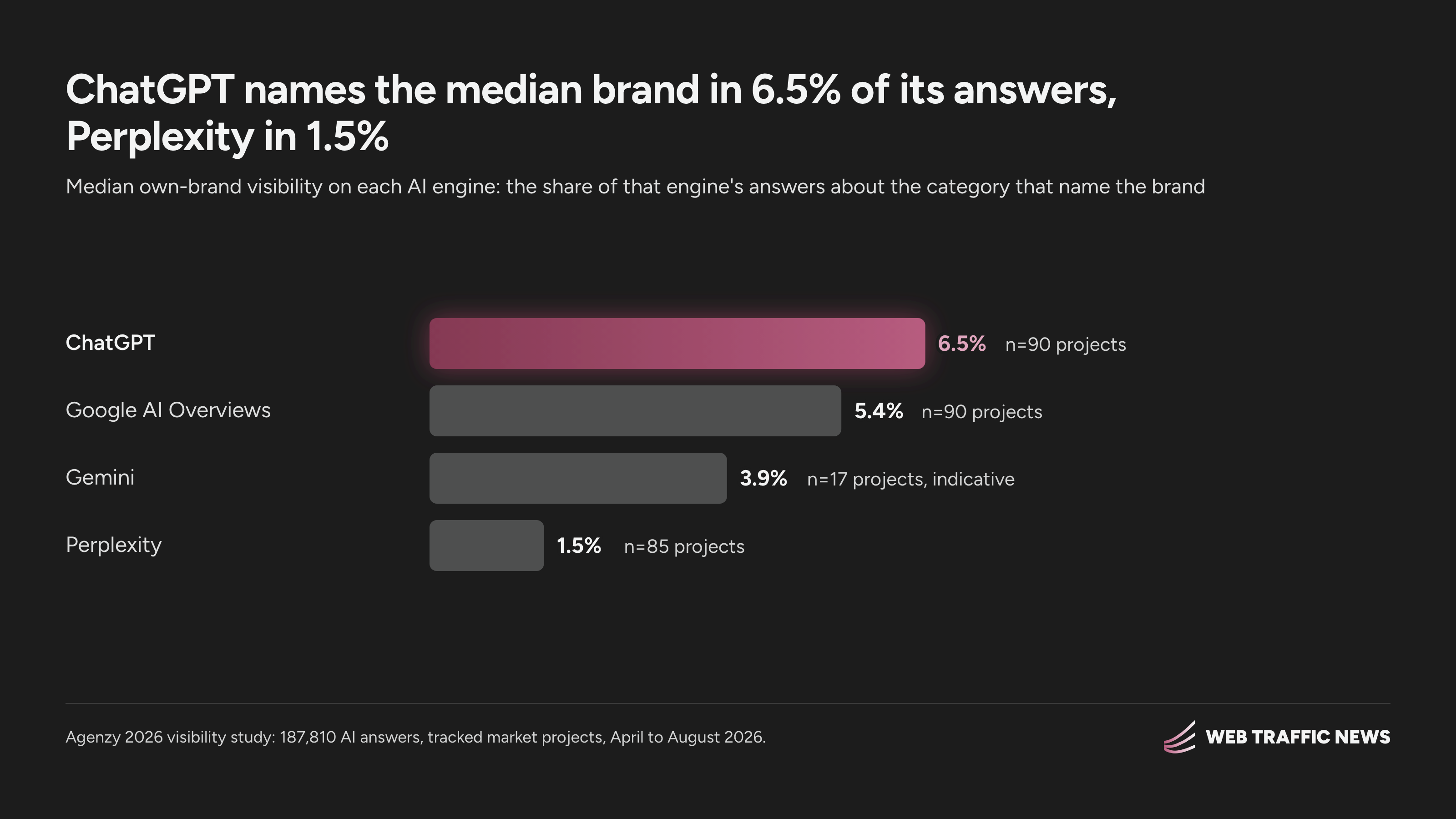
ChatGPT named the median brand in 6.5% of its answers and Google AI Overviews in 5.4% (n=90 projects each), against 1.5% on Perplexity (n=85). Gemini’s 3.9% rests on 17 projects, so it is indicative.
Each engine draws on its own pool of pages. Seer Interactive found, in a study of more than 500 citations published on 6 February 2025, that ChatGPT search citations matched a page in Bing’s top 20 results in more than 87% of cases when the same question ran as a Bing search, against 56% for Google. The mechanics are set out in where ChatGPT gets its information when it searches the web.
Google AI Overviews draws on Google Search instead. Google’s guide to AI features, last updated on 10 December 2025, says a page qualifies as a supporting link once it is indexed and can show in Google Search with a snippet, with no extra requirements for AI Overviews or AI Mode. How that selection works is covered in how Google AI Overviews choose the pages they show.
Page types AI engines cite
Comparison pages were cited more heavily than homepages in the 2026 visibility study. Across 2,730 top-cited URLs in 91 projects, comparison-style pages had a median citation rate of 1.70 against 1.06 for homepages, a 1.6x gap, yet homepages took 28.6% of all citations. A page’s citation rate is the average count of its citations within each answer that uses it, so the number can pass 1 and carries no percent sign.
Median citation rate by page type, with each type’s share of all citations:
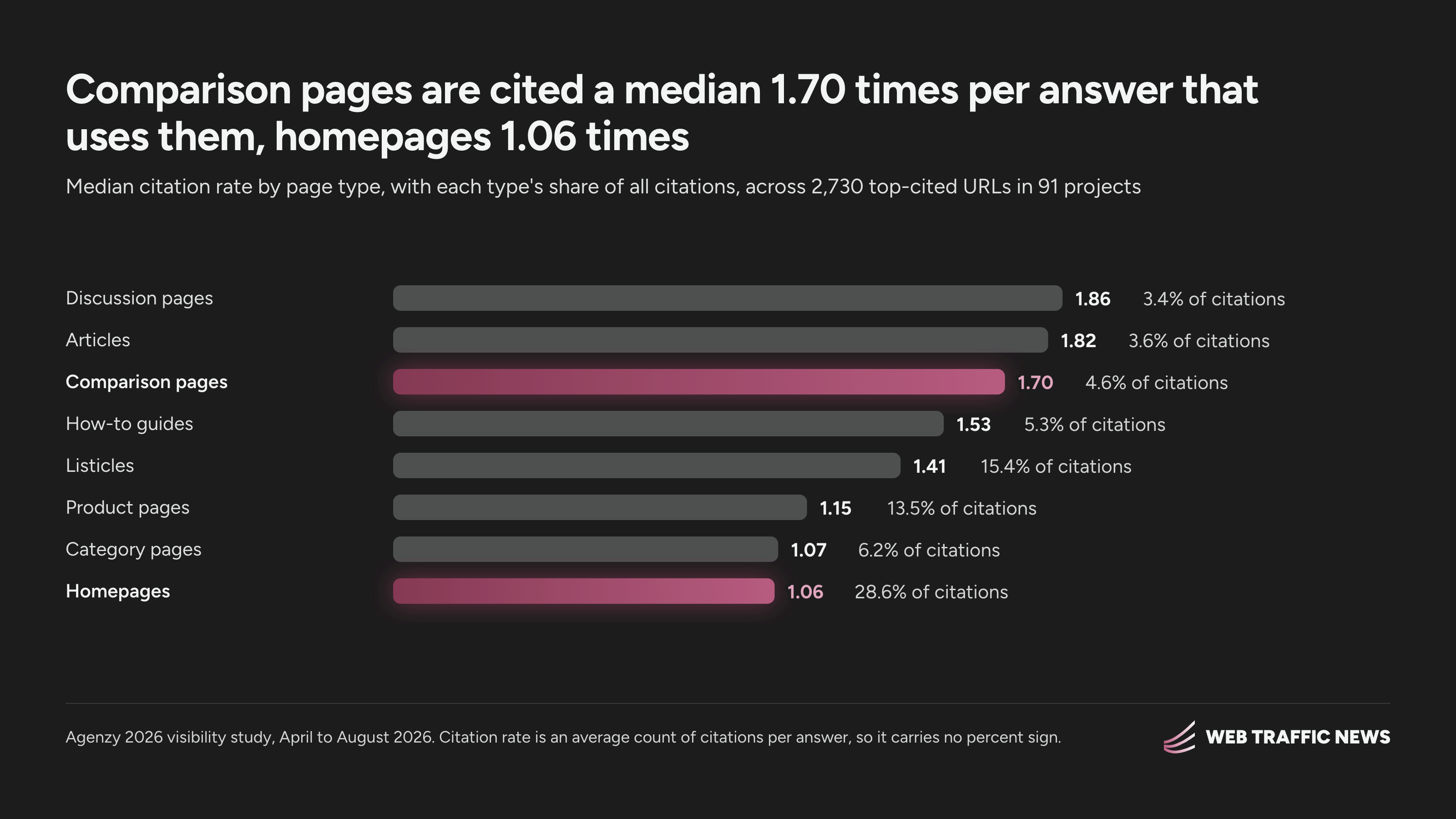
Homepages sit last on rate and first on volume, since nearly every business has a homepage and few publish comparisons.
By median citation rate, discussion pages led at 1.86 with 3.4% of citations, then articles at 1.82 with 3.6%, comparison pages at 1.70 with 4.6% and how-to guides at 1.53 with 5.3%. Listicles had 1.41 and 15.4% of citations, product pages 1.15 and 13.5%, category pages 1.07 and 6.2%, and homepages 1.06 and 28.6%.
Comparison pages are rare in other data too. AirOps reported on 5 June 2026, using Wix AI Search Lab data, that product alternative and comparison pages draw under 3% of citations. The 2026 visibility study puts them at 4.6% of citation volume, and its rate figure adds that engines cite such a page more heavily than a homepage whenever an answer uses one.
What it means
Marketing leads should judge AI visibility engine by engine and close the gap between being named and being cited, beginning with the buyer questions where the brand already appears. A new page needs time before the engines cite it, which how long GEO takes to show up in ChatGPT answers measures. The steps, in order:
- Put your buyers’ category questions, without your brand name, to ChatGPT, Google AI Overviews, Gemini and Perplexity, and record visibility for each engine separately.
- Set each result against the 2026 distribution: 5.0% for the median brand, 12.9% at the 70th percentile and 29.6% at the 90th.
- List the questions where an engine names your brand but leaves your own site out of the sources it cites, and publish a page that answers each one in its first sentence.
- Write some of those pages as comparisons that set your offer next to the alternatives on price and use, since comparison pages drew a median 1.70 citations per answer against 1.06 for homepages.
- Get your brand mentioned on the third-party company sites, forums and media each engine cites for your category.
- Run the same questions every month and count a change only when it holds for several weeks.
FAQ
Do brands score lower outside their home market?
Brands scored lower outside their home market in the 2026 visibility study, though the sample is small. Projects that tracked a business in a foreign market had a median visibility of 1.0% (n=12), against 5.9% for home-market projects (n=78). The expansion projects were few and mostly young, so the study keeps the split out of its findings and cannot separate the market from the age of the project.
Which websites do AI engines cite for these brands?
Reddit was among the most cited sources in 84% of the 91 projects in the 2026 visibility study, more than any other domain, counting each project’s 30 most cited sources. Facebook followed in 37% of projects and YouTube in 24%, while two business directories drew 137 of the 497,883 citations. Each engine’s own list is compared in which websites ChatGPT, Google AI Overviews and Perplexity cite most.
Why do AI engines name some brands more often?
Brands that other websites mention often tend to be named more often in Google AI Overviews. In Ahrefs’ study of 75,000 brands, published on 26 May 2025, Louise Linehan, Content Marketer at Ahrefs, wrote that “Web mentions (0.664) correlate much more strongly than backlinks (0.218)” with AI Overviews brand visibility. Brands in the top quarter for web mentions averaged 169 AI Overviews mentions, against 14 for the quarter below.
Sources
- agenzy.lt/blog/ai-search-visibility-study-2026
- docs.peec.ai/metrics/…/visibility
- docs.peec.ai/understanding-sources
- seerinteractive.com/insights/87-percent-of-searchgpt-citations-match-bing…
- developers.google.com/search/…/ai-features
- airops.com/blog/page-types-earn-ai-citations
- ahrefs.com/blog/ai-overview-brand-correlation
The week in AI search, in one email
One email a week with what changed in ChatGPT, Google AI Mode, Perplexity and Gemini, and the week's data piece.
Up next
2
of 10
most cited websites shared by ChatGPT, Google AI Overviews and Perplexity for the same brand, the median across 109 business projects.
Which websites ChatGPT, Google AI Overviews and Perplexity cite most
Data
0.5
%
of all visits came from AI referrals across 10,000 domains each in the US and France, in Similarweb data analyzed by the Growth Memo.
Growth Memo data puts AI referral traffic at 0.5% of total visits
Brief
1,900
characters
of a typical 14,600-character page reach the model that writes Claude's answer, Peec AI measured through the Claude API.
Peec AI finds Claude search uses Brave and reads an eighth of a page
Brief