BriefResearch
What changed in AI search, 25 to 30 October 2026
What changed in AI search this week puts the work on page openings, on prompts full of buyer context and on what Google's Knowledge Graph says about a brand.
 By Emilis Zabilius · · 3 min read
TL;DR
- TJ Robertson’s study of 193,507 AI answers found cited pages opened with a direct answer 20% of the time, against 5% for passed-over pages.
- iPullRank’s comparison of 16,310 users from November 2024 found 96% of AI prompts had no matching Google search within 30 minutes.
- Brands should check what Google’s Knowledge Graph says about them, since DEJAN found Google AI Mode receives those facts as search results with no URL.
Which pages AI answers cite
TJ Robertson, founder of the GEO agency TJ Digital, published a study of 193,507 AI answers on 25 October 2026. The answers covered 4,167 buyer questions in ChatGPT, Google AI Mode and Google AI Overviews from 27 August to 21 October 2026. In 195 blind-rated pairs, the cited page opened with a direct answer 20% of the time, against 5% for a Google top-10 page that never came up in the AI’s searches. Robertson reports these as associations without proof of cause. Brands should open every page built for a buyer’s question with the answer, because AI engines pick pages whose opening carries what the question asks, which is part of getting pages cited in Google AI Overviews.
Robertson’s two rounds of blind ratings compared cited and passed-over pages:
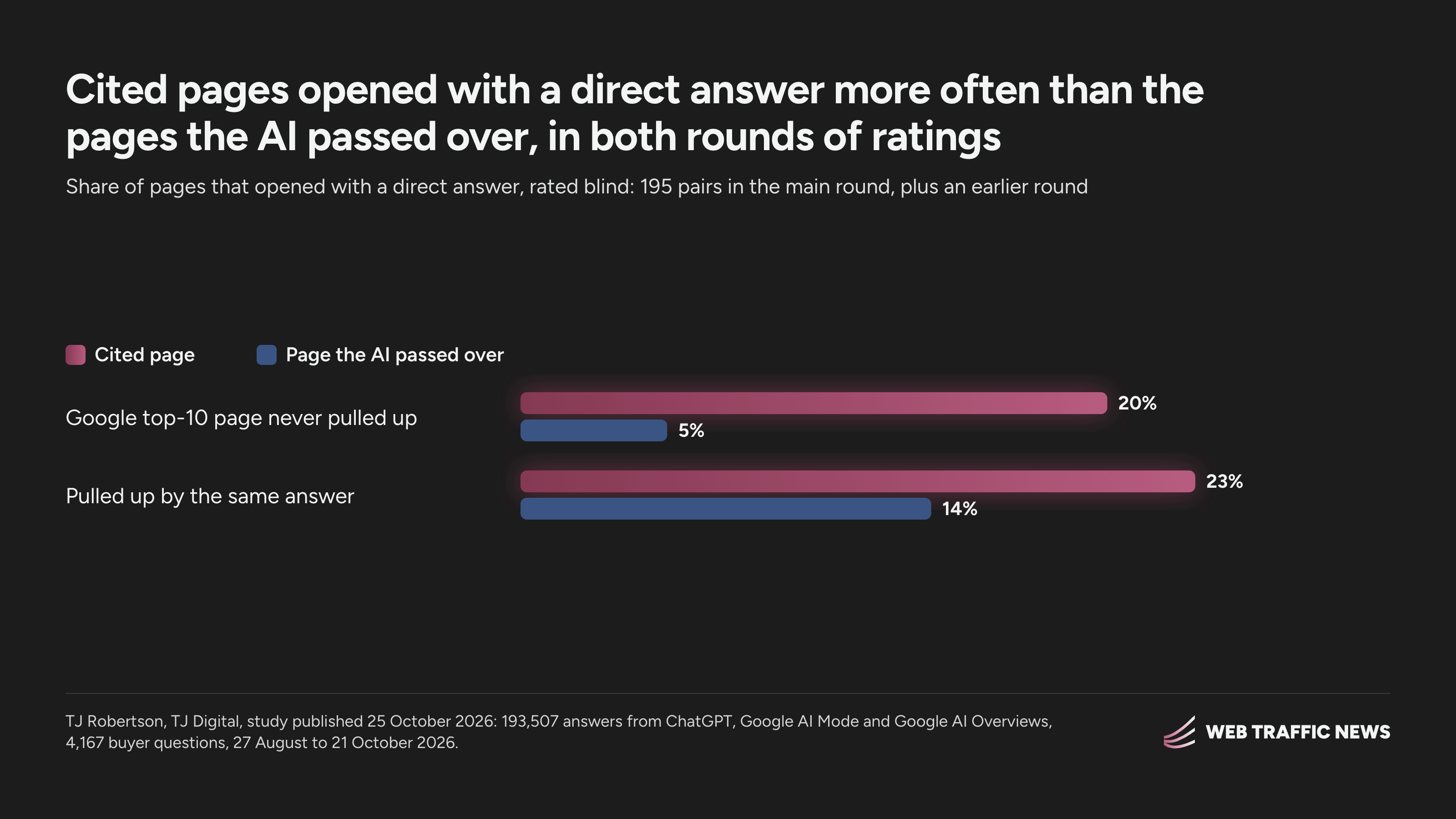
In an earlier round, among pages the same answer pulled up, cited pages opened with a direct answer 23% of the time and uncited pages 14%.
How people prompt AI versus Google
Cate Dombrowski, a researcher at iPullRank, published on 29 October 2026 a comparison of the same 16,310 users on Google and AI search, matched across two Datos panels. The panels cover US desktop users in November 2024, and the AI panel recorded prompts typed into Perplexity, Copilot and you.com. The same users averaged 8.4 words in AI search and 4.2 on Google, and Alphabet has published its own figure on longer AI Mode queries. For 96% of AI prompts, the same user didn’t search that topic on Google within 30 minutes. Buyers bring an AI assistant their whole situation and get one recommended solution back, so a brand needs pages that answer those situations in the buyer’s words.
The same users asked different kinds of queries on each surface:
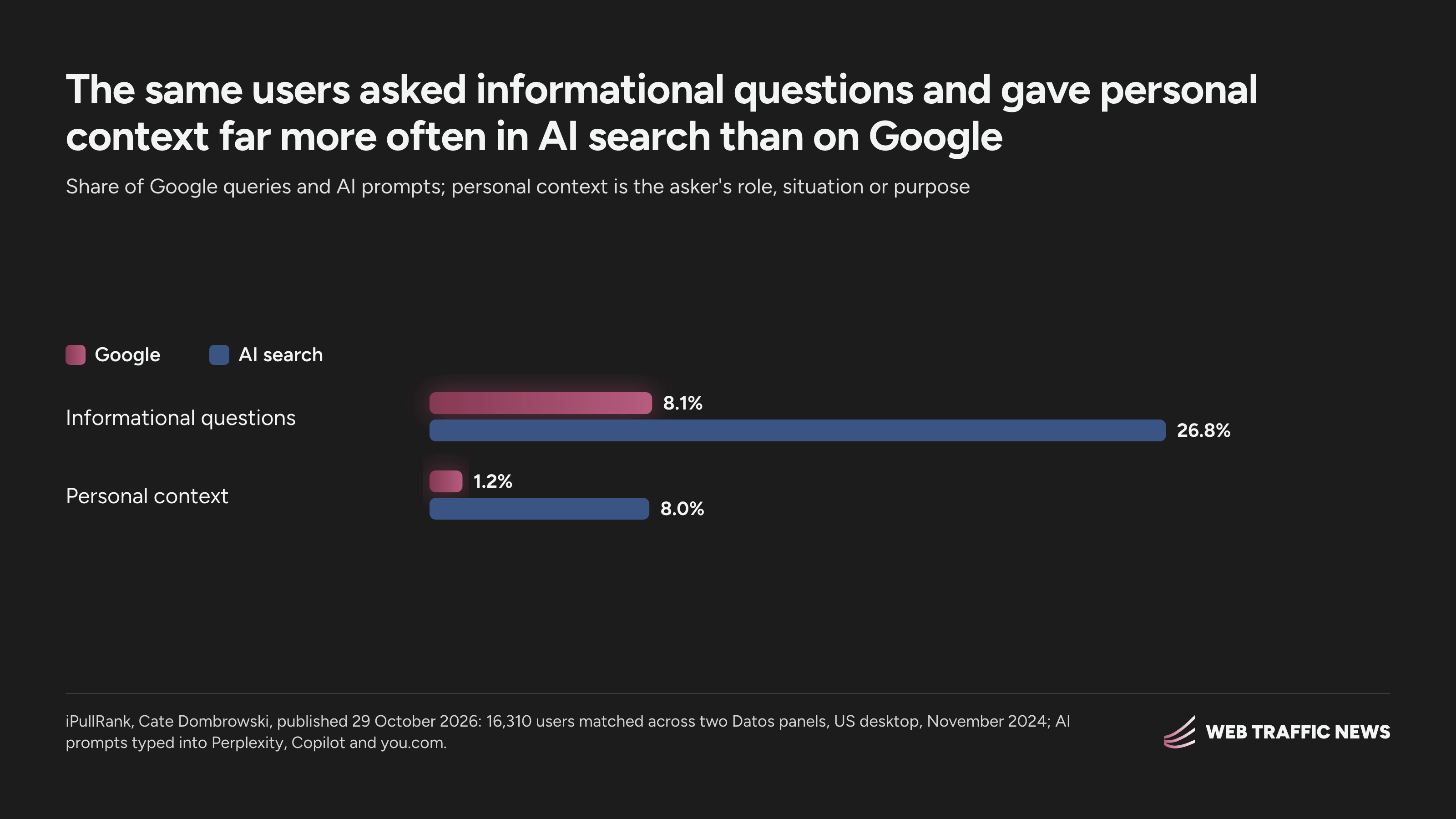
Informational questions made up 26.8% of AI prompts and 8.1% of Google queries, and 8.0% of AI prompts revealed the asker’s role, situation or purpose, against 1.2% on Google.
Knowledge Graph facts in AI Mode
Dan Petrovic of DEJAN published on 28 October 2026 that Google AI Mode receives Knowledge Graph biographies of people and companies as search results with no URL. Asked for Petrovic’s age and the raw source data, AI Mode returned a “Person Biography” record with no link in two incognito sessions, and cited only a Wikipedia page about a footballer. A test on owayo returned an “Organization Biography” with the company’s founding year, founders and headquarters. DEJAN notes that AI Mode itself wrote these records when asked. What AI says about a brand outweighs how often it says it, so a company should check what Google’s Knowledge Graph holds about it.
ChatGPT search volume against Google
Mitul Gandhi, co-founder of seoClarity, published on 28 October 2026 an estimate that ChatGPT’s daily search-equivalent activity is approximately 7.5% of Google’s search-query volume. The estimate puts ChatGPT at about 1.24 billion search-like messages a day against 16.44 billion modeled Google queries. seoClarity built the estimate from OpenAI’s Signals v3.0 usage data plus its own assumptions, such as 20% growth on Google’s five trillion annual searches, and calls it a modeled comparison. ChatGPT at that volume needs its own count of how often AI answers mention a brand, because buyers who met a brand in an answer return later through Google or direct, and analytics undercount them.
Sources
The week in AI search, in one email
One email a week with what changed in ChatGPT, Google AI Mode, Perplexity and Gemini, and the week's data piece.
Up next
Ahrefs measured AI citation stability for 20 days and found half or more of citations gone the next day, so a single check misreads a brand's AI visibility.
Ahrefs study of AI citation stability finds half gone the next day
Brief
Universal Cart lets U.S. shoppers save and buy products from many stores in Google Search and Gemini, so retailers missing from AI answers lose the sale.
Google launches Universal Cart across Search and the Gemini app
Brief
Google's Connected Apps Platform brings brands' apps into Search and Gemini, and AI Mode may default to the app a user last picked for a task.
Google opens a Connected Apps Platform for Search and Gemini
Brief