BriefResearch
Kevin Indig shows how software buyers use AI to reopen shortlists
A survey on how software buyers use AI found assistants added a vendor for 62.7% of buyers who had candidates, so vendors missing from AI answers lose deals.
 By Emilis Zabilius · · 4 min read
TL;DR
- Kevin Indig’s Growth Memo reported on 9 November 2026 that AI assistants added a vendor for 62.7% of 158 software buyers who already had candidates.
- Software vendors that Claude and ChatGPT name in the first answer gain the reopened deals, while vendors relying on an existing shortlist lose them.
- Heads of marketing at software companies should track shortlist questions on Claude, ChatGPT and Gemini and answer pricing, integrations and setup on their own pages.
What changed
Kevin Indig’s analysis of how software buyers use AI, published in Growth Memo on 9 November 2026, found that AI assistants added a vendor for 99 of 158 respondents (62.7%) who already had candidates in mind. “The most surprising insight from this qualitative data is that AI reopens the shortlist,” wrote Indig, who discloses that he’s an investor in Wynter, which ran the survey.
The data covers 200 responses to Wynter’s 13-question survey, and every respondent’s industry profile included SaaS or software. The percentages are self-reported and unweighted, and Indig writes that they aren’t representative of all B2B buyers. Of the 40 respondents who began with no vendor in mind, 33 (82.5%) got a vendor onto their shortlist through AI, yet only 40% of those 40 reported choosing a vendor.
Each share below is measured against its own group of respondents:
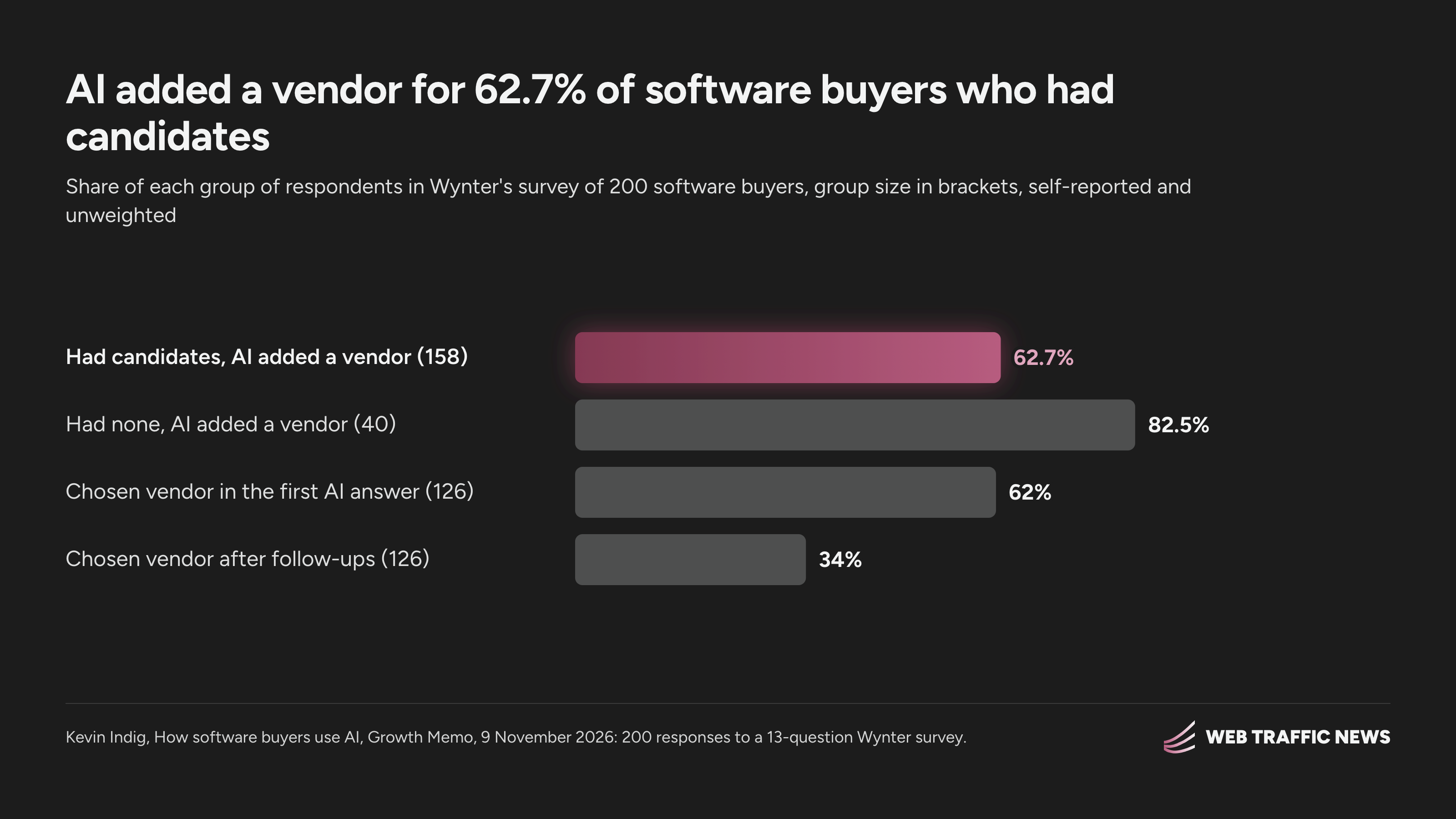
The chart shows that 62% of the 126 respondents who chose a vendor, 78 people, said the first AI answer already named it, and 43 (34%) said it came up after follow-ups.
Buyers kept asking after the first answer: 41.5% sent 3 to 5 messages after the first prompt, and the follow-ups covered pricing (57.5%), vendor comparisons (54.5%), integrations (46%) and setup (40%). After the chat, 145 of 200 respondents (72.5%) visited vendor websites and 96 (48.0%) searched Google.
Claude was the most used assistant, at 71%, ahead of ChatGPT at 62.5%, Gemini at 38.5% and Google’s AI Overviews or AI Mode at 15%, and 67.5% used more than one AI platform.
Why it happened
AI answers carry more brands than a buyer brings to the chat. Most buyers come to a decision with 2 options in mind, Indig writes, while AirOps’ report of 2 November 2026 found answers on ChatGPT, Gemini and Google AI Mode named 7.7 brands on average in January 2026 and 5.3 in September.
The research happens inside the chat, and the click comes later. Indig’s Similarweb analysis of 26 October 2026 found AI referrals account for roughly one in 200 visits across 10,000 domains in each of the US and France. In Similarweb’s study published on 14 October 2026, US desktop users who saw ChatGPT recommend a brand between July and December 2025 were more likely to visit it within seven days than its competitor, usually later through another channel, often search.
What it changes for GEO
A software company’s shortlist stays open until the buyer’s chat ends. The AI recommendation is the most valuable moment in the purchase: 62.7% of Wynter’s respondents with candidates added a vendor through AI, and 62% of chosen vendors were already in the first answer. A vendor missing from that answer starts behind.
Challengers gain the most, because an assistant puts them in front of buyers who came with other names. Incumbents that counted on buyers knowing their name lose that protection. AirOps found AI search keeps naming the brands it named first, with the January leader still named most in September on 62.8% of questions, so the first vendors in keep the recommendation.
Follow-ups on pricing (57.5%), vendor comparisons (54.5%), integrations (46%) and setup (40%) show what the answer has to carry, so comparisons and pages answering those questions in their title and opening get picked. The company’s own site is the one source it controls, and a wrong price or a missing integration in the answer costs the deal.
Each engine is judged on its own, since 67.5% of the survey’s respondents used more than one AI tool:
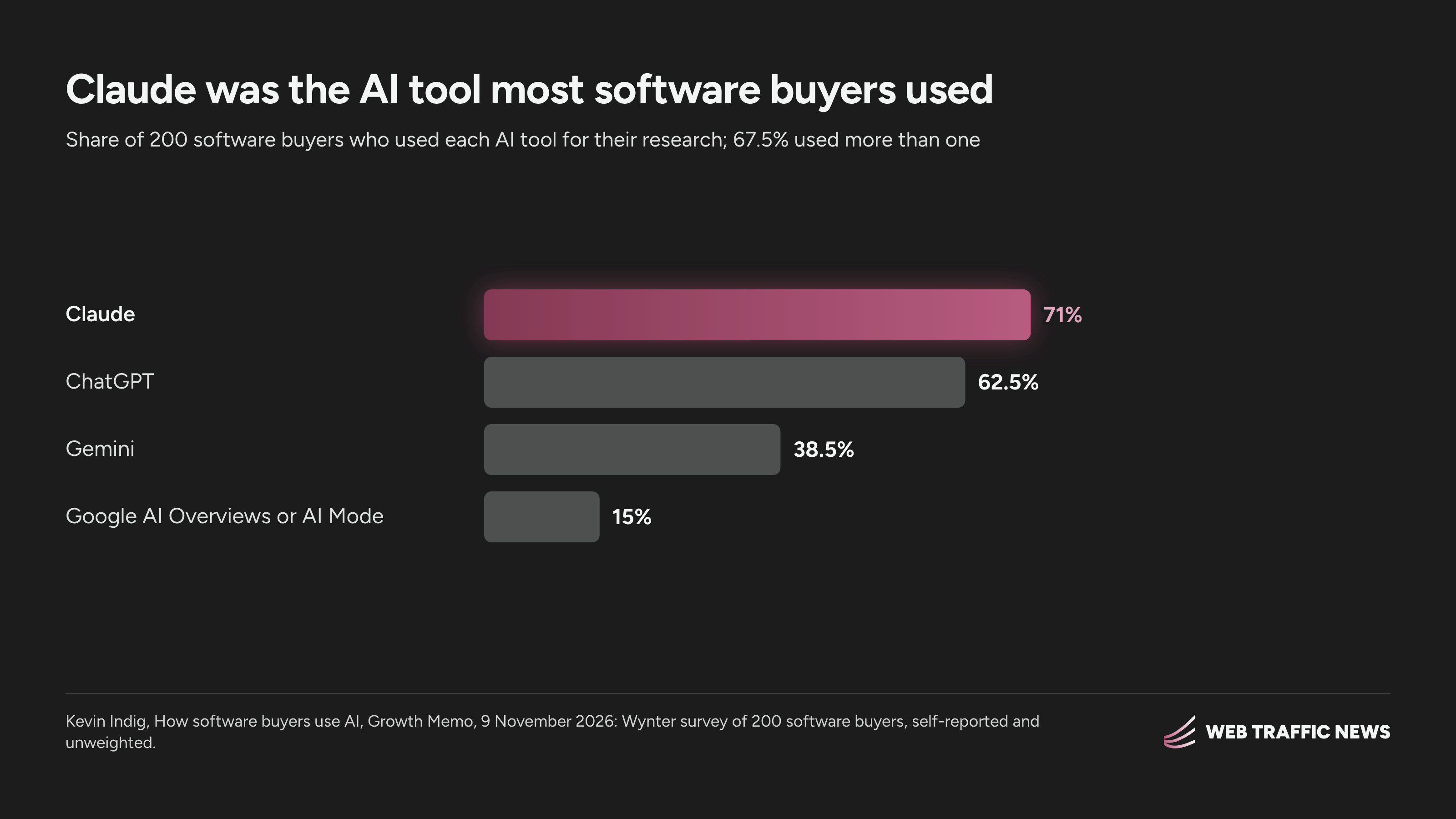
Claude at 71% leads ChatGPT at 62.5%, so a vendor tracking ChatGPT alone misses the assistant most surveyed buyers used. Agenzy’s 2026 study measured a median 5.1x visibility gap between a brand’s best and worst AI engine, and 30% of visible brands were completely invisible on at least one engine (n=86 brands visible somewhere, 2026-04 to 2026-08).
Analytics label the sale an assistant started as search or direct, because 72.5% of Wynter’s respondents visited vendor websites after the chat and 48.0% searched Google. The reliable measure is asking every new customer how they found the company, and measuring AI search revenue when analytics credit Google sets out how.
What to do
The head of marketing at a software company should start with a tracked set of the questions buyers ask before they have a shortlist, in the buyers’ own words, built as a prompt set for AI visibility tracking. The set runs separately on Claude, ChatGPT and Gemini, and the team records whether each first answer names the company.
Next, the web team puts pricing, integrations, setup and comparisons on the company’s own pages, in the words buyers use in their follow-ups. Because Claude’s web search draws on Brave’s index, the team also checks those pages appear in Brave Search. Sales adds “How did you first hear about us?” to the demo and signup forms.
To check the result, the head of marketing compares each month’s share of first answers that name the company, engine by engine, with the number of new customers who say an AI assistant brought them.
Sources
The week in AI search, in one email
One email a week with what changed in ChatGPT, Google AI Mode, Perplexity and Gemini, and the week's data piece.