BriefResearch
AirOps finds AI search keeps naming the brands it named first
AirOps's study of the cost of waiting in AI search found brands named early kept their place for months, so a brand that begins late fights for a shorter list.
 By Emilis Zabilius · · 4 min read
TL;DR
- AirOps reported on 2 November 2026 that ChatGPT, Gemini and Google AI Mode named brands present in Q1 and Q2 10x more than Q3 newcomers.
- Brands already named in AI answers gain, since the top brand stayed on top on 62.8% of questions, while late brands compete for shorter lists.
- Heads of marketing should record which brands AI answers name on their buyers’ questions now and build cited evidence where their own brand is missing.
What changed
AirOps published a study of the cost of waiting in AI search on 2 November 2026, finding that brands first named over the summer were named about a tenth as often as brands already in the answers. AirOps, which sells software to research, publish and refresh content for AI search, followed hundreds of thousands of the same questions, and tens of millions of answers, on ChatGPT, Gemini and Google AI Mode from January to September 2026.
AirOps counted non-branded questions only, pooled across brands, with the three engines weighted equally. Brands first named from July to September appeared in 3.6% of a question’s answers, against 36.7% for brands already named from January to June. The ratio was about 1 to 10 on each engine:
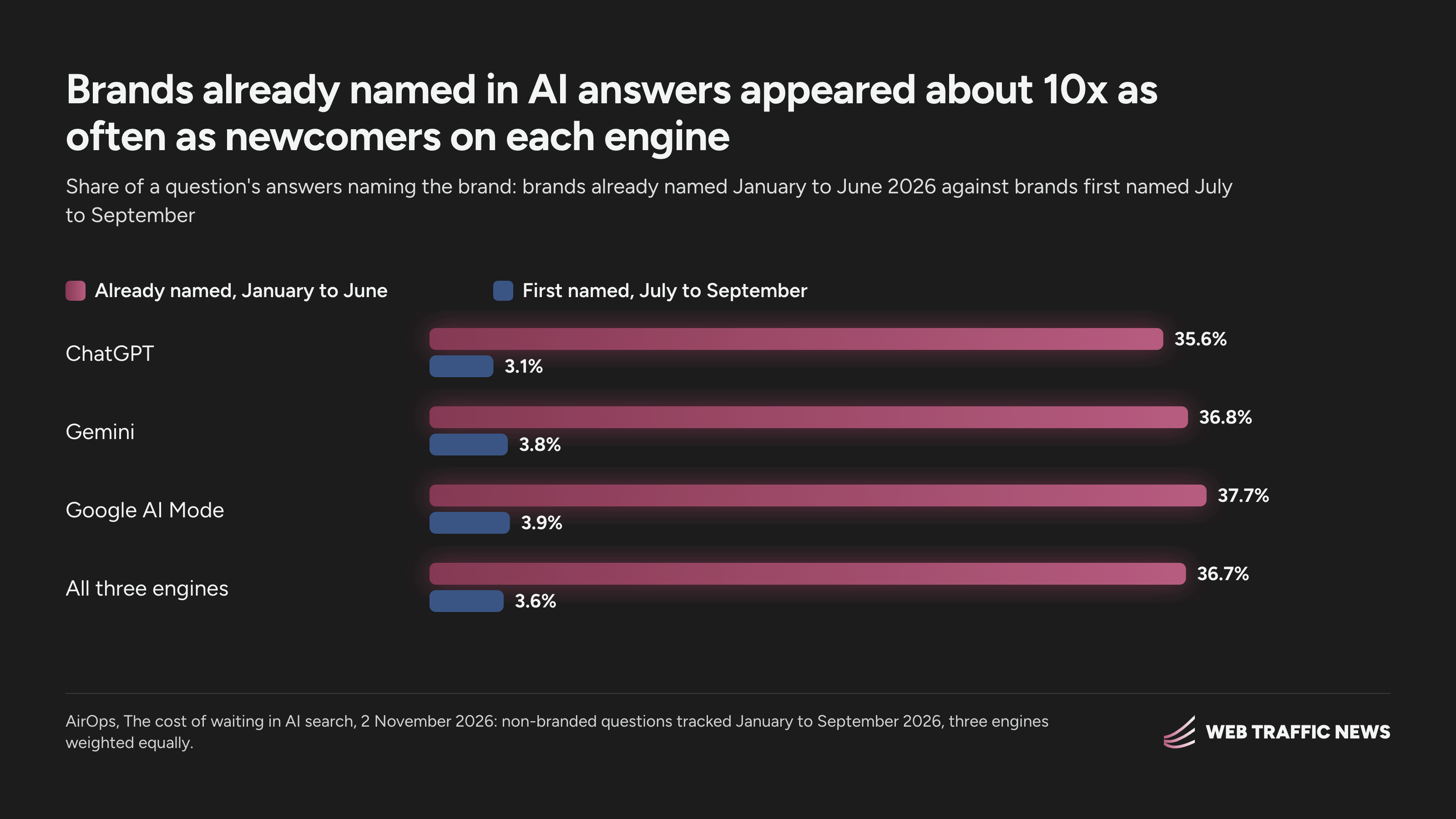
ChatGPT named newcomers in 3.1% of answers against 35.6% for brands already there, Gemini in 3.8% against 36.8%, and Google AI Mode in 3.9% against 37.7%.
The top brand held its place as well. On 62.8% of the questions, the brand named most in January and February was still named most in September, against 14.9% for a brand picked at random. Answers also named fewer brands over the year: in banking, 7.6 brands per answer in January and 4.7 in September, and across all sectors 7.7 and 5.3, down about 31%.
“The wording of an answer changes week to week, while the brands named in the shortlist it presents hold for months,” wrote Jason Saltzman, head of research and insights at AirOps, in the report.
Why it happened
AirOps’s earlier studies traced how ChatGPT turns search results into citations. On 12 March 2026, AirOps reported that ChatGPT left 85% of the pages it retrieved uncited, across 548,534 retrieved pages and 15,000 original prompts. On 13 April 2026, AirOps and Kevin Indig of Growth Memo found that a page at position 1 in ChatGPT’s retrieval results had a 58% citation rate, against 14% at position 10.
On 11 August 2026, AirOps reported that the citation share of brands’ own pages fell 10% between August 2025 and June 2026, while the share of creator and social sources grew 140%, across nearly 3.5 billion citations. The new report explains its pattern with the pages behind AI answers, mostly third-party pages built up over months that name the brands present when they were written.
What it changes for GEO
Brands that get into AI recommendations first keep them, and AirOps’s data shows that pattern on ChatGPT, Gemini and Google AI Mode alike, though the study records who kept being named without testing why. A brand missing from the one answer a buyer gets loses that sale.
Late brands lose twice. AirOps found newcomers’ share of brand mentions fell from 4.3% in spring to 3.0% in summer, and the lists they need to enter shortened, with the brands around the leader the ones that dropped out. AirOps writes that its reading would be wrong if that share climbed back above 4.3% or answers began naming more brands again.
AI engines judge a brand by how many trusted sources mention it, and AirOps’s durability test fits that. AirOps sorted brands named in January answers by what those answers cited:
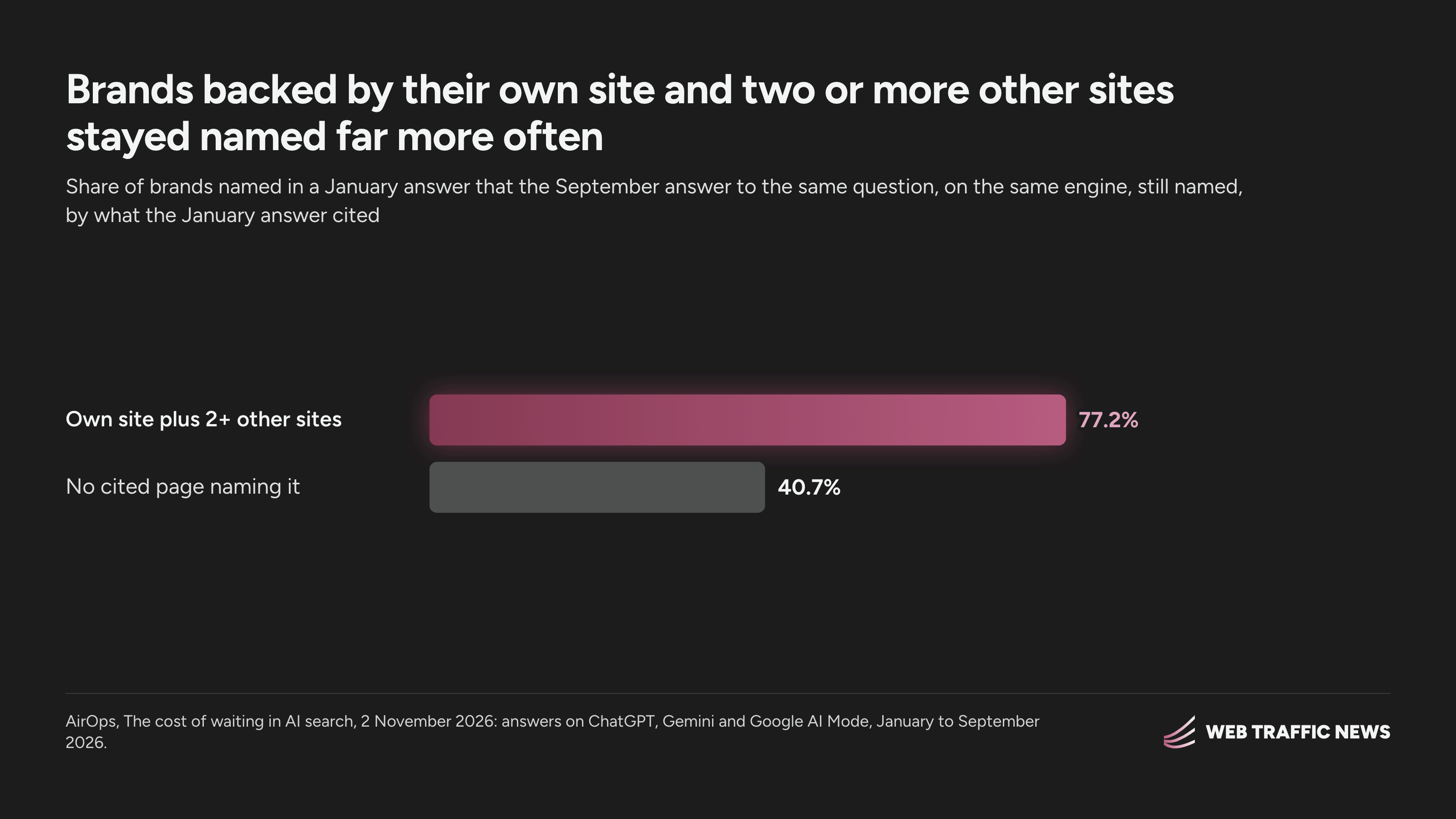
Of brands whose January answer cited their own site plus two or more other sites naming them, 77.2% were still named on the same question in September, against 40.7% when no cited page named the brand.
AirOps adds that better-known brands are more cited and more stable, though well-supported brands lost less ground than their baseline predicted. A brand’s own site is the one source it controls, so the work begins there. 34.8% of the businesses in Agenzy’s 2026 source study did not have their own website among the 30 sources AI engines cited most for their own category (n=138 business projects).
Evidence takes months to count, so each month of delay pushes results further out. AirOps found 75.2% of the most cited Reddit threads and 70.3% of the most cited YouTube videos were more than six months old. A GEO program needs about three months for a first verdict, and how long GEO takes to show up in ChatGPT answers varies by page.
What to do
The head of marketing should have the team list the non-branded questions buyers ask before they buy and record which brands ChatGPT, Gemini and Google AI Mode name on each, engine by engine, the way brands measure how often AI answers mention them. Where the brand is named, the team checks that the answer cites the brand’s own page plus two or more other sites naming it, and adds what is missing.
Where the brand is absent, the team earns mentions on the third-party pages those answers already cite, because AI search keeps citing such pages for months. The team then checks each month whether the brand is still named on the same questions, since cited pages change from one day to the next, as Ahrefs’ study of how many AI citations disappear the next day found.
Sources
- airops.com/report/the-cost-of-waiting-in-ai-search
- airops.com
- airops.com/people/jason-saltzman
- airops.com/report/influence-of-retrieval-fanout-and-google-ser…
- airops.com/report/the-fan-out-effect-what-happens-between-a-qu…
- airops.com/blog/fastest-growing-source-in-ai-search
- agenzy.lt/blog/which-sources-ai-engines-cite-2026
The week in AI search, in one email
One email a week with what changed in ChatGPT, Google AI Mode, Perplexity and Gemini, and the week's data piece.
Up next
0.5
%
of all visits came from AI referrals across 10,000 domains each in the US and France, in Similarweb data analyzed by the Growth Memo.
Growth Memo data puts AI referral traffic at 0.5% of total visits
Brief
1,900
characters
of a typical 14,600-character page reach the model that writes Claude's answer, Peec AI measured through the Claude API.
Peec AI finds Claude search uses Brave and reads an eighth of a page
Brief
72,000
requests
from ChatGPT-User in 30 days to a site of 50,000 invented statistics, months after Google deindexed its pages.
Peec AI researcher finds ChatGPT kept citing a fake statistics site
Brief