BriefClaude
Test finds Brave Search submit form indexes pages within two hours
Pages sent through the Brave Search submit form were in Brave's index within about two hours in a test, and Claude's web search cites from Brave's results.
 By Emilis Zabilius · · 4 min read
TL;DR
- Pages submitted through Brave Search’s URL form on 8 November 2026 reached Brave’s index within about two hours of each batch, a test found.
- Brands with pages missing from Brave’s index can fix that in an afternoon, while brands waiting for Brave’s crawler stay out of Claude’s citations.
- Web teams should run a site: search on Brave, submit every missing page through the form and repeat the search two hours later.
What changed
Every page sent through the Brave Search submit form on 8 November 2026 was in Brave’s index within about two hours of its batch, in a test that Agenzy, a GEO agency, ran on two of its websites and published the same day. Agenzy submitted 105 URLs by hand that afternoon. A script had shown beforehand that every page passed Brave’s technical checks, yet pages of both sites were still missing from the index.
The agenzy.lt home page, already in Brave’s index, went first at about 15:45, and the new fetch replaced a stored copy showing an outdated figure. The first 16 missing pages went in at about 16:00 and were all indexed by about 17:50. The other 88 went in at about 18:00, none showed at a 19:00 recount, and all 88 were in at 19:45. Minutes from each batch’s submission to the check that found every page indexed:
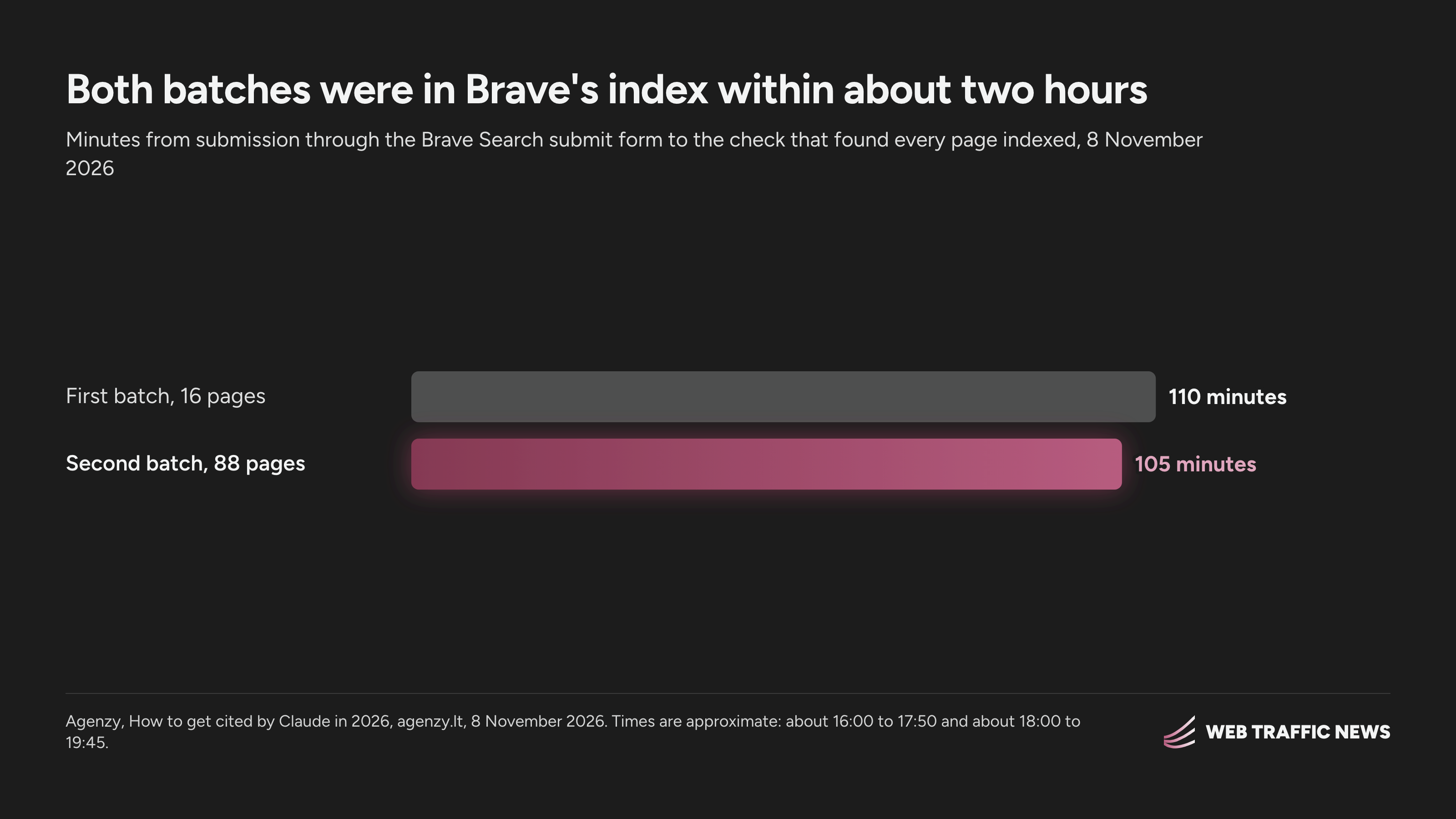
The first batch of 16 pages was all in within about 110 minutes and the second batch of 88 pages within about 105 minutes, so the larger batch was no slower.
Agenzy’s post names two other actions that could explain the result. Between about 16:10 and 16:25, Agenzy also sent every agenzy.lt URL to Bing’s webmaster tool, and it opened Google and Bing site: results in a Brave browser with Web Discovery on, which reports search results to Brave. No page was left unsubmitted for comparison. The post calls the form the most likely cause, because the second batch appeared only after its own submission, hours after the other two actions.
Why it happened
Claude’s web search draws on Brave. Anthropic’s subprocessor list names Brave Search as a subprocessor for web search in all Anthropic products, and Peec AI’s study of 28 October 2026 found 89.1% of the pages Claude cites in Brave’s top 20 results for the same queries, across 8,500 URLs. “One of the easiest and quickest actions to take is to submit URLs to Brave’s index,” wrote Tomek Rudzki, GEO expert at Peec AI.
Brave learns about new pages partly from its users. Brave’s crawler help page says the crawler is partially powered by the Web Discovery Project, an opt-in feature of the Brave browser, and offers the submit form for re-fetching a page. The post reads the project’s public code: one Brave user searching Google or Bing reports the pages in those results, while a visited page becomes readable only after 20 users send it (THRESHOLD = 20).
What it changes for GEO
Access comes first, and for Claude access means a place in Brave’s index. Each engine retrieves from its own sources: ChatGPT search draws on outside providers such as Microsoft and on OpenAI’s own index, while Anthropic names Brave Search for Claude. A page missing from Brave stays out of Claude’s answers without its owner knowing, as a crawler block does, whatever its Google rank.
Brands with new pages, small sites and changed prices gain the most from Brave’s submit form. Brave counts a visited page only after 20 users report it, and both test websites still had pages missing from the index, one eleven days after launch. A resubmission replaces the copy Brave stores, and the post says Claude quotes that stored copy, so an old price keeps reaching Claude’s answers until Brave fetches the page again.
Brands that wait for Brave’s crawler lose on the questions that sell. Anthropic’s web search documentation says Claude searches when a request needs information about specific organizations, people, or products that might have changed.
A place in Brave’s index is the first step. A citation still needs a top position in Brave for Claude’s short queries and a passage that answers them, since Claude search reads about an eighth of a page. Technical work gets the page read, while content and mentions on other sites earn the recommendation, and the brand’s own pages come first because it controls them.
Agenzy’s test covers one afternoon on two websites, with two other actions in the same window and no unsubmitted pages for comparison, so it is an anecdote by the standard any GEO claim should meet. It shows that every submitted page reached Brave’s index within about two hours. The form’s effect stays unmeasured, and the test measured no ranking or citation.
What to do
The head of marketing should have the web team run a site: search for the company’s domain on search.brave.com and compare it with the sitemap. The team submits every missing page through Brave’s form at search.brave.com/submit-url, then resubmits any page whose prices or product names have changed.
For a page that stays missing, the team checks the rules Brave’s browser applies on its second download: HTTP 200 with no redirect, a response under 10 seconds, a page under 2 MB, content in HTML without JavaScript and no “noindex” anywhere in the head. Robots.txt also has to let Googlebot in, because Brave’s crawler will not crawl a page Googlebot cannot crawl.
To check the result, the team repeats the site: search two hours after each batch, then searches Brave for the queries Claude shows above its answers to buyers’ questions, to see whether the page reaches the top ten.
Sources
The week in AI search, in one email
One email a week with what changed in ChatGPT, Google AI Mode, Perplexity and Gemini, and the week's data piece.