BriefGoogle
Ziff Davis says Google AI answers cited its sites 2.7 billion times
Ziff Davis says Google AI answers cited its sites 2.7 billion times in a quarter, nearly ten times its Google clicks, as its search referrals fell 37%.
 By Emilis Zabilius · · 4 min read
Ziff Davis says Google AI answers cited its sites 2.7 billion times in a quarter, nearly ten times its Google clicks, as its search referrals fell 37%.
TL;DR
- Ziff Davis told analysts on 6 November 2026 that Google AI answers cited its sites roughly 2.7 billion times in the third quarter.
- Brands named inside Google’s AI answers reach buyers who never click, while brands that count only Google visits see a shrinking share of their exposure.
- Marketing leads should open Search Console’s generative AI report, set AI impressions beside clicks for each page and read what the answers say.
What changed
Ziff Davis, the owner of CNET, IGN and Everyday Health, said on its third-quarter 2026 earnings call on 6 November that Google AI answers cited its sites roughly 2.7 billion times in the quarter. Chief executive Vivek Shah put that at “nearly 10x the clicks those same sites received from Google Search.” The comparison sets AI impressions against all of Ziff Davis’s clicks from Google Search, including the clicks from ordinary results.
Shah said the statistic, called AI Impressions, counts how many times a link to a page was shown inside generative AI features, and that it “comes from Google’s Google Search Console.” On the same call he said organic Google referrals to Ziff Davis’s properties fell about 37% year over year, with the tech and shopping brands facing the strongest search traffic headwinds. Asked about the outlook, he said the company is “not planning on a search recovery” and expects referrals to keep falling.
Revenue came to $289.3 million against $306.5 million a year earlier, according to the results release filed with the SEC. Chief financial officer Bret Richter said advertising and performance revenue fell 7.7%. The same quarter at another large publisher is covered in People Inc.’s report of a 26% traffic decline from AI search.
Why it happened
Google introduced the source of Shah’s number in June 2026, when it launched generative AI performance reports in Search Console for AI Overviews, AI Mode and Discover. The reports count impressions, meaning how often a site’s URLs appeared in generative AI features, broken down by page, country, device and date. Google rolled them out to a subset of websites first and listed no click metric for the AI features, so a publisher can only set AI impressions against its overall Search clicks, which is the comparison Shah made.
The traffic loss is older than the report. Shah said the third-quarter drop in Google referrals a year earlier was about 23%, and he called “the disruption of search traffic by Google, and LLMs” a clear business headwind. The two third quarters side by side:
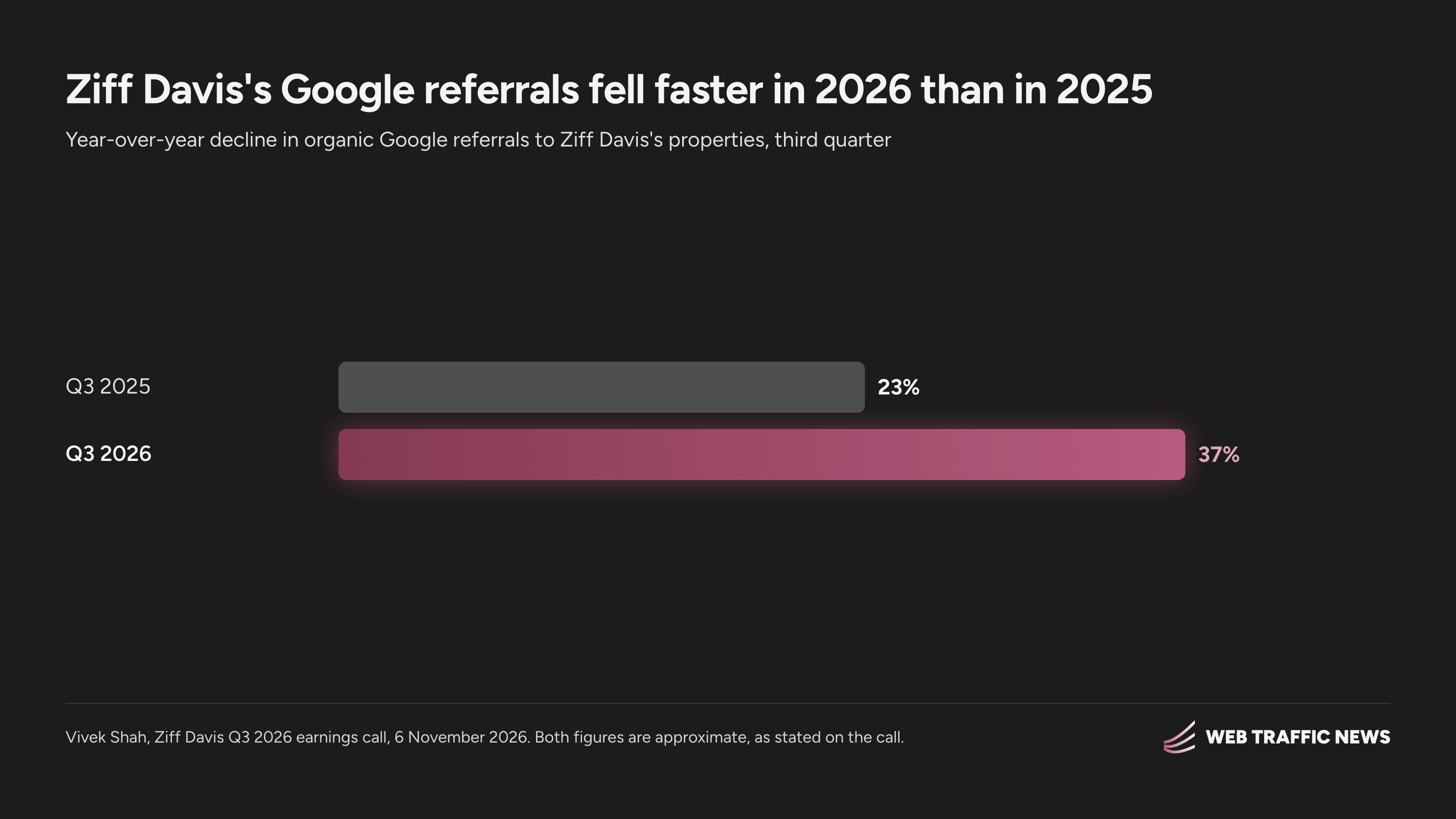
Taken together, the two drops make the two-year fall in Ziff Davis’s Google referrals more than 50%, by Shah’s count. He also said Ziff Davis remains open to licensing deals and expects its litigation with OpenAI to bring clarity on how AI systems pay for content.
What it changes for GEO
The 2.7 billion figure is a count from Google’s own data, made public by a large publisher, of how often its AI answers show a source against how often anyone clicks. Even if every one of Ziff Davis’s Google clicks had come from an AI answer, at least nine of every ten AI impressions ended without a visit. The recommendation inside the answer is the moment that decides the purchase, so a brand absent from it loses the sale whatever its ranking below.
Brands that measure success by visits from Google lose sight of most of their exposure. Analytics already undercount AI because buyers who met a brand in an answer arrive later through Google or direct, and this ratio measures that gap for Google alone. A report built on sessions misses most of what the answers do for or against a brand.
Brands mentioned by trusted publishers gain, even as those publishers lose traffic, because AI engines judge a brand by how many trusted sources mention it. A product review on a cited site keeps carrying the brand into answers that few people click. Shah said marketers are “factoring AI visibility” into the media partners they pick, so a placement is now priced on the citation as well as the visit.
The brand’s own site is the one source it controls. 34.8% of the businesses in Agenzy’s 2026 source study did not have their own website among the 30 sources AI engines cited most for their own category (n=138 business projects). Since few people click through, what the answer says about the brand counts for more than how often it appears, and a wrong price or an old name in it costs deals.
What to do
The head of marketing asks whoever runs Search Console to open the generative AI performance report and export AI impressions by page for the last full month. Not every site has the report yet, since Google rolled it out to a subset of websites first.
Put those impressions beside Search clicks for the same pages, then list the twenty pages with the most AI impressions. For each one, search its main queries in AI Overviews and AI Mode and read how the answer describes the brand, its prices and its products. Correct the brand’s own page where the answer is wrong, and ask the publishers that review your products which of those reviews AI answers cite, with the method behind the eight GEO metrics that show whether AI search brings in buyers.
Check the result once a month, after the next export: AI impressions per page, the wording of the answers, and the share of new customers who say an AI answer led them to the company.
Sources
The week in AI search, in one email
One email a week with what changed in ChatGPT, Google AI Mode, Perplexity and Gemini, and the week's data piece.