BriefGoogle
People Inc. reports a 26% traffic decline from AI search
People Inc. reported a 26% traffic decline from AI search in its third quarter, so brands that count on publisher coverage and Google clicks reach fewer buyers.
 By Emilis Zabilius · · 3 min read
TL;DR
- People Inc. reported on 2 November 2026 that core sessions on its main sites fell 26% year over year to 1,613 million in the third quarter of 2026.
- Brands that relied on Google clicks and on publisher reviews to reach buyers lose reach, while brands named inside AI answers keep the buyer’s attention where the decision is made.
- Heads of marketing should check which buyer questions now show an AI answer and start asking every new customer how they found the company.
What changed
People Inc., the publisher of People, Allrecipes and Investopedia, reported a 26% traffic decline from AI search in the third quarter of 2026. Its Q3 2026 results, filed with the SEC on 2 November 2026, put core sessions at 1,613 million against 2,168 million a year earlier, a decline the company attributed primarily to AI-oriented search and content discovery experiences.
Core sessions are People Inc.’s count of unique visits to its most significant owned sites, and total sessions across the whole network fell 25% to 1,794 million. People Inc. said the fewer visits meant lower impression volumes and lower open programmatic advertising revenue.
The money moved with the visits. Revenue tied to site visits fell while revenue earned outside a visit grew:
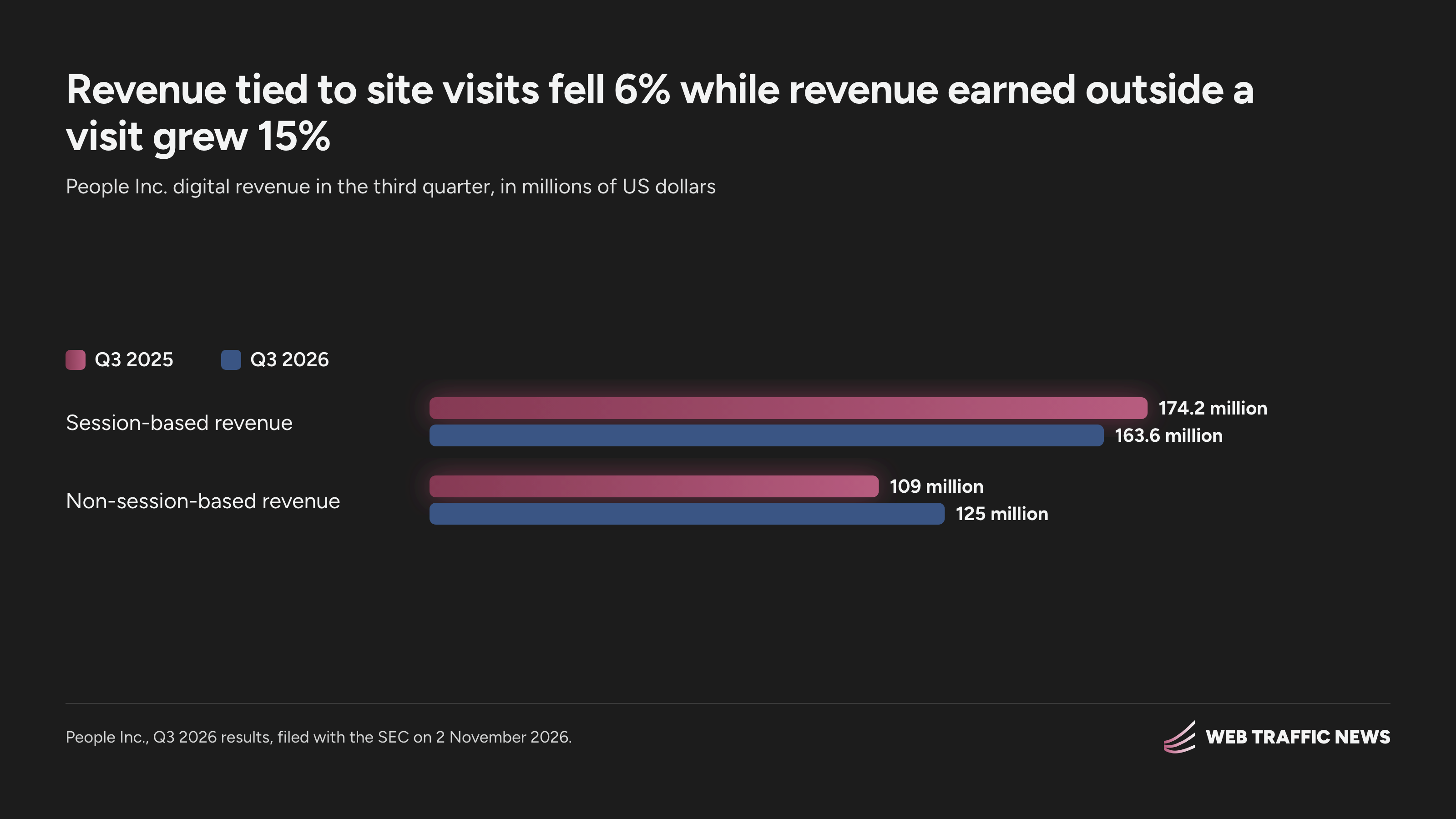
Session-based digital revenue fell 6% to $163.6 million, and non-session-based revenue grew 15% to $125.0 million, with licensing and other revenue up 49%. Total digital revenue still rose 2% to $288.5 million.
Why it happened
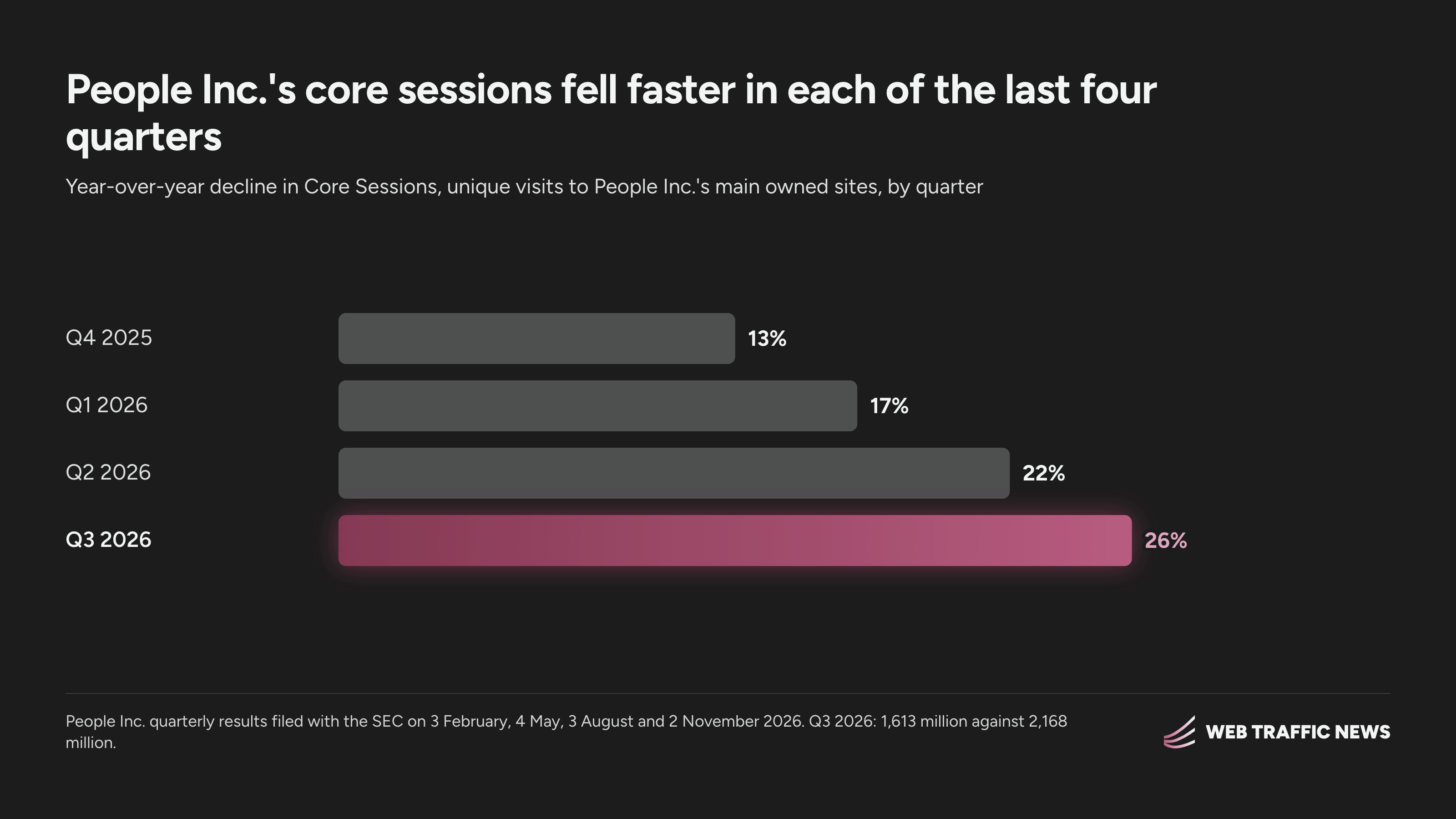
People Inc. has reported a larger decline in each of the last four quarters:
Core sessions fell 13% in the fourth quarter of 2025, 17% in the first quarter of 2026 and 22% in the second quarter. In each of those three releases the company named the growing prominence of Google AI Overviews on Google search results as the main cause.
Google, for its part, said at I/O on 20 May 2026 that AI Mode had passed 1 billion monthly users and that AI Overviews and AI Mode now run as one AI Search experience worldwide. The Q3 release also books $0.7 million of higher costs for People Inc.’s antitrust litigation against Google.
What it changes for GEO
A buyer who once clicked from Google to a publisher’s comparison page or product roundup now reads more of the answer on Google’s page. For a brand, that publisher page was a road to the buyer: a placement in a “best of” list delivered the click and the sale. People Inc.’s four quarters show that road narrowing at a publisher with 1,613 million core sessions a quarter, and narrowing faster each quarter.
Publisher coverage still counts, because AI engines judge a brand by how many trusted sources mention it and how widely. The difference is where the buyer meets the result. The recommendation now happens inside the AI answer, and a brand the answer leaves out loses the sale before any click exists. How Google AI Overviews choose the pages they show decides which publisher pages feed that answer.
Brands named in AI answers for their buyers’ questions gain, since the shrinking click matters less to them. Brands that bought affiliate and listicle placements for the referral traffic lose, as do brands whose pipeline rests on Google organic clicks. A test of click-through rates on Google’s AI answers shows how little of that traffic reaches a site.
Measurement breaks in the same move. Analytics records fewer visits while buyers still meet the brand in the answer and arrive later through a branded search or a direct visit, so session counts understate what AI search does for a brand.
What to do
The head of marketing should take the 20 buyer questions that bring the most Google traffic today and search each one, noting which show an AI Overview and whether the answer names the brand. Then list the publisher and affiliate placements the brand pays for and check which of those pages the AI answers cite, because a cited page still carries value and an uncited one now delivers little.
Next, add a required “How did you hear about us?” field to every lead form and copy the answer into the CRM, as set out in measuring AI search revenue when analytics credits Google. Check the result monthly by comparing the share of new customers who name an AI assistant with the trend in organic sessions.
Sources
The week in AI search, in one email
One email a week with what changed in ChatGPT, Google AI Mode, Perplexity and Gemini, and the week's data piece.
Up next
64
%
of 282 brand and product names BrightEdge tracks showed a Google AI Overview in late October 2026, up from 19% in mid-August.
BrightEdge finds AI Overviews on brand searches now reach 64%
Brief
US users can now book home services in AI Mode through Angi, Thumbtack, Housecall Pro and Jobber, so firms on those platforms win the job in the answer.
Google adds links to book home services in AI Mode through partners
Brief
Google spam guidance now tells services with shareable pages, generated outputs or tools to noindex link-only pages, and only indexed pages reach AI Overviews.
Google spam guidance now covers shareable pages and generated outputs
Brief