BriefGoogle
BrightEdge finds AI Overviews on brand searches now reach 64%
BrightEdge tracked AI Overviews on brand searches rising from 19% to 64% in ten weeks, so Google now describes most brands before a buyer clicks.
 By Emilis Zabilius · · 4 min read
TL;DR
- BrightEdge reported on 6 November 2026 that Google AI Overviews appeared on 64% of 282 tracked US brand and product names, up from 19% in August.
- Brands that trusted sources describe accurately gain from AI Overviews on brand searches, while brands with a thin or outdated record lose the first description buyers read.
- Heads of marketing should search every version of their brand name in Google, read each AI Overview and list the sources it cites.
What changed
Google AI Overviews on brand searches rose from 19% to 64% of the 282 brand and product names BrightEdge tracks between 16 August and 24 October 2026, the search platform company reported on 6 November 2026. BrightEdge counted the weekly presence of an overview on Google United States desktop and treats any single week as provisional, because the count peaked at 208 names (74%) in week 42 and fell to 180 (64%) a week later.
BrightEdge’s weekly brand-name count, from the first tracked week to the last:
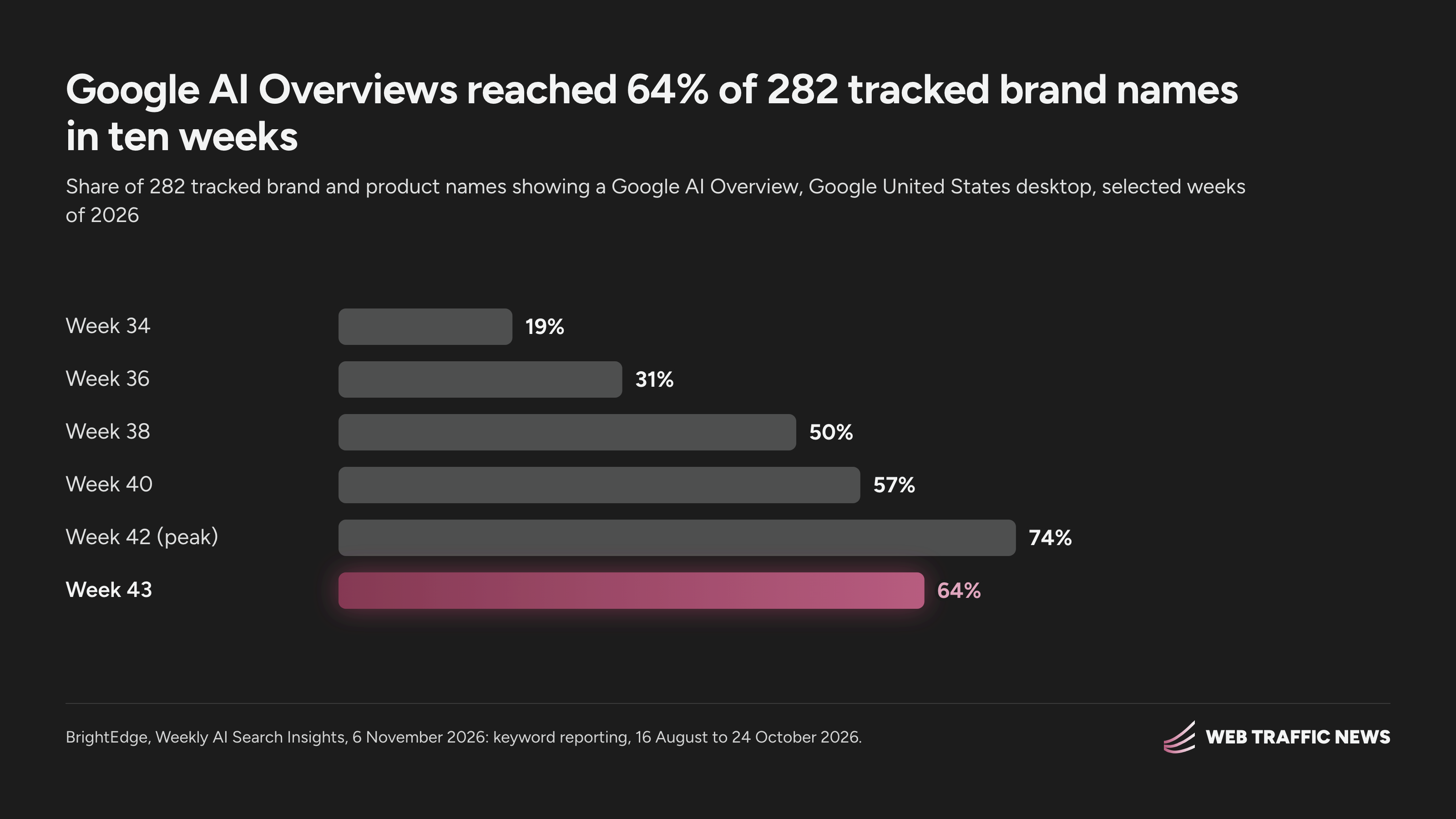
The chart shows the climb from 19% in week 34 to the 74% peak in week 42 and the drop back to 64% in week 43.
The largest brands arrived last in BrightEdge’s data. None of the 32 brand names above 1 million monthly searches had an overview in the opening week, and 18 of 32, or 56%, had one ten weeks later:
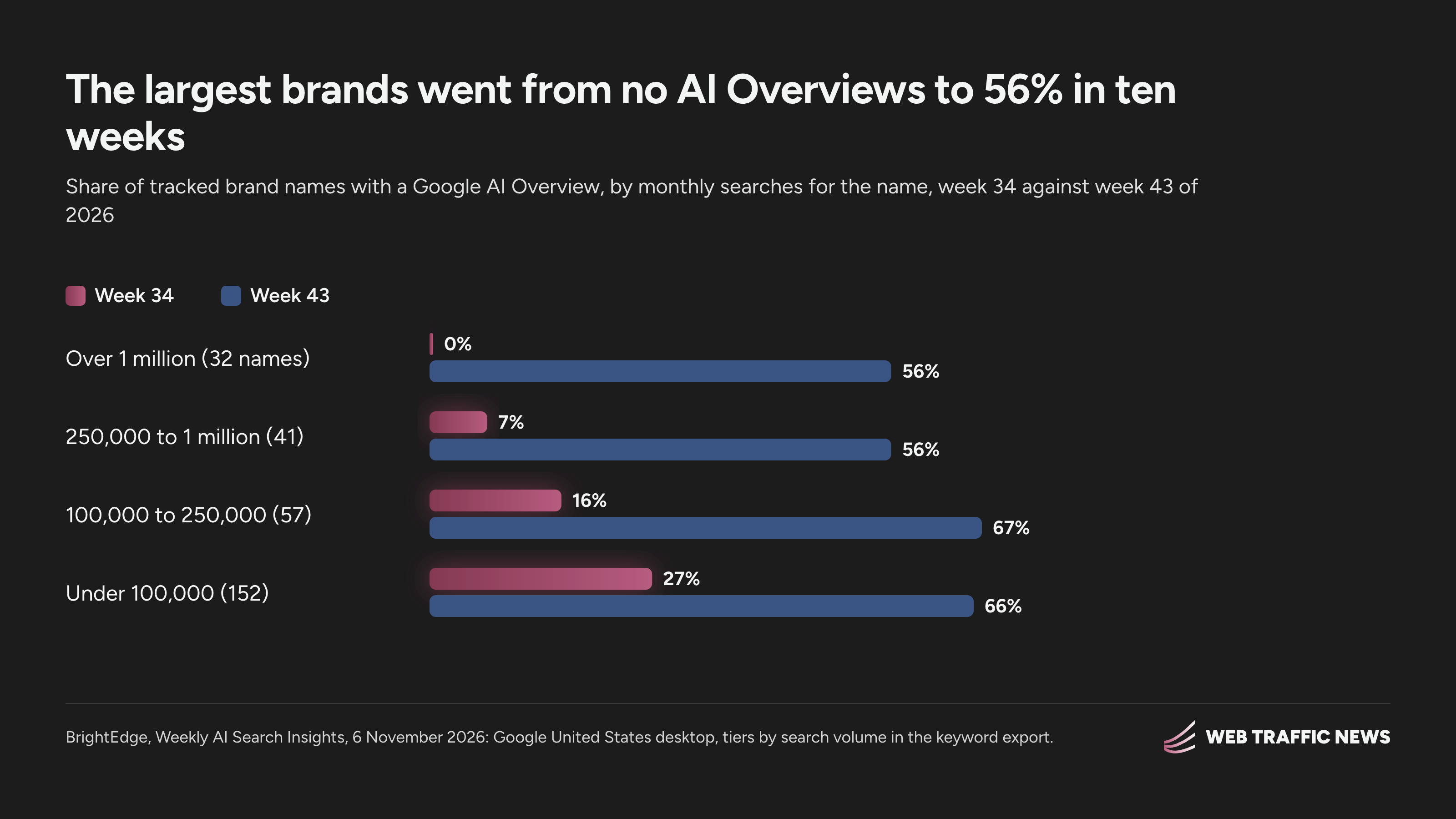
The smallest tier, names under 100,000 monthly searches, moved from 27% to 66% over the same weeks.
Local brands stayed mostly outside. Of the 59 tracked brand names that also show a local 3-pack, 20% carried an overview, against 75% of the other 223, and 40 of those 59 are restaurants. The wording of the name decides it too: BrightEdge found “American Express” carries an overview and “amex” does not. The study records whether an overview appears, and it does not measure what the overview says, whether the brand’s own site is cited or how clicks changed.
Why it happened
BrightEdge states no cause and says it found no public announcement of a branded-query change. In BrightEdge’s earlier tracking of nine industries from May 2024 to September 2025, AI Overview coverage grew from 26.6% to 44.4% of queries, while e-commerce fell to 18.5%, which BrightEdge read as Google protecting transactional searches.
At Google I/O on 20 May 2026, Google announced that AI Mode had surpassed more than 1 billion monthly users and that AI Overviews and AI Mode now run as one AI Search experience, live on desktop and mobile worldwide. In BrightEdge’s opening week of the new study, definitional searches such as “what is” already showed an overview on 97% of 286 tracked terms, while brand names stood at 19%.
What it changes for GEO
A brand search now shows, more often than not, Google’s summary of the brand next to the brand’s own listing. That moves the most commercial query a company has, its own name typed by someone close to buying, into the territory where how Google AI Overviews choose the pages they show decides the first impression.
What the overview says matters more than whether the brand appears in it. A wrong price, an old product name or a stale complaint costs deals at the exact moment a buyer has already chosen to look the brand up. The overview is assembled from sources, and AI engines give the most weight to how many trusted sources describe a brand and how widely, and little weight to what the brand says about itself.
Brands with consistent reviews, comparisons and press coverage gain, because the overview has accurate material to draw from. Brands that relied on their homepage ranking first for their own name lose control of the first description.
The brand’s own site still matters as the one source it controls, and how often AI answers cite a brand’s own website shows it cannot be assumed. 34.8% of the businesses in Agenzy’s 2026 source study did not have their own website among the 30 sources AI engines cited most for their own category (n=138 business projects).
Local brands whose names show a local 3-pack are the exception for now, with 20% carrying an overview. For everyone else the change is large: the share of tracked brand names with an overview rose 3.4-fold in ten weeks, and the names above 1 million monthly searches went from none to 56%.
What to do
The head of marketing should start this week by searching every version of the brand name in Google: the full name, the short name, the main product names and the common misspellings. For each search that shows an AI Overview, record what it says about the products, prices and reputation, and list every source it cites.
Then sort those sources into the brand’s own pages and third-party pages. Correct anything wrong on the brand’s own pages first, since that is the source the brand controls, then work on the third-party pages the overview leans on, such as review sites and comparisons. The guide to getting pages cited in Google AI Overviews covers that second step.
Repeat the same searches every week and compare the sources each overview cites, because BrightEdge saw brand names drop out of overviews and return between weeks, so a single reading shows one week and a run of readings shows the direction.
Sources
The week in AI search, in one email
One email a week with what changed in ChatGPT, Google AI Mode, Perplexity and Gemini, and the week's data piece.
Up next
26
%
fewer core sessions at People Inc. in Q3 2026 than a year earlier, which the publisher put down mainly to AI-oriented search.
People Inc. reports a 26% traffic decline from AI search
Brief
US users can now book home services in AI Mode through Angi, Thumbtack, Housecall Pro and Jobber, so firms on those platforms win the job in the answer.
Google adds links to book home services in AI Mode through partners
Brief
Google spam guidance now tells services with shareable pages, generated outputs or tools to noindex link-only pages, and only indexed pages reach AI Overviews.
Google spam guidance now covers shareable pages and generated outputs
Brief