BriefGoogle
Google rolls out Gemini 4 Hydrogen in Google Search for all users
Gemini 4 Hydrogen in Google Search runs simultaneous queries across a question's subtopics and links more sites, so pages that answer one subtopic gain.
 By Emilis Zabilius · · 4 min read
Gemini 4 Hydrogen in Google Search runs simultaneous queries across a question’s subtopics and links more sites, so pages that answer one subtopic gain.
TL;DR
- Google made Gemini 4 Hydrogen available to all Google Search users on 12 November 2026, with an upgraded query fan-out that links more sites.
- Sites with pages for each subtopic of a buyer’s question gain links in Google’s AI answers, while brands relying on one main-query page lose share.
- Heads of marketing should list the subtopics Google AI Mode covers for their buyer questions and publish a page for each subtopic their site lacks.
What changed
Gemini 4 Hydrogen in Google Search is now available globally for all users, Google announced on 12 November 2026. Robby Stein, VP of Product, Google Search, wrote: “This is the biggest model upgrade to Search yet.” Google lists four changes, and query fan-out is the one about links to websites.
Search now reads questions with several parts, typos or very specific requests, and answers each part. Query fan-out searches every relevant subtopic of a question at the same time and links more sites than before. Responses get more visual, with more images, structured responses, comparison tables and custom tools, and answers are more nuanced in every supported AI Mode language.
The four changes, as Google lists them:
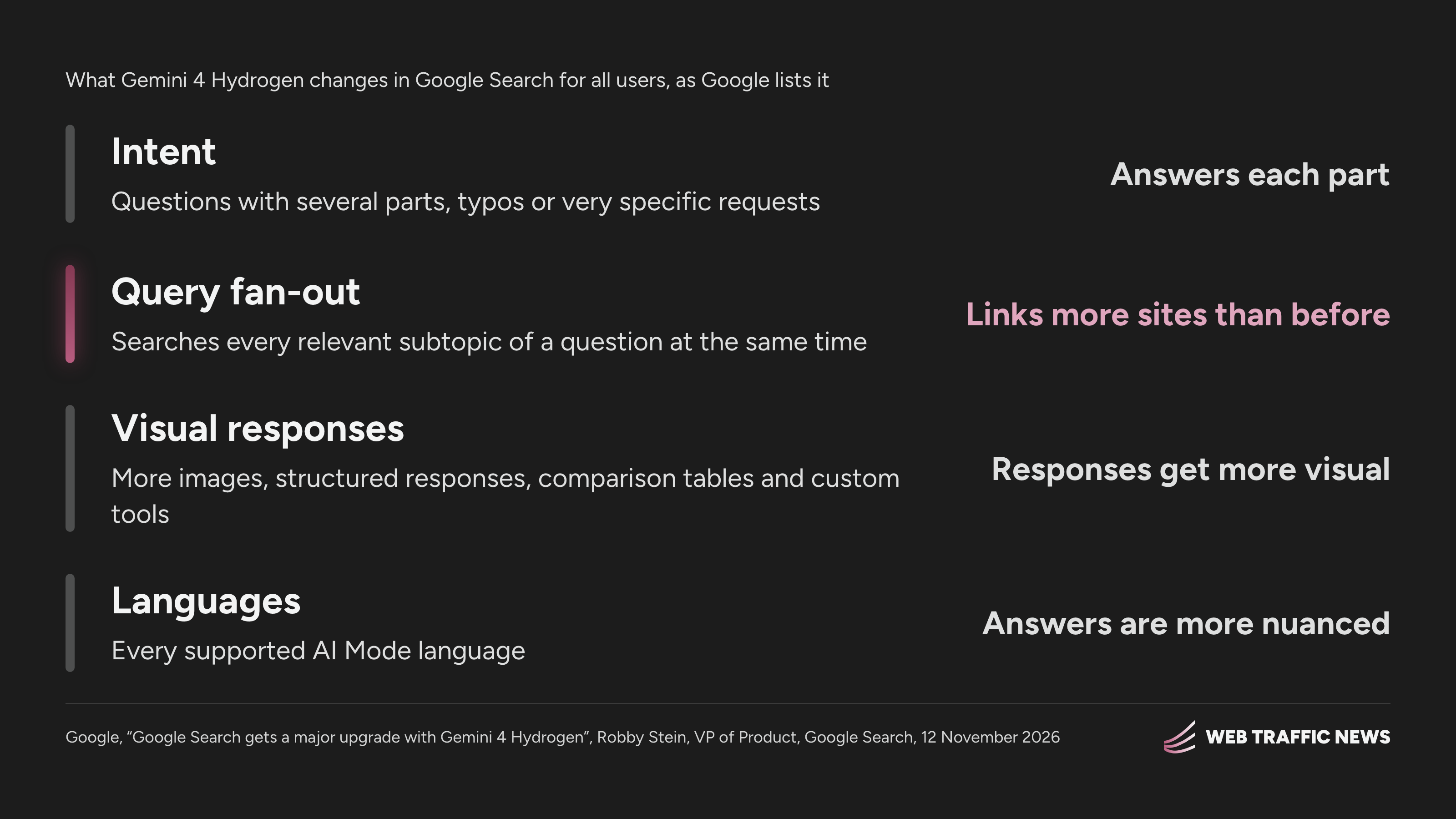
Google ties links to the fan-out change, saying Search now helps people find sites they previously might not have discovered.
Query fan-out is the technique in which Google Search splits one question into searches on its subtopics and runs them at the same time. Google DeepMind’s announcement of Gemini 4 Hydrogen, by Koray Kavukcuoglu, SVP, Google DeepMind, says Hydrogen’s reasoning upgrades that technique. The same post describes Hydrogen as built for rapid execution, while the frontier models Gemini 4 Carbon and Gemini 4 Argon handle deep, long-horizon reasoning.
Google has not said whether Hydrogen is now the default model in AI Mode, or whether it also writes AI Overviews, whose page choice is covered in how Google AI Overviews work and choose the pages they show.
Why it happened
Google Search has moved AI Mode to newer Gemini models since March 2025, and its most capable models reached paying subscribers first. Google introduced AI Mode on 5 March 2025 as a Labs experiment for Google One AI Premium subscribers, with a query fan-out technique that ran several related searches on subtopics at once.
On 18 November 2025, Gemini 3 came to AI Mode for Google AI Pro and Ultra subscribers in the US, and Google said fan-out could perform even more searches. On 19 May 2026, Gemini 3.5 Flash became the default model in AI Mode for everyone globally, as Google said AI Mode had passed one billion monthly users.
On 10 November 2026, Gemini 4 Carbon reached AI Mode for Google AI Ultra subscribers. The five steps in order:
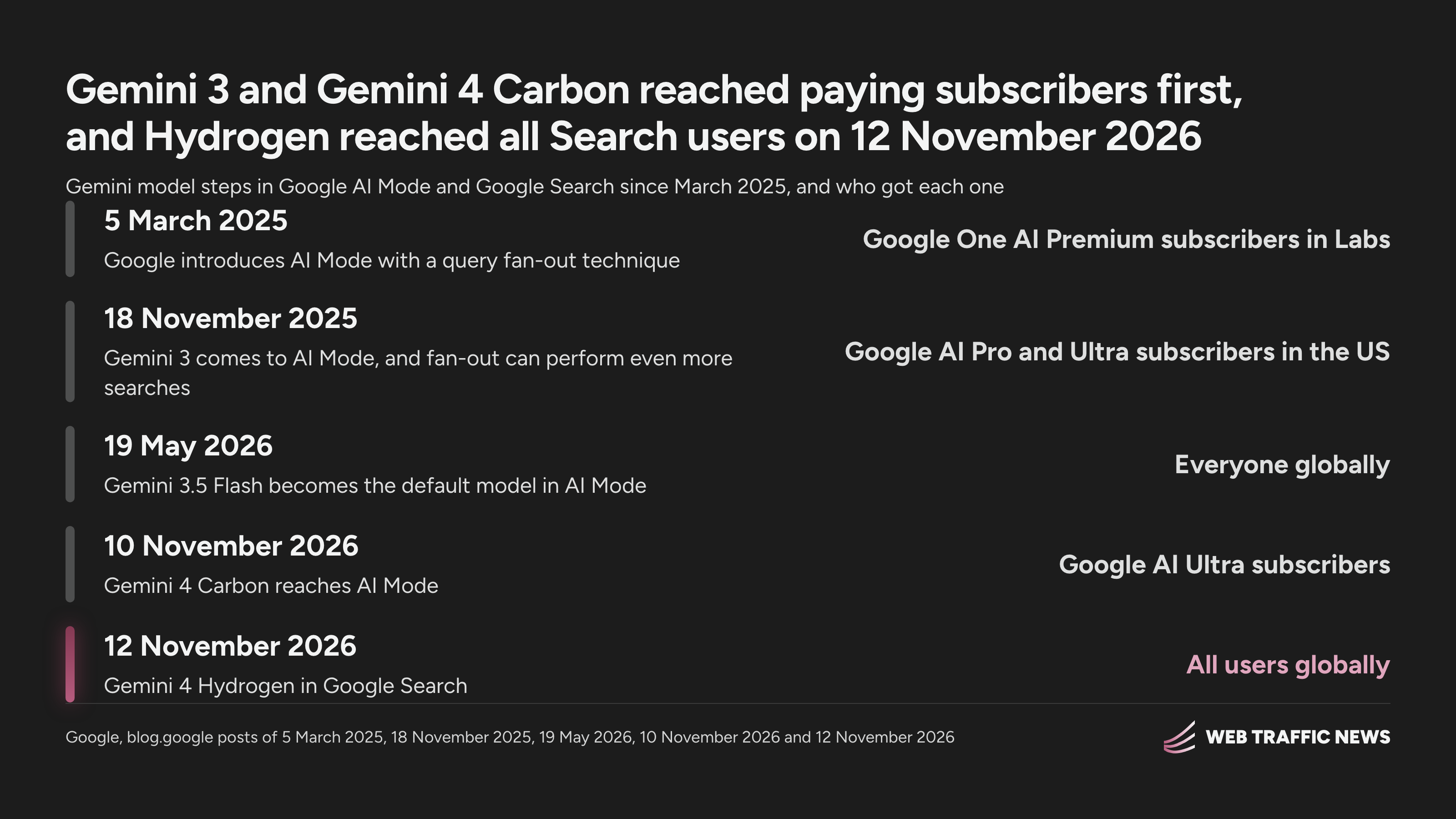
Hydrogen reached all users two days after Carbon reached Ultra subscribers.
What it changes for GEO
Sites with a page for each subtopic of a buyer’s question gain from Gemini 4 Hydrogen, because Google Search now searches every relevant subtopic of a question at the same time and links more sites. The change moves retrieval, the step where Google picks the pages an answer can cite. Fan-out queries differ from what a person types, so a page on pricing, setup or one use case can earn a link in an answer to a broader question.
Brands that built their Google AI visibility on one page ranking for the main query lose share, because that page answers one subtopic out of many and the links now spread across more sites. Google also adds more comparison tables, and comparison pages and best-X-for-Y pages are the pages AI answers pick, so a brand without them leaves the comparison to the brands that have them.
Hydrogen reads multi-part and highly specific questions, and the recommendation inside the answer is the most valuable moment in a purchase. A specific “who can do this for me” question goes to a service page written in the buyer’s own words, so brands whose service pages state the buyer’s conditions in their title and opening get matched to more of those questions.
Hydrogen changes Google alone, and a brand’s position is judged engine by engine, since each engine answers from a different set of cited websites. Agenzy’s 2026 study measured a median 5.1x visibility gap between a brand’s best and worst AI engine, and 30% of visible brands were completely invisible on at least one engine (n=86 brands visible somewhere, 2026-04 to 2026-08). A rise or fall in Google AI Mode after 12 November says nothing about ChatGPT or Perplexity.
What to do
The head of marketing should ask the content team this week to run the buyer questions that bring in revenue through Google AI Mode and record the sites linked, the brands named and the subtopics each answer covers. A prompt set built for AI visibility tracking keeps those questions fixed each week.
For every subtopic where the brand has no page, the team writes one whose title and opening answer that subtopic in the buyer’s words, with comparison pages first. The team then compares impressions in Search Console’s Generative AI performance report for the weeks after 12 November with the weeks before 9 November.
Google lists a logging error that cut impressions in that report from 9 to 11 November 2026, so those three days stay out of the comparison. Early numbers swing on small samples, so the team reads the trend over four weeks or more.
Sources
- blog.google/products-and-platforms/…/gemini-4-hydrogen-search-upgrade
- blog.google/innovation-and-ai/…/introducing-gemini-4-hydrogen
- blog.google/products-and-platforms/…/ai-mode-search
- blog.google/products-and-platforms/…/gemini-3-search-ai-mode
- blog.google/products-and-platforms/…/search-io-2026
- blog.google/innovation-and-ai/…/gemini-4-carbon-now-available
- agenzy.lt/blog/ai-search-visibility-study-2026
- support.google.com/webmasters/…/6211453
The week in AI search, in one email
One email a week with what changed in ChatGPT, Google AI Mode, Perplexity and Gemini, and the week's data piece.