BriefChatGPT
OpenAI says ChatGPT search volume is roughly one-fifth of Google's
OpenAI puts ChatGPT search volume at roughly one-fifth of Google's, so brands that ChatGPT leaves out of its answers miss a growing share of buyers.
 By Emilis Zabilius · · 4 min read
TL;DR
- Adam Fry, ChatGPT’s consumer product lead at OpenAI, said on 2 November 2026 that ChatGPT’s search-like queries are roughly one-fifth of Google’s query volume.
- Brands that ChatGPT recommends on buying questions gain, while brands that judge themselves by Google rankings or referral clicks lose sight of a growing channel.
- Heads of marketing should check which brand ChatGPT recommends on their buyers’ questions, separately from Google, and ask every customer how they found the company.
What changed
ChatGPT search volume is roughly one-fifth of Google’s, Adam Fry, ChatGPT’s consumer product lead at OpenAI, told an OpenAI dinner in New York reported by Big Technology on 2 November 2026. Alex Kantrowitz’s newsletter Big Technology published the conversation on 3 November 2026 and put the figure at approximately 20% of Google’s.
“ChatGPT’s volume of search-like queries is now roughly one-fifth the volume of queries of Google,” Fry said. He counted as search-like anything a user would once have taken to a traditional search engine, such as looking up a person or a place, or a finance or health question.
OpenAI has not published how it counts a search-like query, such as whether each web search in one conversation counts separately, so the one-fifth figure is a spoken estimate. seoClarity, an SEO software company, modeled on 28 October 2026 that ChatGPT’s daily search-equivalent activity equals about 7.5% of Google’s search queries, or about 1.24 billion search-like messages a day. seoClarity built that model from OpenAI’s published usage data and assumptions it lists. The two estimates sit far apart:
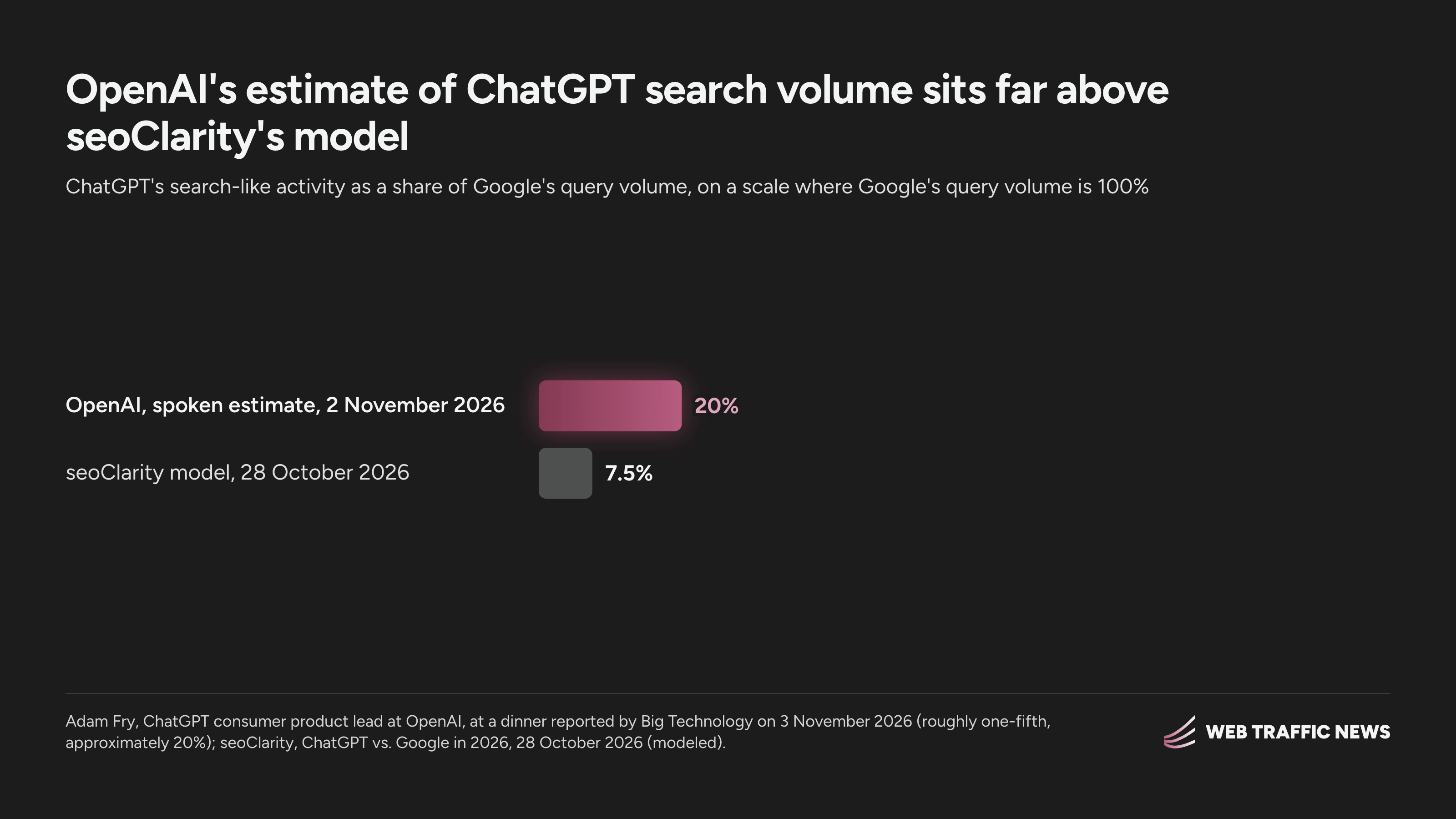
On a scale where Google’s query volume is 100%, OpenAI’s spoken estimate sits at approximately 20% and seoClarity’s model at 7.5%.
Google’s query volume is rising too. Sundar Pichai, CEO of Google and Alphabet, said in his Q3 2026 earnings remarks on 28 October 2026 that Google’s year-over-year query growth was the highest in five years. In the same remarks, Alphabet said AI Mode queries run three times longer than searches.
Why it happened
On 15 September 2025, OpenAI published How People Use ChatGPT, a paper that counted 18 billion messages a week from 700 million users in July 2025. The paper found that Seeking Information messages, about people, current events, products and recipes, appear to stand in closely for a web search.
ChatGPT went from 1 billion to 1.2 billion weekly active users in the two months before 2 November 2026, about 100 million every 30 days, Adam Fry of OpenAI said. Over the past year, he added, users moved from writing and coding help toward questions that need current information. ChatGPT’s weekly users rose like this:
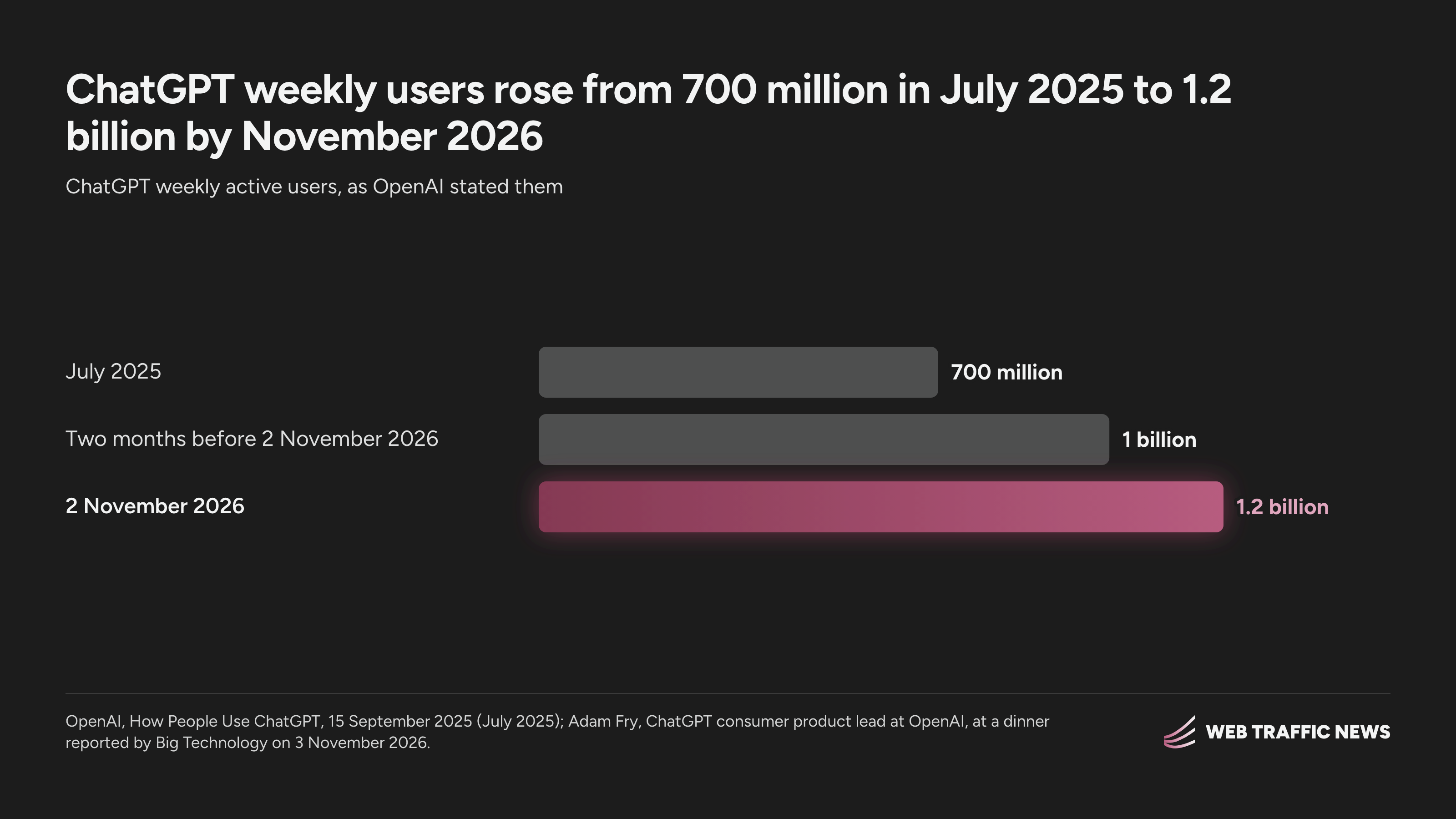
OpenAI’s paper counted 700 million weekly users in July 2025, and Fry put the count at 1 billion two months before 2 November 2026 and 1.2 billion on that day.
What it changes for GEO
A buyer who asks ChatGPT how to solve a problem gets one recommended solution and the business behind it, and OpenAI puts ChatGPT’s search-like queries at roughly one-fifth of Google’s. That recommendation is the most valuable moment in a purchase, so brands that ChatGPT names gain the sale, and brands it leaves out lose it however well they rank on Google. Even seoClarity’s lower 7.5% model means about 1.24 billion search-like messages a day.
ChatGPT adds an engine to win next to Google, and each engine answers from its own sources. ChatGPT, Google AI Overviews and Perplexity share only 2 of their top 10 cited sources when answering the same questions about the same brand, according to Agenzy’s 2026 source study (n=109 business projects). A brand’s Google position says little about whether ChatGPT recommends it, so every judgment is made engine by engine.
ChatGPT search finds candidate pages through Bing, so a page missing from Bing’s index, or worded unlike the buyer’s question, seldom reaches the answer. In Seer Interactive’s study of about 100 questions, published 6 February 2025, more than 87% of SearchGPT citations matched Bing’s top organic results, against 56% for Google. Brands whose pages sit in Bing in the buyer’s words gain. That lever weakens as OpenAI builds its own index, covered in where ChatGPT search gets its information.
Brands that judge ChatGPT by referral clicks underrate it. Buyers who meet a brand in a ChatGPT answer often arrive later through Google or by typing the address, so analytics undercount AI. The Growth Memo data on AI referral traffic as a share of total visits shows how small the click count stays. Asking every customer how they found the company is the reliable measure of what ChatGPT brings in.
What to do
The head of marketing should first have the team write down the questions buyers ask before they buy, in the buyers’ own words. The team then runs each question in ChatGPT and in Google separately, and records which business each engine recommends and which pages ChatGPT cites.
Next, the team searches Bing for the brand’s page that answers each question, and rewrites the title and opening of any page whose words differ from the question. Sales adds “How did you find us?” to the contact form and to the first call.
To check the result, the team reruns the same questions every month and counts, engine by engine, the answers that name the brand. It also counts the customers who name ChatGPT, and both numbers sit among the eight GEO metrics that show whether AI search brings in buyers.
Sources
- bigtechnology.com/p/openai-chatgpt-search-is-about-20
- seoclarity.net/blog/chatgpt-search-volume-vs-google-oct-2026
- blog.google/company-news/…/alphabet-earnings-q3-2026
- cdn.openai.com/pdf/…/economic-research-chatgpt-usage-paper.pdf
- agenzy.lt/blog/which-sources-ai-engines-cite-2026
- seerinteractive.com/insights/87-percent-of-searchgpt-citations-match-bing…
The week in AI search, in one email
One email a week with what changed in ChatGPT, Google AI Mode, Perplexity and Gemini, and the week's data piece.
Up next
$0.89
per visit
in revenue from a paid ChatGPT visit in US traffic, against $2.45 for a paid Google Search visit, in a working paper of October 2026.
Study finds ChatGPT ads revenue per visit trails Google Search ads
Brief
37
%
fall in GA4 sessions from ChatGPT across a few hundred websites from 9 October 2026, as ChatGPT's links lost their tracking tag.
OpenAI's GPT-6 rollout hides a week of ChatGPT referral traffic
Brief
72,000
requests
from ChatGPT-User in 30 days to a site of 50,000 invented statistics, months after Google deindexed its pages.
Peec AI researcher finds ChatGPT kept citing a fake statistics site
Brief