BriefChatGPT
OpenAI lets businesses claim profiles in ChatGPT Business Hub
Businesses can now claim a verified profile in ChatGPT Business Hub and see 28-day mentions and clicks, while ChatGPT still picks whom it recommends.
 By Emilis Zabilius · · 4 min read
TL;DR
- OpenAI opened Business Hub in ChatGPT on 10 November 2026, where verified businesses edit their profile and product feed and see 28-day insights.
- Brands whose websites ChatGPT cites gain a record of mentions and clicks, while brands it leaves out gain a profile that doesn’t guarantee more visibility.
- Heads of marketing should claim their Business Hub profile, correct its details and keep tracking buyer questions themselves, since Business Hub shows no individual prompts.
What changed
OpenAI opened ChatGPT Business Hub on 10 November 2026, according to its ChatGPT release notes, and its help article on setting up a business says an owner or authorized representative can now claim the business from the ChatGPT sidebar. OpenAI reviews each claim, verified by phone, business email, a DNS TXT record or a Shopify store.
After identity verification with Persona, the profile gets a blue check, and the business can update its description, category, logo, delivery and return policies and connect a product feed with prices and availability. OpenAI reviews and publishes each change, and the Businesses in ChatGPT policy says profiles may also include information from other sources.
Business Hub insights cover the past 28 days and include mentions, website clicks and discovery topics, which sort the answers that named or cited the business into themes, with no individual prompts shown. OpenAI’s help article defines the two counts this way:
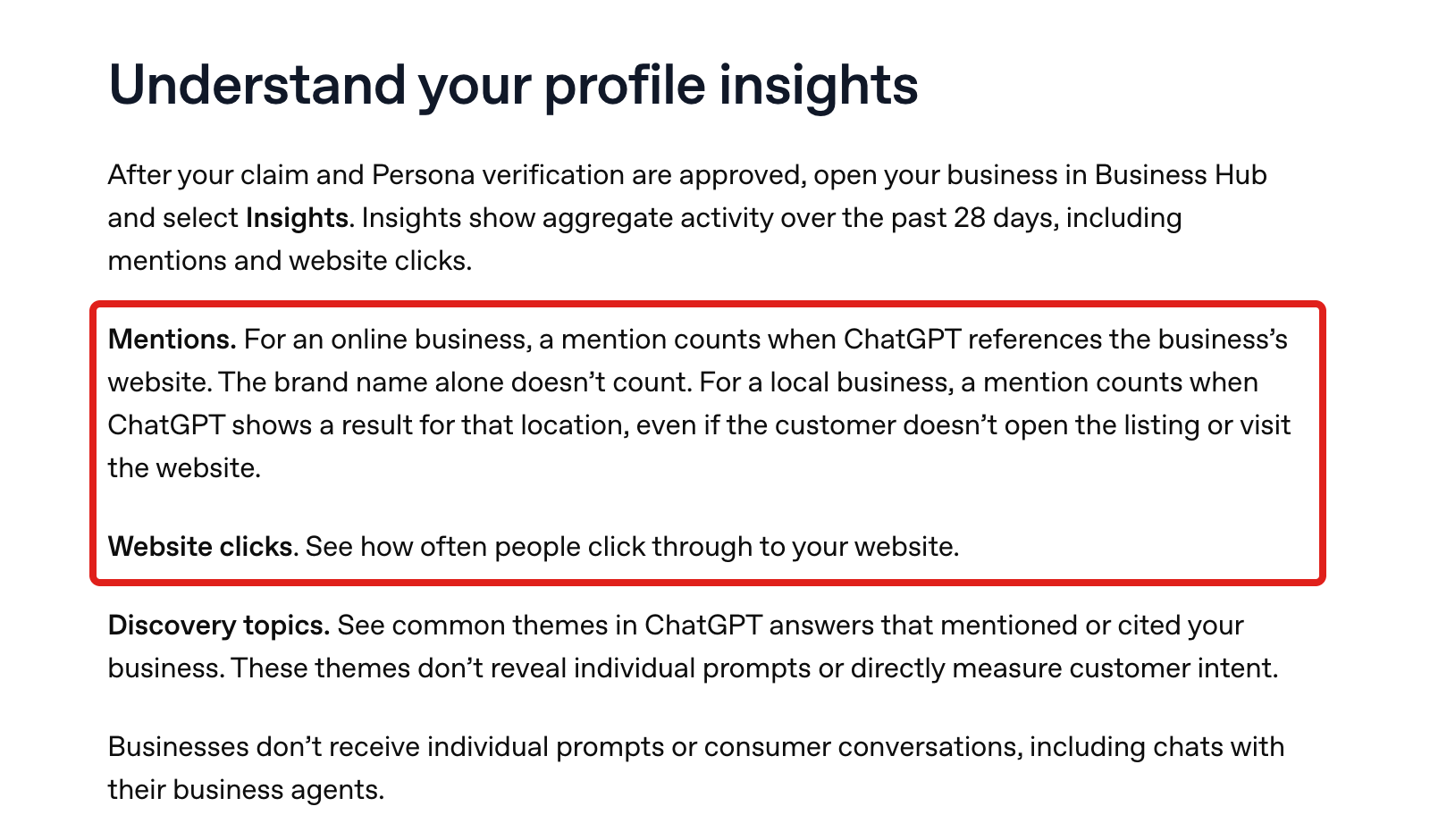
An online business earns a mention only when ChatGPT points to its website, so an answer that names the brand without its site adds nothing to the count. Search Engine Roundtable published the click count’s tooltip on 10 November 2026: “Clicks don’t confirm website visits or conversions.”
Eligible US ecommerce and online service businesses with a website can also publish a business agent that answers customer questions in a separate chat. OpenAI’s help article says claiming “doesn’t guarantee increased visibility or give you direct control over ChatGPT’s independent recommendations,” and that advertising doesn’t influence ChatGPT’s independent answers.
Why it happened
Business Hub opened after three OpenAI moves on search volume and advertising in ChatGPT. On 21 October 2026, OpenAI expanded ChatGPT Ads to 26 more countries and said over 100,000 advertisers have used ChatGPT Ads. Adam Fry, ChatGPT’s consumer product lead at OpenAI, put ChatGPT’s search-like queries at roughly one-fifth of Google’s query volume, Big Technology reported on 3 November 2026.
On 9 November 2026, the day before Business Hub opened, OpenAI’s ChatGPT Ads bidding guide made Target CPA, a target average cost per conversion, the bidding option for new conversion campaigns in place of Max Bid. OpenAI’s help article on Business Hub keeps the two products apart: a business needs no Ads account to claim its profile, and OpenAI runs advertising separately from claiming.
What it changes for GEO
Business Hub gives a brand a verified say in its ChatGPT profile, while ChatGPT still picks the one solution it recommends to a buyer asking how to get something done. OpenAI promises no visibility gain from claiming, so brands that claim and stop there lose the recommendation to brands that get cited in ChatGPT answers.
AI engines judge a brand by how many trusted sources mention it and how widely, and give little weight to what the brand says about itself. Business Hub now takes the business’s own description and product feed, and OpenAI’s policy says a profile may also include information from other sources.
What ChatGPT says about a brand outweighs how often it says it, because a wrong price or an old name in the answer costs deals, and a product feed gives the brand a direct channel for prices and availability. Business agents are open only to eligible US ecommerce and online service businesses, so e-commerce and US-market brands gain first, and B2B manufacturers come later.
Business Hub’s mention count measures one thing for an online business: how often ChatGPT cites the brand’s own website. 34.8% of the businesses in Agenzy’s 2026 source study did not have their own website among the 30 sources AI engines cited most for their own category (n=138 business projects). A brand’s own site is the one source it controls, so citable pages there move this count.
Brands that read Business Hub’s clicks as revenue lose, since OpenAI’s tooltip says clicks don’t confirm visits or conversions, and buyers who met a brand in an answer often arrive later through Google or direct. Asking every customer how they found the company is the reliable measure, the method in how to measure AI search revenue when analytics credits Google.
What to do
The head of marketing should have whoever controls the website domain or the Shopify store claim the Business Hub profile this week, in this order:
- Open Business Hub from the ChatGPT sidebar, find the business and verify it with a method the team controls, such as a DNS TXT record.
- Complete Persona verification, since insights, published changes and agents wait for its approval.
- Correct the description, category, logo, delivery policy and return policy, and connect the product feed so prices and availability match the site.
- Add teammates or the agency from the claiming admin’s account, each person on their own ChatGPT account.
Then track the buyer questions that Business Hub keeps hidden, using AI visibility tracking that shows whether ChatGPT cited the site, and compare each 28-day mention count with that tracking and with what new customers say when asked how they found the company.
Sources
- help.openai.com/en/…/20001635-setting-up-your-business-on-chatgpt
- help.openai.com/en/…/6825453-chatgpt-release-notes
- openai.com/policies/businesses-in-chatgpt
- seroundtable.com/chatgpt-business-hub-42505.html
- openai.com/index/chatgpt-ads-expands-26-new-countries
- bigtechnology.com/p/openai-chatgpt-search-is-about-20
- help.openai.com/en/…/20001634-bidding-strategies-and-how-pricing-…
- agenzy.lt/blog/which-sources-ai-engines-cite-2026
The week in AI search, in one email
One email a week with what changed in ChatGPT, Google AI Mode, Perplexity and Gemini, and the week's data piece.