BriefResearch
Seer Interactive finds AI info pages beat llms.txt in GEO client tests
Seer Interactive's client tests found AI info pages fetched and cited while llms.txt drew almost no bot requests, so wrong AI facts belong on an HTML page.
 By Emilis Zabilius · · 4 min read
TL;DR
- Seer Interactive’s GEO tests, published on 10 November 2026, put llms.txt at 0 for 2 and an AI info page at 3 for 4.
- Brands whose AI answers carry wrong prices or retired products gain a page engines fetch live, and llms.txt budgets buy a file engines rarely request.
- Heads of marketing should list what AI answers get wrong about their brand, publish corrections on one HTML page and check server logs for fetches.
What changed
Seer Interactive published a comparison of llms.txt and AI info pages on 10 November 2026, from its GEO Test & Learn Library of 70 completed GEO tests across 17 clients as of 5 October 2026. llms.txt went 0 for 2 on formal client tests, or 0 for 3 counting a head-to-head launch, and an AI info page was picked up for 3 of 4 clients.
An AI info page, as Seer describes it, is an HTML page of plain facts on a company’s site: what it sells, who buys it and what AI answers get wrong. Of about 9.2M AI answers across 100 client data sets, only 73 cited an llms.txt URL, mostly developer docs.
Seer counted agent requests for both in the server logs of two client sites and its own, over 2026 periods ending 5 October:
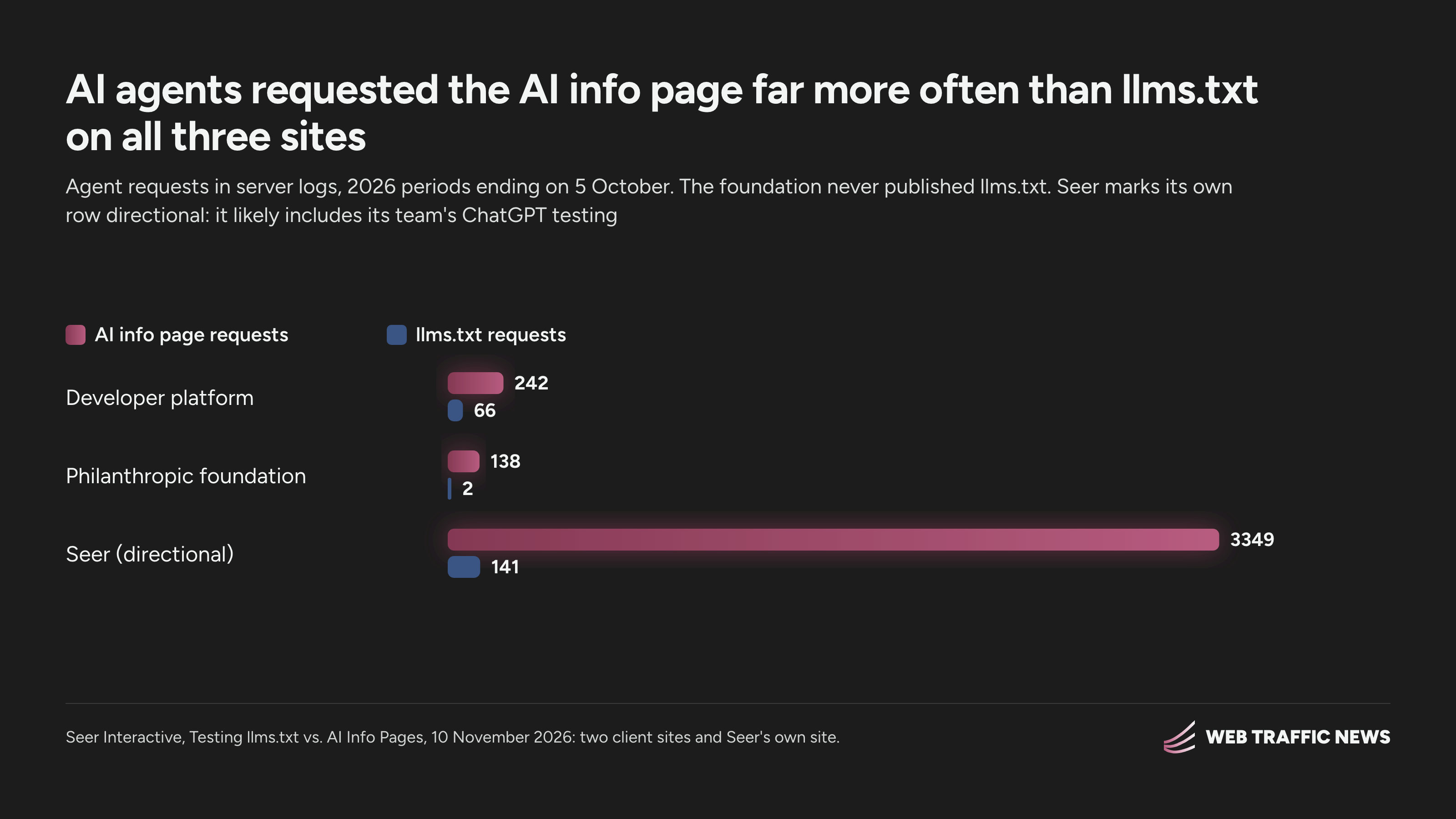
The AI info page drew 242 requests against 66 for llms.txt on a developer platform running both, and 138 against 2 at a philanthropic foundation whose 2 requests were bots seeking an llms.txt it never published. Seer’s site logged 3,349 against 141, a row Seer marks directional because it likely includes its team’s ChatGPT testing.
The miss was a communications SaaS company whose page bots never fetched: 1 of 30 tracked facts reached answers as Markdown and 0 of 30 after an HTML relaunch in January 2026. “A page that never gets fetched can’t change an answer, regardless of what’s on it,” wrote Corey Abramson, Senior Analytics Manager at Seer Interactive.
Why it happened
llms.txt began as a proposal Jeremy Howard published on 3 September 2024 for a Markdown file that helps agents use a website, and what llms.txt is and who actually reads it traces how the file spread. Seer Interactive shipped llms.txt for several clients in 2025 and tested it because the file was cheap and much discussed on LinkedIn, and Seer’s own AI info page went live in October 2025.
Evidence against the file then built up. Ahrefs’ study of 137,210 domains, published on 15 June 2026, found 28% publishing llms.txt and 97% of those files receiving zero traffic in May 2026. Google’s guide to its generative AI features, last updated on 10 July 2026, says sites need no new AI text files, markup or Markdown to appear in Google Search, because Search itself does not use them.
What it changes for GEO
Brands that bought llms.txt as GEO work lose that money, because Seer Interactive’s tests and Ahrefs’ logs show answer engines rarely request the file, and Google Search does not use it. llms.txt does not raise AI visibility, and a proposal that sells it as the fix sells something false.
Brands whose AI answers carry a wrong price or a retired product gain the most, because what an answer says about a brand outweighs how often it names it, and those errors cost deals. An AI info page puts the corrections on the brand’s own site, the one source it controls, and Seer’s energy technology client saw 21 of 57 tracked facts reach ChatGPT answers within about a month.
Access decides whether the page gets read. ChatGPT-User, which OpenAI’s crawler documentation says may visit a page when a user asks ChatGPT a question, requested one developer platform’s AI info page 118 times and its llms.txt 9 times. A site whose robots.txt, CDN or firewall blocks AI crawlers drops out of the engines it blocks, as the AI crawlers list shows.
Brands chasing category recommendations gain from neither tactic. Seer found unbranded category questions unmoved by both, and its own page held the who-are-you answer while losing ground on should-I-hire-you prompts, which Seer says draw on more of the web. AI engines judge a brand by how many outside sources mention it, so category recommendations come from content and mentions on other sites.
Seer’s base is small, two llms.txt tests and four AI info page tests, and Seer calls the page wins thinner because none had a control and most were read on one AI engine. A GEO claim without a measured baseline and a comparison is an anecdote, so each brand’s AI info page is its own test.
What to do
The head of marketing should start this week with a list of every wrong or missing fact that ChatGPT and the other assistants its buyers use give on questions naming the brand. The web team then publishes one AI info page in HTML with those corrections spelled out, dated numbers and the buyers’ words in place of internal product names.
Seer Interactive’s checklist for the page is a clean URL returning a 200 status, no noindex, text readable without JavaScript, a footer link and a sitemap entry. Before judging the page, the team reads the server logs for ChatGPT-User and PerplexityBot requests, since Seer treats no fetch as no test.
Seer takes a first look at language adoption on branded prompts after 4 weeks and makes the call at 12, and AI visibility tracking shows whether the answers cite the page.
Sources
The week in AI search, in one email
One email a week with what changed in ChatGPT, Google AI Mode, Perplexity and Gemini, and the week's data piece.