BriefClaude
Peec AI finds Claude search uses Brave and reads an eighth of a page
Peec AI found Claude search draws on Brave and passes about an eighth of a page to its model, so the answer passage has to sit near the top.
 By Emilis Zabilius · · 4 min read
TL;DR
- Peec AI reported on 28 October 2026 that Claude forwards about 1,900 of a typical page’s 14,600 characters to the model that writes its answers.
- Pages in Brave’s index with the answer near the top gain Claude citations, while pages missing from Brave or burying the answer lose them.
- Heads of marketing should have the web team submit the most important pages to Brave Search and move each page’s answer passage to the top.
What changed
Peec AI published research on how Claude search picks what it reads and cites on 28 October 2026. Peec AI, an AI search analytics company, ran the tests through the Claude API, which exposes the queries Claude runs, the pages Claude fetches and the text Claude quotes.
Peec AI measured that 89.1% of the pages Claude cites also appear in Brave’s top 20 results for the same queries, across 1,000 prompts, 8,500 URLs and 1,000 Claude queries. A typical page in Peec AI’s data held about 14,600 characters, and Claude forwarded about 1,900 of them to the model that writes the answer:
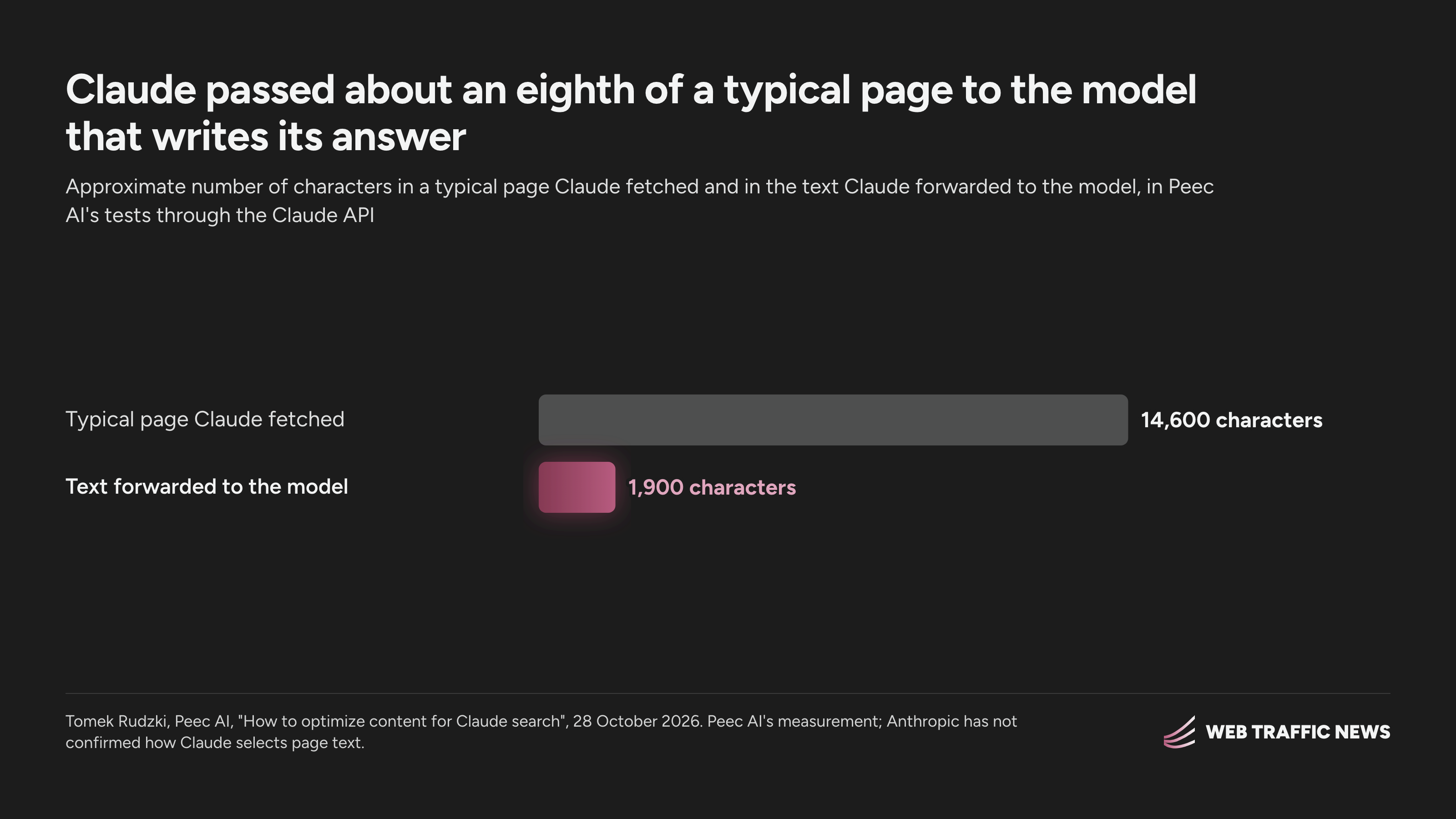
Claude’s answer model saw about an eighth of a typical page in Peec AI’s tests.
Anthropic states the provider behind its web search and how results come back. Anthropic’s subprocessor list names Brave Search as the subprocessor for web search in all Anthropic products. Anthropic’s web search documentation names no provider, returns each result’s content encrypted and shows up to 150 characters of each cited passage.
For a page Claude fetches by its address, Anthropic’s web fetch documentation says the API retrieves the full text content. Peec AI’s eighth comes from pages Claude reached through its own search queries in the API.
Peec AI infers that Claude picks passages with BM25, a word-matching formula, together with an embedding model that scores meaning, probably a custom one. “None of these conclusions have been officially confirmed by Anthropic,” wrote Tomek Rudzki, GEO expert at Peec AI.
Why it happened
Peec AI built its tests on Anthropic’s contextual retrieval research, published on 19 September 2024. Anthropic reported that adding context to each chunk cut the top-20-chunk retrieval failure rate, the share of relevant passages missing from the 20 best-scored chunks, by 35%. Combining that with BM25 cut the rate by 49%, and adding a reranker cut it by 67%.
The same Anthropic post found Gemini and Voyage embeddings particularly effective. Peec AI tested both among 12 public embedding models: Voyage and Gemini came closest to Claude’s citations, and a model Peec AI trained on those citations beat both. According to Peec AI, nobody at Anthropic has confirmed which algorithm picks the text Claude reads.
What it changes for GEO
Brave’s index decides which pages Claude can cite. Each engine retrieves from its own sources: ChatGPT search gets its information from outside providers, Microsoft’s Bing among them, and from OpenAI’s own index, while Anthropic names Brave Search for Claude. Brave’s API page says every result comes from Brave’s own index with no fallback, so a page missing from Brave seldom reaches Claude’s answer, whatever its Google rank.
Pages shaped like the buyer’s question gain in Claude, a pattern the University of Toronto study of AI citations also found in ChatGPT. Peec AI found that Claude turns a question into fan-out queries, the short searches Claude runs for the user, and adds words the user never typed, such as the year. Peec AI measured how often each method found the passage Claude quoted, across 734 pages and 1,568 quotes:
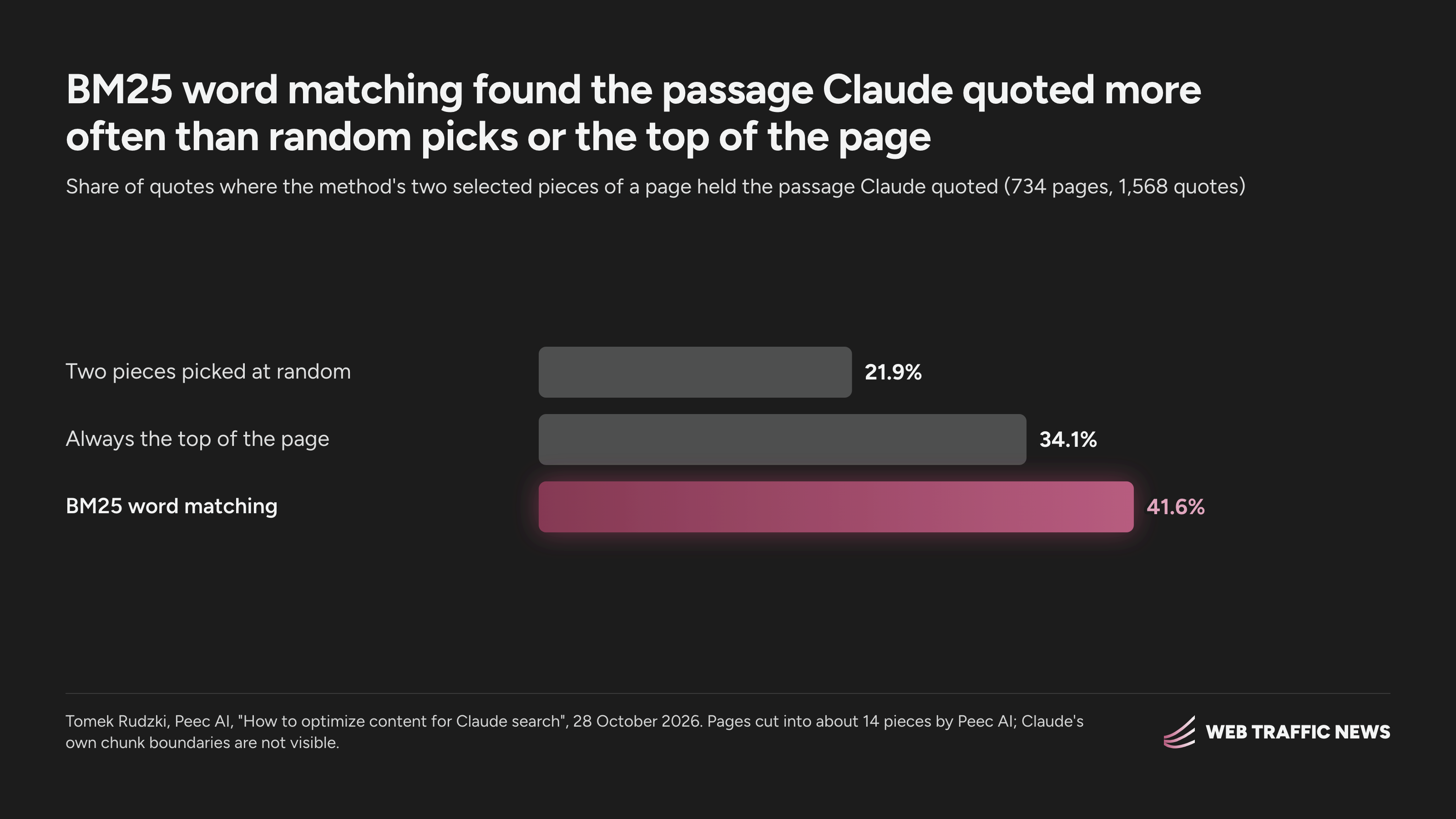
BM25, the word-matching formula, found Claude’s quote 41.6% of the time, against 34.1% for the top of the page and 21.9% for two random pieces. Peec AI tested BM25 against two baselines, which makes the result one of the few tested GEO findings, though Anthropic has not confirmed it.
Pages that answer near the top in the fan-out queries’ own words gain, and specific terms such as years and exact product names help BM25 find that answer. Long guides that save the answer for the end lose. Claude’s answer can only use the slice Claude receives, so an old price or product name in the chosen passage reaches the buyer.
Access comes first. Anthropic’s crawler page says blocking Claude-SearchBot, which indexes content for search, or Claude-User, which fetches pages when a person asks, may reduce a site’s visibility in Claude’s search results. Anthropic’s web fetch tool also refuses URLs that robots.txt blocks.
What to do
To optimize content for Claude, the head of marketing should have the web team check that Brave Search returns the site’s most important pages. The team submits the missing ones through Brave’s URL submission page. The web team then confirms that robots.txt allows Claude-SearchBot and Claude-User, and that those pages read without JavaScript, which Anthropic’s web fetch tool cannot render.
The content team picks the one passage on each page that answers the buyer’s question and moves it to the top. The team rewrites that passage with the year, the audience, the figures and the exact product names.
The web team can check server logs for Claude-SearchBot visits to the site’s most important pages, one of the checks AI visibility tracking runs for each AI assistant. Claude’s web search always cites its sources, so asking Claude the buyers’ questions each week shows which pages Claude cites for them.
Sources
- peec.ai/blog/how-to-optimize-content-for-claude-search
- trust.anthropic.com/subprocessors
- platform.claude.com/docs/…/web-search-tool
- platform.claude.com/docs/…/web-fetch-tool
- anthropic.com/engineering/contextual-retrieval
- brave.com/search/api
- support.claude.com/en/…/8896518-does-anthropic-crawl-data-from-the-w…
- search.brave.com/submit-url
The week in AI search, in one email
One email a week with what changed in ChatGPT, Google AI Mode, Perplexity and Gemini, and the week's data piece.
Up next
0.5
%
of all visits came from AI referrals across 10,000 domains each in the US and France, in Similarweb data analyzed by the Growth Memo.
Growth Memo data puts AI referral traffic at 0.5% of total visits
Brief
72,000
requests
from ChatGPT-User in 30 days to a site of 50,000 invented statistics, months after Google deindexed its pages.
Peec AI researcher finds ChatGPT kept citing a fake statistics site
Brief
A University of Toronto study of what drives AI citations found search retrieval outweighs page features, so pages have to match how the model searches.
University of Toronto study finds retrieval drives AI citations
Brief