BriefResearch
Podqi finds AI chatbots recommend fake websites to shoppers
Podqi's review of 6,795 shopping answers shows AI chatbots recommend fake websites and dead stores, so brands must check where AI sends their buyers.
 By Emilis Zabilius · · 4 min read
Podqi’s review of 6,795 shopping answers shows AI chatbots recommend fake websites and dead stores, so brands must check where AI sends their buyers.
TL;DR
- Podqi’s study, reported by The Verge on 12 November 2026, found 9% of 6,795 ChatGPT, Gemini and Perplexity shopping answers showed a risky website.
- Impersonators gain buyers when AI answers recommend their sites, and brands selling across borders lose most on the question about regional websites.
- Heads of marketing should run the riskiest where-to-buy questions about their brand every month and publish one crawlable page listing every official store.
What changed
AI chatbots recommend fake websites and dead stores to shoppers, according to a study by IP protection firm Podqi, shared exclusively with The Verge, which reported it on 12 November 2026. Podqi asked ChatGPT, Gemini and Perplexity five where-to-buy questions about 151 brands over two waves in September 2026, with data from AI search company Gauge, and reviewed every website the 6,795 answers named.
Podqi labeled a site risky when it seemed to pose as the brand or sell suspected counterfeits, and when it was dead. Of 4,437 domains reviewed, 718 were risky: 351 fake and 367 dead. In all, 9% of answers showed a risky website, with shares differing by engine:
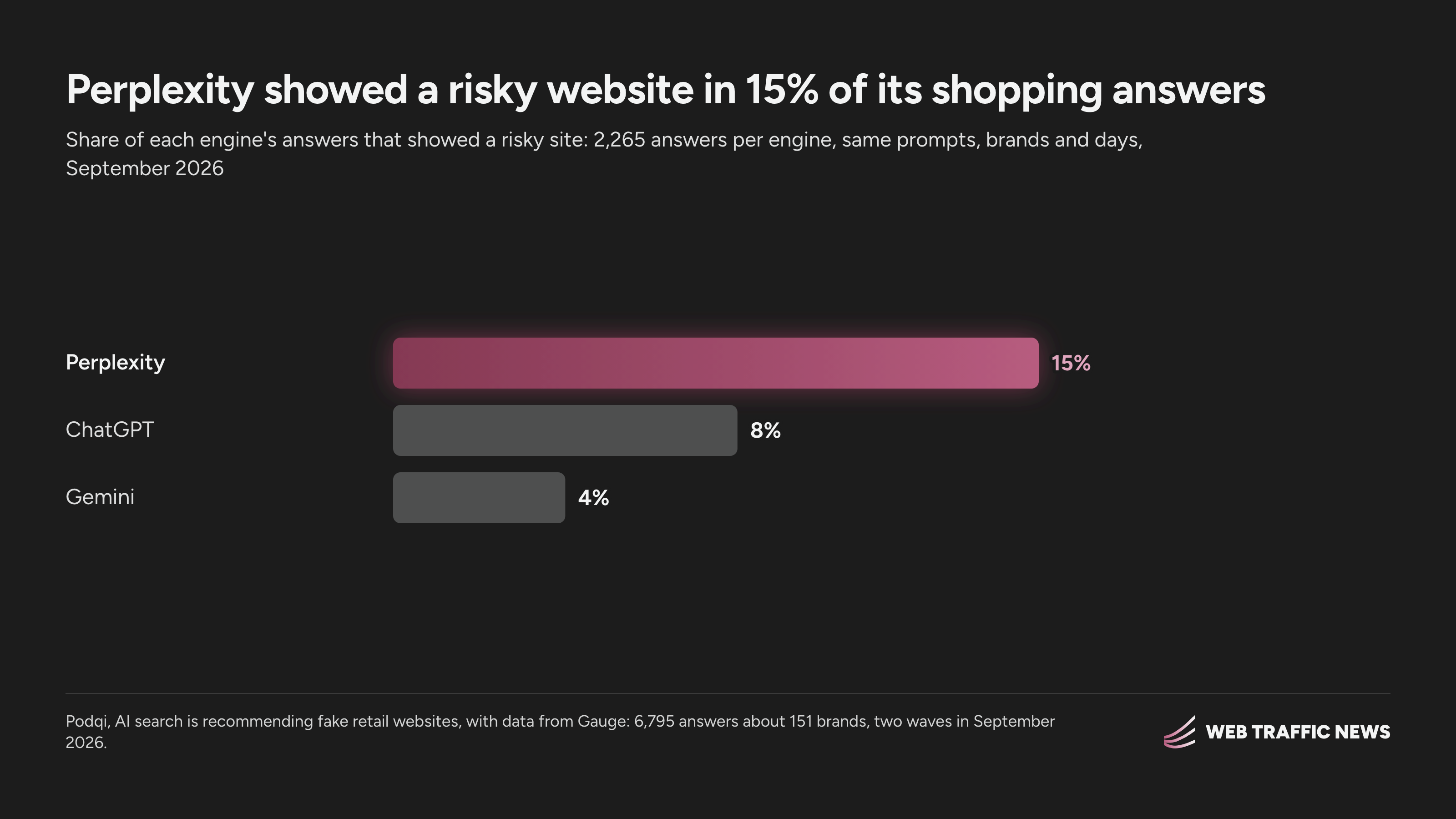
Perplexity showed a risky site in 15% of its answers, ChatGPT in 8% and Gemini in 4%, from 2,265 answers per engine on the same prompts, brands and days.
The riskiest question asked for a brand’s regional websites, with 16% of its answers showing a risky site. Risk fell from 12% of answers in the first wave to 7% in the second. When an answer did show a risky site, the engine mostly presented it as a place to buy:
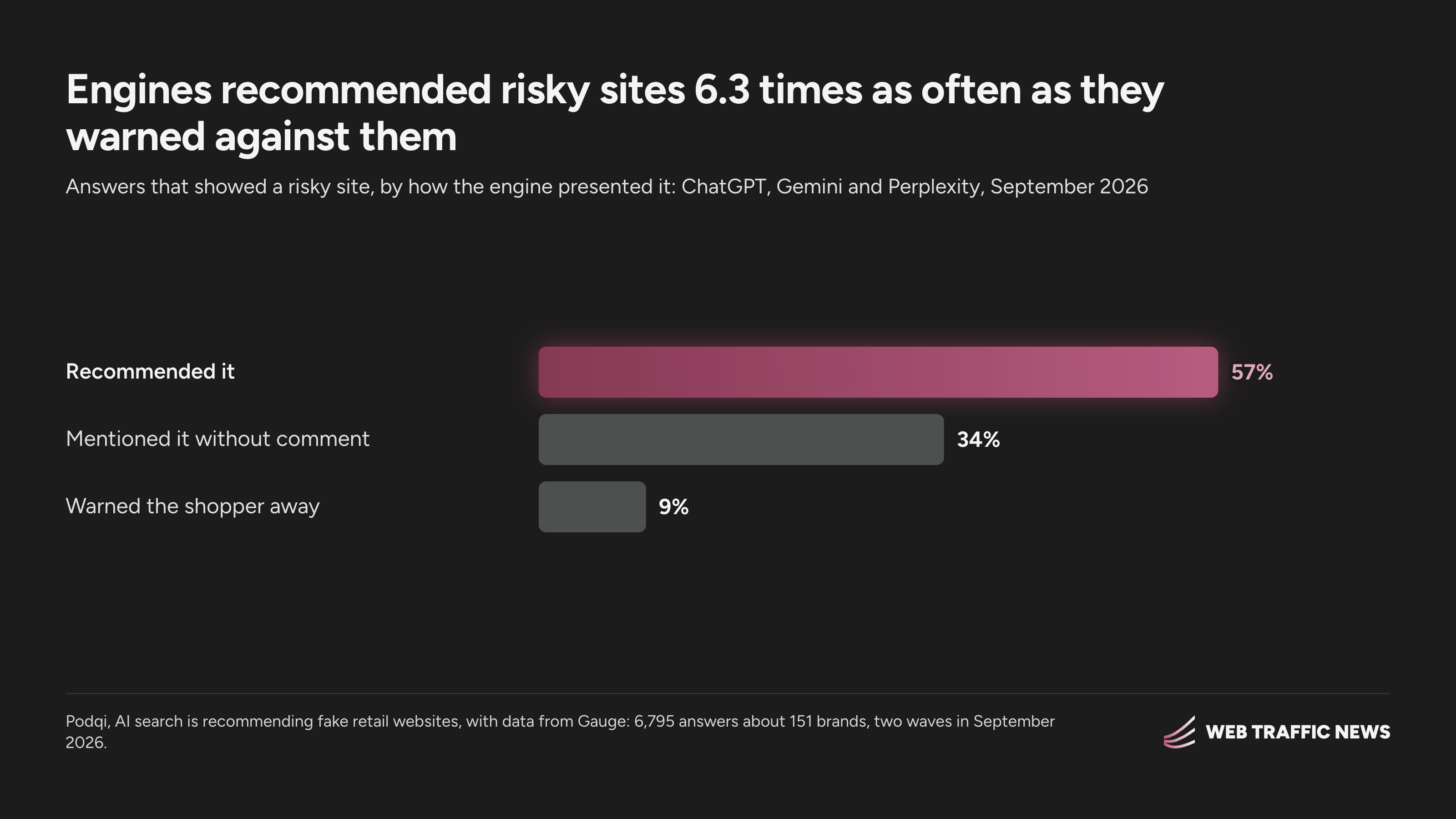
Of those answers, 57% recommended the risky site, 34% mentioned it without comment and 9% warned the shopper away, so engines recommended risky sites 6.3 times as often as they warned against them. “We’re continuing to improve our safeguards to make potentially deceptive sites less likely to appear in shopping-related results,” OpenAI spokesperson Taya Christianson told The Verge.
Why it happened
All three engines built shopping into their answers in late 2025. OpenAI’s ChatGPT release notes record Instant Checkout on 29 September 2025, when OpenAI said ChatGPT finds organic, unsponsored product results from across the web. Google added places to buy to the Gemini app for US users on 13 November 2025, drawing on a Shopping Graph of more than 50 billion product listings. Perplexity launched shopping for all US users on 25 November 2025, with PayPal checkout.
Podqi says the engines are aware of counterfeits, because one in five answers that mishandled a risky site carried a general warning about fakes, and that telling which site is fake needs data on who owns it. Dead domains open a second route, since a lapsed domain is open to anyone who registers it again, and 367 of the 718 risky domains Podqi found were dead.
What it changes for GEO
What AI says about a brand outweighs how often it says it, and Podqi’s study measures the worst case: an answer that names the brand and recommends someone else’s store. Podqi counted about 5 such recommendations in every 100 shopping answers. The recommendation is the most valuable moment in a purchase, so the brand loses that sale to a lookalike or a dead site.
Impersonators and anyone who re-registers a lapsed brand domain gain. Brands that sell across borders lose most, because the question about regional websites was the riskiest, at 16% of answers. Smaller brands lose more often, since The Verge reported that Podqi found answers about larger companies showed risky sites about half as often. Size buys little protection once a fake appears: 4 of 125 risky answers about enterprise brands warned the shopper.
Each engine answers from its own sources, so a brand measures this exposure engine by engine: on the same prompts, brands and days, Perplexity showed a risky site in 15% of answers and Gemini in 4%.
A brand’s own site is the one source it controls, so the fix begins on that site. OpenAI’s help page on shopping in ChatGPT search says, as of 13 November 2026, that ChatGPT ranks merchants partly on whether they are the maker or primary seller of an item. Engines still named a regional site for about 40 brands that have none, and one crawlable list of official stores hands engines an accurate answer to that question.
34.8% of the businesses in Agenzy’s 2026 source study did not have their own website among the 30 sources AI engines cited most for their own category (n=138 business projects). A brand can track how often AI answers cite its own website before and after it publishes that list.
What to do
The head of marketing should have the team ask ChatGPT, Gemini and Perplexity three of Podqi’s riskiest questions about the brand this month: its regional websites, the top websites for buying it and where else to buy it. The team logs each domain the answers show, marks those the brand doesn’t run and notes whether the answer recommended, named or warned against each one.
The web team builds one crawlable page of the brand’s official country stores and authorized sellers, states which markets have none and links it from the footer and help pages. The legal team lists the brand’s lapsed domains. A verified business can also claim its profile in ChatGPT Business Hub and connect a product feed.
The check is the share of answers naming a domain the brand doesn’t operate, rerun every month on each engine with AI visibility tracking that shows which sites an answer cited.
Sources
- podqi.com/research/ai-search-brand-risk
- theverge.com/ai-artificial-intelligence/…/gemini-chatgpt-perplexity-shopping-test-risk…
- help.openai.com/en/…/6825453-chatgpt-release-notes
- blog.google/products-and-platforms/…/agentic-checkout-holiday-ai-shopping
- perplexity.ai/hub/…/shopping-that-puts-you-first
- help.openai.com/en/…/11128490-shopping-with-chatgpt-search
- agenzy.lt/blog/which-sources-ai-engines-cite-2026
The week in AI search, in one email
One email a week with what changed in ChatGPT, Google AI Mode, Perplexity and Gemini, and the week's data piece.