BriefGoogle
Google spam guidance now covers shareable pages and generated outputs
Google spam guidance now tells services with shareable pages, generated outputs or tools to noindex link-only pages, and only indexed pages reach AI Overviews.
 By Emilis Zabilius · · 4 min read
TL;DR
- Google Search’s guide on user-generated spam, updated 26 October 2026, tells services with shareable pages, generated outputs or tools to noindex link-only pages by default.
- Brands mass-generating pages lose to brands with fewer pages built on buyers’ questions, since Google calls page-per-query publishing aimed at AI answers scaled content abuse.
- Heads of marketing should list each page type their site generates at scale, noindex the link-only ones and keep the pages that answer buyers’ questions.
What changed
Google spam guidance for sites that host what their users make gained a section called “Only index content meant for Search” on 26 October 2026, in Google’s guide to preventing user-generated spam. Google’s documentation changelog says the update helps sites keep user-created pages not meant for Search out of the index and catch spam earlier.
Google’s new section on link-only pages opens with a condition, “If your service lets users create shareable pages, generated outputs, or interactive tools”, and asks such services whether each page should be found through search engines or only opened by people with the link. For pages made for direct sharing, collaboration or utility, the default is a noindex rule, set in a robots meta tag or an X-Robots-Tag header, or a robots.txt crawl block.
The guide’s introduction names hosting services and tools that let users publish shared pages, generated content or web apps. That covers AI chat apps whose share links create public pages, app builders that host what users make, and calculators or generators that give each result its own URL.
The 26 October update added Search Console checks: alerts for manual actions, the Page Indexing and Search performance reports watched for spikes, and a flag when a few users generate a large share of indexable URLs.
The new section sits between Google’s advice on spammy accounts and its advice on manual approval:
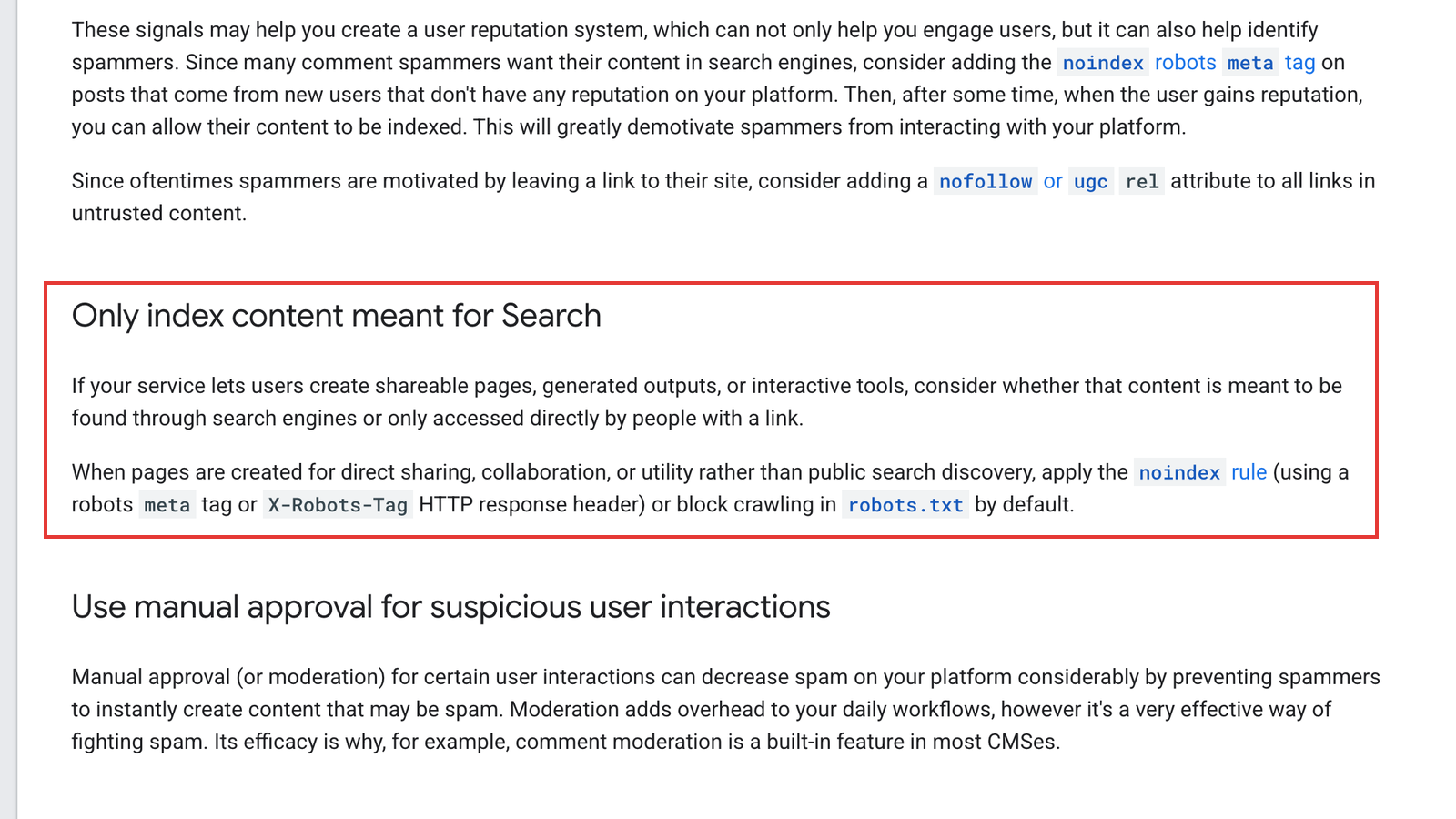
The framed text is the 26 October addition, which makes noindex or a robots.txt block the default for link-only pages.
Why it happened
Google has narrowed the room for mass-produced pages in dated steps. On 5 March 2024, Google added a scaled content abuse policy covering pages made mainly to manipulate rankings, whether automation, people or a mix of both produced them.
On 15 May 2026, Google’s guide to optimizing for generative AI features said that separate pages for every variation of a search, fan-out queries included, made mainly to sway rankings or AI responses violate the scaled content abuse policy. Google’s changelog records a clarification on 15 May 2026 that the spam policies apply to generative AI responses in Google Search.
On 1 October 2026, Google updated its guidance on using generative AI content, which says that generating many pages with AI tools without adding value for users may violate the scaled content abuse policy.
What it changes for GEO
Brands whose GEO plan rests on publishing pages at scale lose in Google’s AI answers, and brands with a small set of pages built on buyers’ questions gain. Google AI Overviews and AI Mode use only pages that are indexed and eligible for a snippet, the first rule in how Google AI Overviews choose the pages they show, so a noindexed page drops out of both.
Against Google’s scaled content abuse policy of March 2024, the 26 October 2026 section on link-only pages is a small step: it adds a default for pages that users create and Search Console checks that catch a sudden rise in indexed pages.
AI engines judge a brand by how many trusted sources mention it and how widely, and give little weight to what the brand says about itself. Every generated page on a brand’s own domain is the brand describing itself once more, adding volume without the outside mentions that make engines recommend a brand more often.
Pages shaped like the buyer’s question get picked, and content has to match the searches a model runs, the retrieval step behind what drives AI citations. Since 15 May 2026, Google has treated one page per fan-out variation, made to sway AI responses, as scaled content abuse, so the fan-out match belongs inside comparisons, “best X for Y” pages and service pages in the buyer’s words.
A brand’s own site is the one source it controls, and Google’s spam policies say sites that violate them may rank lower or not appear at all. Brands running calculators, configurators or AI assistants with share links gain by noindexing result pages early. The tool’s landing page stays indexed, since a block applied too widely drops a site out of the engines it blocks, often without the owner knowing.
What to do
The head of marketing should ask the web team for a list of every page type the site creates without an editor: tool results, shared chats or reports, and generated comparison or location pages. The team keeps indexed the pages that answer a buyer’s question and adds a noindex rule to result and share pages that people open by link.
Next, the head of marketing asks any GEO provider which buyer question each generated page answers, and drops pages written for single query variations. The web team verifies the site in Search Console and reads the Page Indexing and Search performance reports each month. The check is an indexed page count that falls to the chosen pages while the buyer-question pages stay indexed, the first condition for getting pages cited in Google AI Overviews.
Sources
The week in AI search, in one email
One email a week with what changed in ChatGPT, Google AI Mode, Perplexity and Gemini, and the week's data piece.
Up next
0.9
%
estimated click-through rate of one site's Google AI Overviews and AI Mode impressions, measured by opting the site out of Google's AI features.
Opt-out test puts Google AI Overviews and AI Mode CTR at about 0.9%
Brief
Universal Cart lets U.S. shoppers save and buy products from many stores in Google Search and Gemini, so retailers missing from AI answers lose the sale.
Google launches Universal Cart across Search and the Gemini app
Brief
Google's Connected Apps Platform brings brands' apps into Search and Gemini, and AI Mode may default to the app a user last picked for a task.
Google opens a Connected Apps Platform for Search and Gemini
Brief