BriefResearch
University of Toronto study finds retrieval drives AI citations
A University of Toronto study of what drives AI citations found search retrieval outweighs page features, so pages have to match how the model searches.
 By Emilis Zabilius · · 4 min read
TL;DR
- University of Toronto researchers reported on 10 October 2026 that retrieval explained 32% of ChatGPT’s citation variation within websites, against 2.8% for page features.
- Brands ChatGPT already knows gain, because ChatGPT writes known brands into its searches, while the tracked B2B vendor’s own website drew 2.6% of citations.
- Marketing leads should rewrite page titles and opening paragraphs to answer buyers’ questions in the buyers’ own words, then earn mentions on third-party pages.
What changed
University of Toronto researchers Mahe Chen and Nick Koudas published a study of what drives AI citations on arXiv on 10 October 2026. The study follows 158,099 answers with 468,037 citations from ChatGPT, Gemini and Perplexity, collected every day from 24 June to 21 September 2026 through each engine’s API with web search on.
The researchers picked two opposite markets. US home internet, a consumer market led by a few large brands, gave 651 questions and 143,249 answers. Proposal software for building design and construction firms, a niche B2B market of small vendors, gave 55 questions and 14,850 answers.
When the researchers replayed the questions, every page ChatGPT cited was one its own search had returned, 100.0% of 22,315 cited URLs. The share of within-website variation in ChatGPT’s 90-day citation counts that retrieval and page features explained, by market:
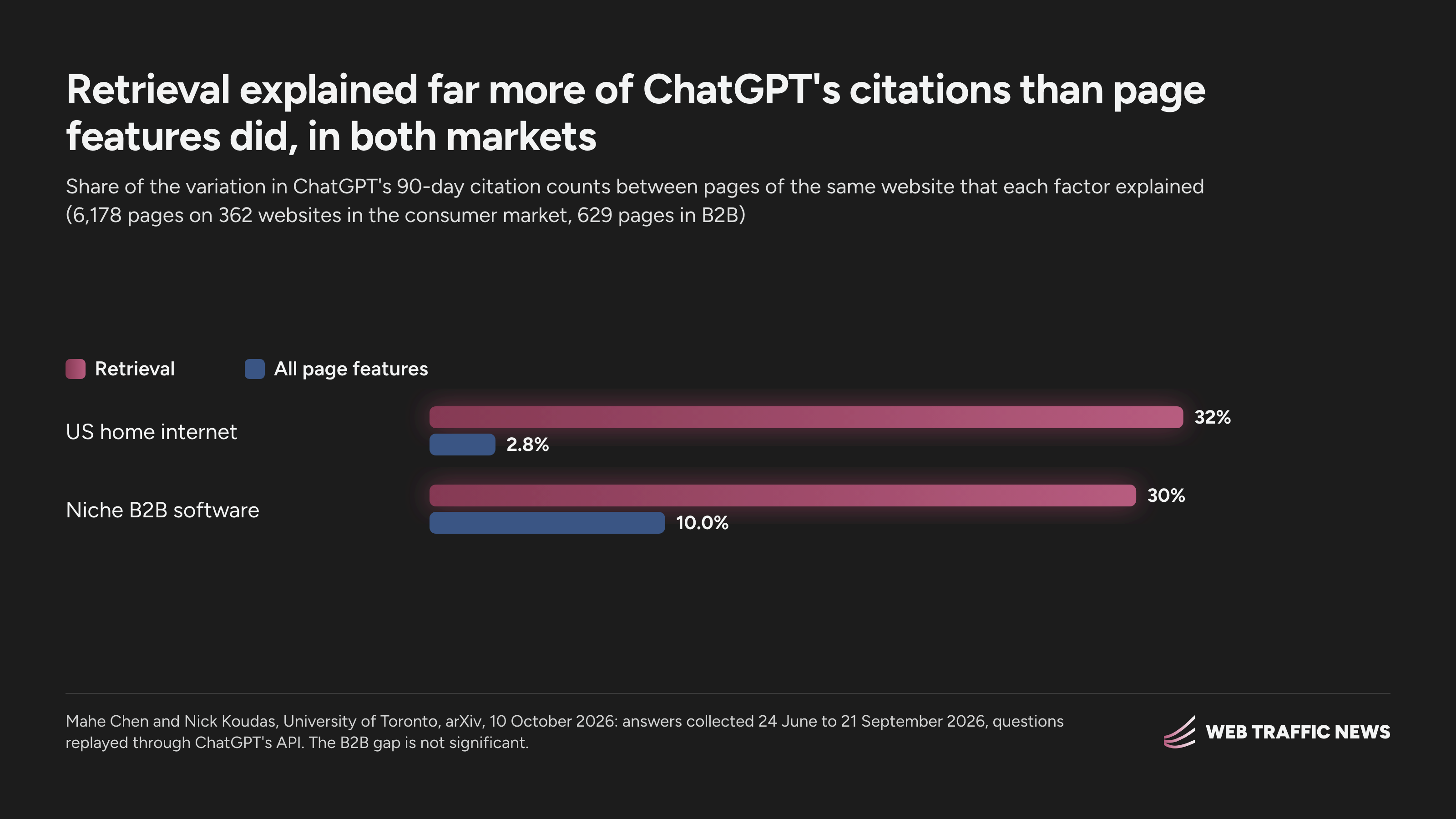
Retrieval explained 32% in the consumer market (6,178 pages on 362 websites), against 2.8% for all page features together. In the B2B market the figures were 30% and 10.0%, a gap the authors report as not significant with 629 pages.
“Pages are thus cited when searched; brands are also named when remembered,” wrote Mahe Chen and Nick Koudas, researchers at the University of Toronto. The study covers English questions about the US market, and the authors state that its results are associations and that the engines’ APIs need not behave like their consumer apps.
Why it happened
Earlier GEO research tested page rewrites on fixed sources. On 16 November 2023, Pranjal Aggarwal and colleagues introduced generative engine optimization, later accepted at KDD 2024, and reported that rewriting content raised visibility in generated answers by up to 40%.
On 6 June 2025, the C-SEO Bench study by Haritz Puerto and colleagues found most such rewriting methods largely ineffective and often harmful to a page’s ranking in AI answers. Traditional SEO methods worked better in the same tests.
On 10 September 2025, Chen, Koudas and two co-authors reported that AI search leaned heavily on earned media, meaning third-party reviews and publishers. Earned sources made up 92.1% of GPT’s US consumer electronics results. The new paper’s authors write that the recommended page practices were largely untested outside controlled settings. Fixed-source tests measure only the answer step, so the authors replayed the engines’ own searches.
What it changes for GEO
Most GEO advice was never tested, and the University of Toronto study tested its staples. FAQ blocks went with 18.1% more citations across websites, because the most cited websites use them more. Within a website, FAQ blocks, structured data, summary boxes, author boxes and page speed showed no significant effect in the study.
Pages shaped like the buyer’s question get picked: a title matching the questions went with 14.1% more citations per standard deviation within a website, and the best-matching paragraph with 15.5% more. ChatGPT search gets its sources from about four rewritten queries per question, so pages have to match how the model searches.
Brands the models already know gain most, because a model that has learned who the answer is keeps recommending it. ChatGPT wrote a brand into its searches in 67% of cases when its model named that brand for the question without searching, against 11% otherwise. Small vendors lose: ChatGPT’s model named the tracked B2B vendors for only 2 to 16% of the questions.
The study also sorted citations by the owner of the cited website:
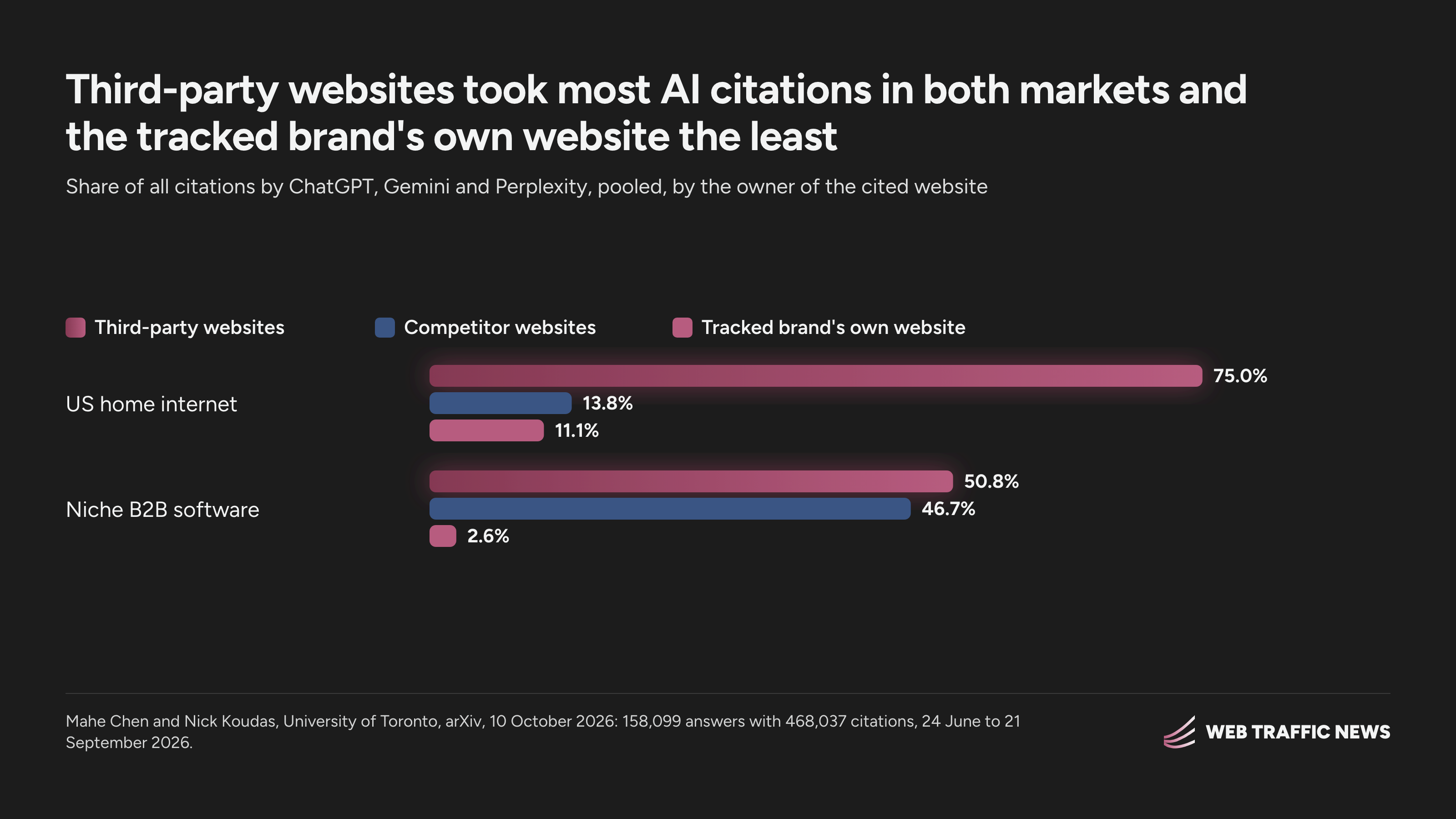
Across the three engines, the tracked brand’s own website took 11.1% of consumer-market citations, competitors 13.8% and third-party websites 75.0%. That share shows how often AI answers cite a brand’s own website, the one source a brand controls. In the B2B market the shares were 2.6%, 46.7% and 50.8%.
AI engines judge a small brand by the trusted sources that mention it. A cited third-party page naming a niche vendor raised ChatGPT’s odds of naming that vendor by a factor of 39.7. 34.8% of the businesses in Agenzy’s 2026 source study did not have their own website among the 30 sources AI engines cited most for their own category (n=138 business projects).
What to do
The head of marketing should have the content team list the questions buyers ask before they buy. The team then rewrites the title and one paragraph of each page meant to be cited, so each answers one question in its own words. Small B2B brands should also get named on third-party pages that answer the same questions, since ChatGPT named niche vendors mainly when a cited page did.
Teams that measure how often AI answers mention a brand should check citations per question and per engine for several weeks after each rewrite. The University of Toronto study found the cited pages changing steadily from week to week.
Sources
The week in AI search, in one email
One email a week with what changed in ChatGPT, Google AI Mode, Perplexity and Gemini, and the week's data piece.
Up next
0.5
%
of all visits came from AI referrals across 10,000 domains each in the US and France, in Similarweb data analyzed by the Growth Memo.
Growth Memo data puts AI referral traffic at 0.5% of total visits
Brief
1,900
characters
of a typical 14,600-character page reach the model that writes Claude's answer, Peec AI measured through the Claude API.
Peec AI finds Claude search uses Brave and reads an eighth of a page
Brief
72,000
requests
from ChatGPT-User in 30 days to a site of 50,000 invented statistics, months after Google deindexed its pages.
Peec AI researcher finds ChatGPT kept citing a fake statistics site
Brief