BriefChatGPT
Study finds ChatGPT ads revenue per visit trails Google Search ads
A working paper puts ChatGPT ads revenue per visit at $0.89 against $2.45 for Google Search ads in the US, so the answer above the ad counts most.
 By Emilis Zabilius · · 4 min read
TL;DR
- Maximilian Kaiser and Christian Schulze’s October 2026 working paper found paid ChatGPT ad visits earned US shops $0.89, against $2.45 for Google Search ad visits.
- Brands that ChatGPT recommends gain, because organic ChatGPT visitors kept converting after ads launched, while brands buying ChatGPT ads paid for clicks that rarely sold.
- Heads of e-commerce should compare revenue per visit from ChatGPT ads and Google Search ads in their own analytics before raising ChatGPT ads budgets.
What changed
A working paper by Maximilian Kaiser and Christian Schulze, first published in October 2026 and under review, puts ChatGPT ads revenue per visit at $0.89 in US traffic, against $2.45 for a paid Google Search visit. Paid ChatGPT visitors converted at 0.37%, against 1.17% for paid search.
Revenue per session and conversion rate of paid US visits, by ad channel:
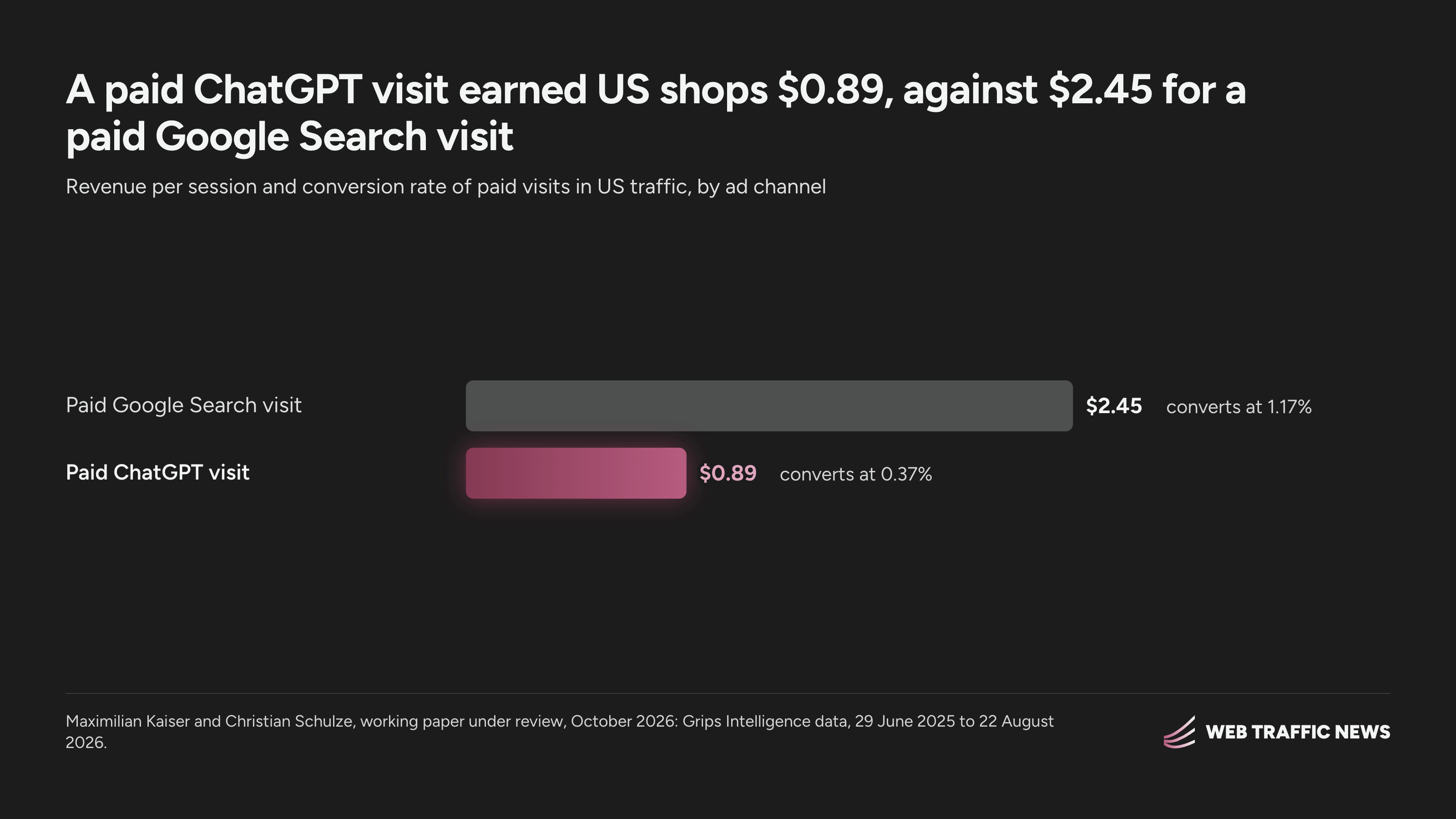
A paid ChatGPT visit brought in 64% less revenue than a paid Google Search visit. Of the 87 advertisers that bought both channels in US traffic, 97% earned less per ChatGPT visit.
The data comes from Grips Intelligence, which supplied it free of charge and where Kaiser is scientific advisor. It covers 1,898 online shops selling $16 billion a year, over 60 weeks from 29 June 2025 to 22 August 2026, with 22.4 million organic ChatGPT referrals.
ChatGPT ads launched country by country while the European Union had none, so the authors measured each launch market against the EU. The authors estimate that organic ChatGPT referrals fell by about 6 to 8% after ads arrived, while visitors who still came converted as before, within 0.02 percentage points of a 2.21% baseline.
Kaiser, of the Vienna University of Economics and Business, and Schulze, of the Frankfurt School of Finance & Management, write that paid ChatGPT visits “perform worst among major channels, offering less than a sixth of the value for money of paid Google Search”. The authors call the paid comparison descriptive, since advertisers chose whether to buy the ads.
Why it happened
OpenAI launched ChatGPT ads in the United States on 9 February 2026, in eight more countries between 16 April and 10 August, and in the European Union on 24 August, according to Maximilian Kaiser and Christian Schulze’s working paper. The paper puts OpenAI’s announced $1 billion in projected annualized ad revenue at about $1 per free user a year, against roughly $5 in free users’ inference costs.
That paper follows the authors’ Marketing Science study of ChatGPT referrals to e-commerce websites, which tracked 973 shops from August 2024 to July 2025 and found organic search converting about 13% more often than ChatGPT referrals. By the time ads launched, that gap had closed, the new paper reports.
On 28 October 2026, Google said it is scaling ads in AI Mode to 10 more countries, including Australia, Canada and India. Google added that sponsored and organic product listings there already get similar click-through rates.
What it changes for GEO
ChatGPT ads sit under the answer on a separate system, so paying for the card leaves the answer unchanged. In the March 2026 screenshot in Maximilian Kaiser and Christian Schulze’s working paper, the sponsored card sits below ChatGPT’s conversational answer, labeled and set apart from it. The authors offer one reading of the weak returns: the cards sit away from the answer, the part of ChatGPT that carries its value.
Brands that ChatGPT names inside the answer gain, because that recommendation is the most valuable moment in the purchase. Organic ChatGPT visitors converted at the same rate after ads launched, and on 387 advertiser websites they bounced less and stayed longer than direct visitors, while paid ChatGPT visitors stayed 104 seconds less. Brands that get cited in ChatGPT answers keep that recommendation, with about 6 to 8% fewer referrals from it where ads run.
Brands that buy only the card lose, because they pay to sit under someone else’s recommendation. Of the 87 shops buying both ChatGPT ads and Google Search ads in US traffic, 84% recorded no paid ChatGPT sale from 18,726 paid ChatGPT sessions. A paid Google Search click cost a median $0.72 and returned $2.45, so at the same rate a ChatGPT click is worth about $0.26:
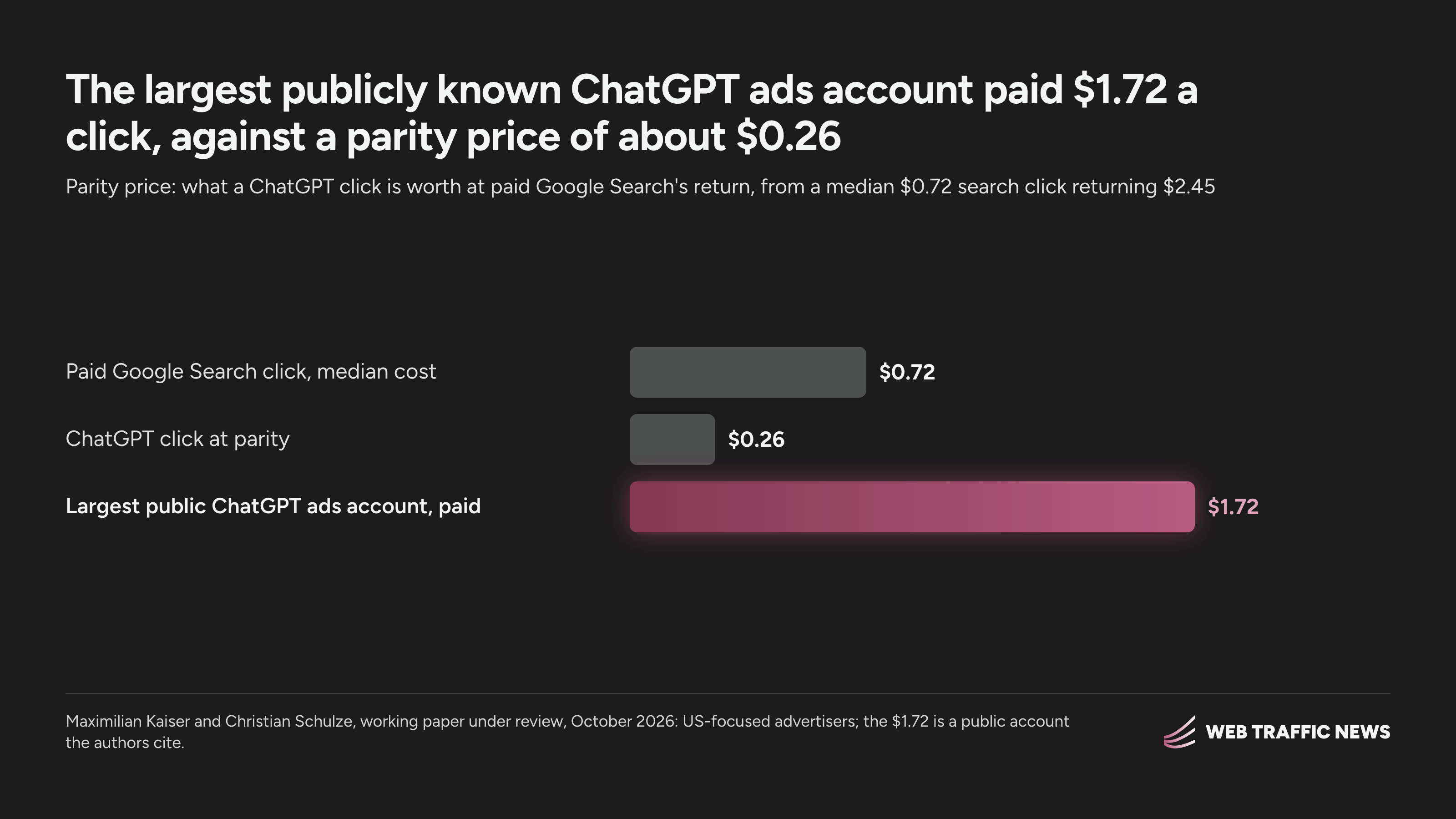
The largest publicly known ChatGPT ads account paid $1.72 a click, more than six times that parity price, the paper finds.
Ads in AI answers matter first to e-commerce and US-market brands, whose products can be clicked and bought from the answer, and those are the brands in this paper: online shops, with ad delivery concentrated in the United States. For those shops, a paid ChatGPT visit earned $0.89 against $2.45 for a paid Google Search visit, a 64% shortfall. B2B manufacturers and service firms come later to ChatGPT ads.
What to do
The head of e-commerce should first pull revenue per session and conversion rate for paid ChatGPT and paid Google Search visits from the shop’s analytics, for the same market and weeks. A ChatGPT click is worth buying up to the price at which it returns as much per dollar as a search click, which the Kaiser and Schulze paper put at about $0.26.
Before raising ChatGPT ads budgets, the marketing lead should check whether ChatGPT names the brand for buyers’ questions, using AI visibility tracking that shows whether ChatGPT cited a site. A brand ChatGPT leaves out works on the answer first.
Judge both channels by revenue. Analytics undercount ChatGPT, because buyers who met a brand in an answer often return through Google or direct, so teams that measure how often AI answers mention a brand should also ask every customer at checkout how they found the shop.
Sources
The week in AI search, in one email
One email a week with what changed in ChatGPT, Google AI Mode, Perplexity and Gemini, and the week's data piece.
Up next
89
countries
where OpenAI now sells ChatGPT Ads, after adding 26 on 21 October.
OpenAI expands ChatGPT Ads to 26 more countries
Brief
37
%
fall in GA4 sessions from ChatGPT across a few hundred websites from 9 October 2026, as ChatGPT's links lost their tracking tag.
OpenAI's GPT-6 rollout hides a week of ChatGPT referral traffic
Brief
72,000
requests
from ChatGPT-User in 30 days to a site of 50,000 invented statistics, months after Google deindexed its pages.
Peec AI researcher finds ChatGPT kept citing a fake statistics site
Brief