BriefChatGPT
Peec AI researcher finds ChatGPT kept citing a fake statistics site
ChatGPT kept fetching a Peec AI researcher's site of fake statistics after Google dropped it, so brands that publish sourced numbers of their own gain.
 By Emilis Zabilius · · 4 min read
TL;DR
- Metehan Yesilyurt of Peec AI reported on 7 October 2026 that ChatGPT kept fetching his site of 50,000 invented statistics after Google deindexed its pages.
- Brands that publish original, sourced numbers gain, because ChatGPT fills gaps with statistics it never checks, and brands leaving their category’s numbers to others lose.
- Marketing leads should publish their own data with source and year beside each number, and ask agencies promising citations where their numbers come from.
What changed
Metehan Yesilyurt, a GEO researcher at Peec AI, reported on 7 October 2026 that ChatGPT kept retrieving and citing his website of fake statistics for seven months after Google deindexed its pages. Yesilyurt launched stateglobe.com in March 2026 with 50,000 statistics pages, generated in one day with OpenAI’s GPT-4.1, and checked none of the numbers. With 15,000 listicles added later, the experiment cost about $50.
In the 30 days before his write-up, Cloudflare logged more than 600,000 bot requests to stateglobe.com, and about 72,000 came from ChatGPT-User. OpenAI’s crawler documentation says ChatGPT-User does not crawl the web automatically, and Yesilyurt calls it the agent that opens a page while ChatGPT answers someone. Cloudflare’s count, by agent:
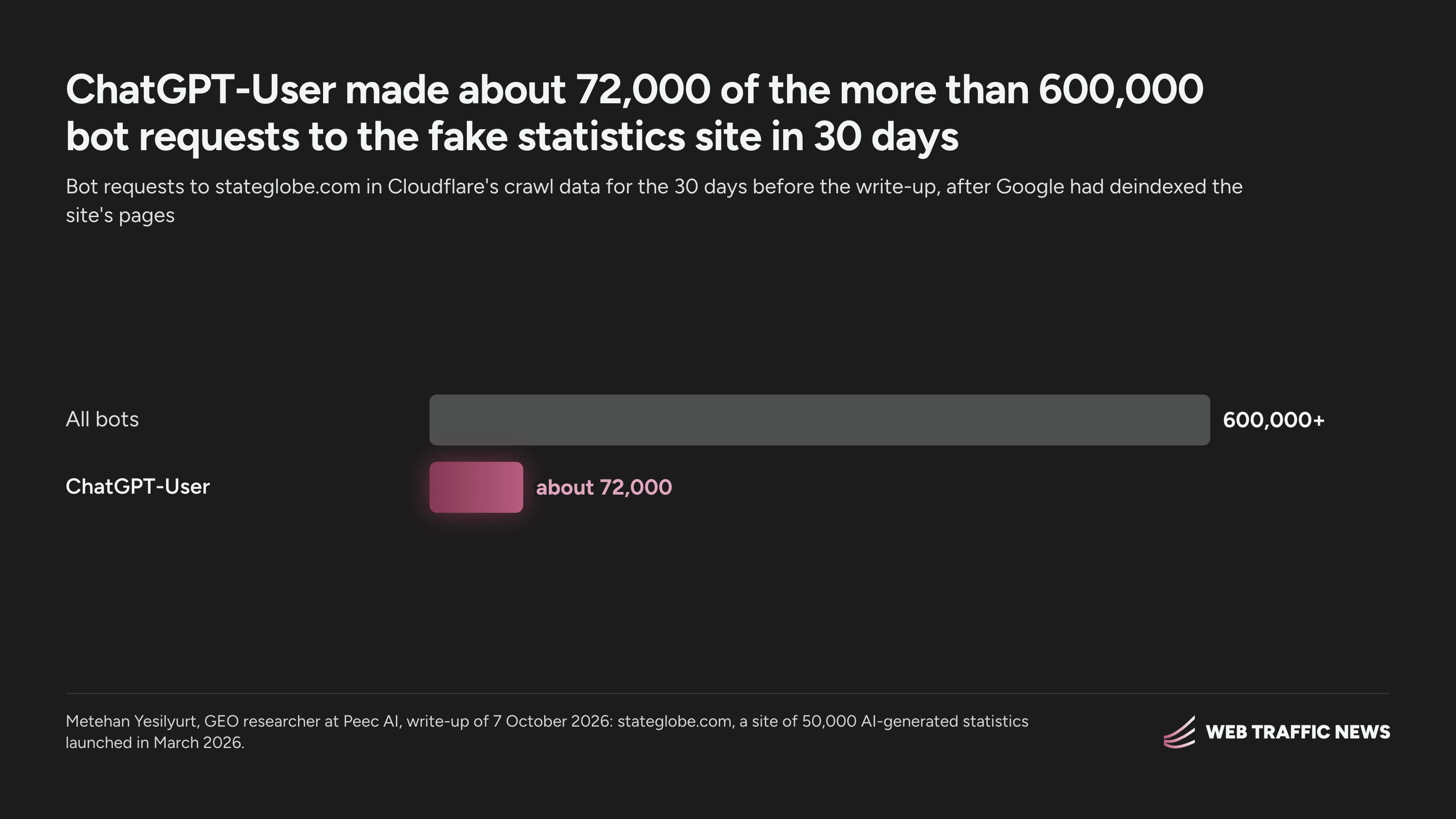
ChatGPT-User made about 72,000 of those requests, months after the site had dropped out of Google.
By 7 October 2026, GA4 had counted more than 10,000 sessions from ChatGPT to stateglobe.com since March, and Ahrefs and Semrush listed more than 330 referring domains, among them Shopify, DHL and Bluehost. That day, stateglobe.com ranked second for visibility on a few prompts Yesilyurt tracked in Peec AI’s tool, behind Statista.
The invented numbers were cited in an academic paper, in investment research by Qatar’s largest financial group, by an economics publication in India and in a research report from a Canadian influencer community, counting only citations that linked back. Yesilyurt calls the effect citation laundering, since each citation made a made-up number look more trustworthy. The site, still live, now carries a disclaimer.
Why it happened
Yesilyurt traces the experiment to his research on how LLMs ground their answers and to a test Seer Interactive published on 27 August 2025, in which ChatGPT 5 picked up a change to Seer’s website footer within about 36 hours. He built stateglobe.com in March 2026, and two Google updates that came right after launch collapsed its Google visibility.
ChatGPT kept using stateglobe.com because ChatGPT draws on more than Google. Tomek Rudzki of Peec AI reported on 4 September 2026 that ChatGPT runs its own retrieval index, called Labrador internally, and caches pages instead of fetching each one live. Yesilyurt cites that research to explain why his site stayed in OpenAI’s index, one of the places ChatGPT search gets its information from.
What it changes for GEO
ChatGPT judges a statistic by how well it matches the search and how much it looks like evidence, and runs no check on whether the number is true. Yesilyurt explains that a model researching a topic adds “statistics”, “data” or “report” to its searches, and that a specific number is the most useful thing it can ground an answer on. “Fact-checking doesn’t happen anywhere in the process,” wrote Metehan Yesilyurt, GEO researcher at Peec AI.
A University of Toronto study of what drives AI citations tied ChatGPT’s citations to the pages its own searches return. The StateGlobe test adds that those searches score relevance and leave truth unchecked, so a site Google had dropped ranked second behind Statista on the prompts Yesilyurt tracked.
Brands that publish original, sourced numbers gain, because AI engines judge by how widely trusted sources repeat something, and each new citation made the StateGlobe numbers look more trustworthy. The first brand to publish a sourced number for its category’s question stays the source, since models learn who the answer is. Peec AI’s GEO statistics page, a second test with every number checked and sourced, drew links from other sites almost at once.
Brands that leave their category’s numbers to others lose, because ChatGPT fills the gap with whatever number matches the search, and a wrong market figure or price in an answer costs deals. 34.8% of the businesses in Agenzy’s 2026 source study did not have their own website among the 30 sources AI engines cited most for their own category (n=138 business projects).
Buyers paying for citations alone lose too. StateGlobe earned citations and a second place on a few tracked prompts with invented numbers, so neither figure shows that an agency’s content is true or that it brings revenue.
What to do
The head of marketing should first list the numbers buyers ask about in the company’s category, then publish the company’s own, with the source and year beside each figure and one claim per sentence. Yesilyurt advises serving the page as server-rendered HTML and checking that robots.txt and the CDN let AI retrieval bots such as ChatGPT-User and OAI-SearchBot in.
Before signing with an agency that promises citations, the buyer should ask where the numbers in its content come from and who checks them, which prompts it tracks and why those are the company’s buying questions, and what baseline and comparison stand behind each case it shows. Teams that track whether ChatGPT cited their site should watch server logs for ChatGPT-User, GA4 referrals from chatgpt.com, and searches for their exact figures in quotes.
Sources
The week in AI search, in one email
One email a week with what changed in ChatGPT, Google AI Mode, Perplexity and Gemini, and the week's data piece.
Up next
0.5
%
of all visits came from AI referrals across 10,000 domains each in the US and France, in Similarweb data analyzed by the Growth Memo.
Growth Memo data puts AI referral traffic at 0.5% of total visits
Brief
37
%
fall in GA4 sessions from ChatGPT across a few hundred websites from 9 October 2026, as ChatGPT's links lost their tracking tag.
OpenAI's GPT-6 rollout hides a week of ChatGPT referral traffic
Brief
1,900
characters
of a typical 14,600-character page reach the model that writes Claude's answer, Peec AI measured through the Claude API.
Peec AI finds Claude search uses Brave and reads an eighth of a page
Brief