BriefCopilot
Microsoft Bing adds two ways to turn off AI answers in search
Bing searchers can now turn off AI answers with a browser toggle or the -ai operator, so brands need a place in Bing's ranked links as well as its answers.
 By Emilis Zabilius · · 4 min read
TL;DR
- Microsoft Bing announced on 11 November 2026 a preview extension for Chrome and Edge and a -ai operator that hide AI-generated answers on Bing.
- Brands ranked in Bing’s classic results gain the searchers who switch AI answers off, and brands seen on Bing only inside AI answers lose them.
- Heads of marketing should check their Bing rankings on buyer questions, then compare Bing results with and without the -ai operator every month.
What changed
Microsoft Bing now lets searchers turn off AI answers in two ways, Bing announced on 11 November 2026. The Microsoft Bing AI Search Choice extension, in preview, adds a toggle that shows or hides AI-generated answers, and the setting applies across all of a user’s Bing searches. The -ai operator needs no install: adding -ai to any Bing search returns results without AI-generated answers.
The Bing extension runs in Google Chrome and Microsoft Edge and also sets Bing as the default search engine, Bing says. The Chrome Web Store listing, offered by Microsoft Corporation, adds that the extension opens Bing on every new tab, and the same extension is listed in Microsoft Edge Add-ons.
Microsoft Bing gave its reason in the announcement: “our research shows users want to have the option to choose whether or not AI is involved in every session.” The post gives no figures from that research.
As of 12 November 2026, Google’s AI Overviews help page says AI Overviews cannot be turned off, and that searchers can select the Web filter after a search to see only text-based links. A Google searcher who skips the filter still sees AI Overviews, with sources picked as described in how Google AI Overviews choose the pages they show.
The three ways to search without AI answers differ in how far each choice reaches:
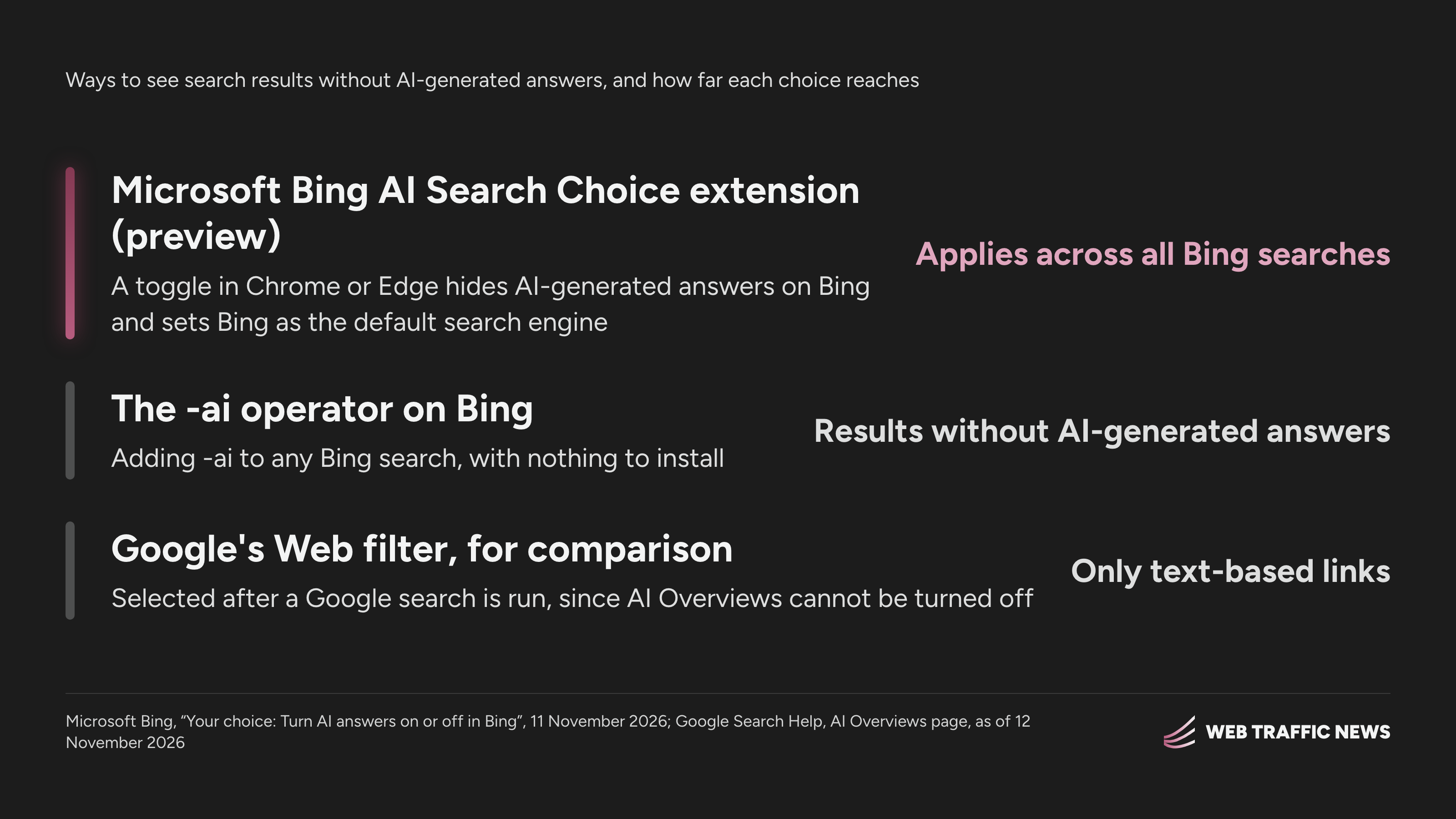
Only the Bing extension holds the choice across all Bing searches, while -ai works query by query and Google’s Web filter is selected after a search.
Why it happened
Microsoft Bing says the switch answers its research on what users want, after a year of posts about moving search from ranking pages to supporting answers. On 20 November 2025, Bing’s webmaster blog cited Microsoft Advertising figures: Copilot-assisted customer journeys 33% shorter than traditional search, and high-intent conversion rates 76% higher in AI-powered experiences.
On 6 May 2026, Bing’s post on the role of the index said grounding, which picks the information an AI answer uses, runs on the same crawlers and quality signals as search. On 16 June 2026, Bing added Citation Share and three other reports to the AI Performance Report in Bing Webmaster Tools, which tracks AI citations.
On 30 October 2026, Bing gave publishers separate preferences for AI training and grounding, effective 1 February 2027, and warned that disallowing grounding brings reduced brand visibility in AI experiences. On 11 November, searchers got their own choice.
What it changes for GEO
Brands that rank in Bing’s classic results gain, because a searcher who switches AI answers off sees Bing’s ranked links and compares the sources there. Brands that reach Bing users only as a mention inside an AI answer lose those searchers, since the toggle removes the answer and leaves the links. For searchers who keep answers on, the AI recommendation stays the most valuable moment in a purchase, so Bing now has two places a brand needs to be.
Search groundwork pays twice on Bing, because Bing’s AI answers draw on the same crawlers and quality signals as its ranked links. A GEO retainer that is SEO under a new name still misses the AI answers, and a GEO plan that drops ranking work misses every searcher who switches them off. The change is larger on Bing than on Google, where AI Overviews cannot be turned off and the Web filter is selected after a search.
ChatGPT search finds candidate pages through Bing, as how ChatGPT search finds the pages it cites explains, so a page missing from Bing seldom reaches ChatGPT’s answer. On Bing itself, that page now also misses every searcher who turns AI answers off, which makes Bing indexing the first check for any brand that wants to be found in either version.
A brand’s position is judged engine by engine, and Bing now shows each query two ways. A tracker reading Bing’s AI answers sees one version, and Bing publishes no share of searchers who switch answers off. Analytics undercount AI because buyers who met a brand in an answer arrive later through Google or direct, so asking each customer how they found the company stays the reliable measure beside the GEO metrics that show whether AI search brings in buyers.
What to do
The head of marketing should ask the search team this week for the brand’s Bing rankings on the buyer questions that bring in revenue, because those ranked links are what a searcher with AI answers off sees. The team then runs each question on Bing twice, once as typed and once with -ai added, and records where the brand appears in each version.
Pages missing from Bing’s ranked links get fixed first, since the same gap seldom lets them reach ChatGPT’s answers. Each month the team repeats the two Bing runs, compares the citation reports in Bing Webmaster Tools with AI visibility tracking of ChatGPT citations, and asks every new customer how they found the company.
Sources
- blogs.bing.com/search/…/your-choice-turn-ai-answers-on-or-off-in-bing
- chromewebstore.google.com/detail/…/mcaabonmnmphidjfohjkdobemneigopa
- microsoftedge.microsoft.com/addons/…/pmjianmjibiamoboooofebdpagpdekao
- support.google.com/websearch/…/14901683
- blogs.bing.com/webmaster/…/How-AI-Search-Is-Changing%E2%80%AFthe%E2%80%…
- blogs.bing.com/search/…/Evolving-role-of-the-index-From-ranking-page…
- blogs.bing.com/search/…/New-AI-Visibility-Insights-in-Bing-Webmaster…
- blogs.bing.com/search/…/your-content-your-choice-clearer-preferences…
The week in AI search, in one email
One email a week with what changed in ChatGPT, Google AI Mode, Perplexity and Gemini, and the week's data piece.